



Login
Get Instant Pricing On 23,000+ Aircraft

>
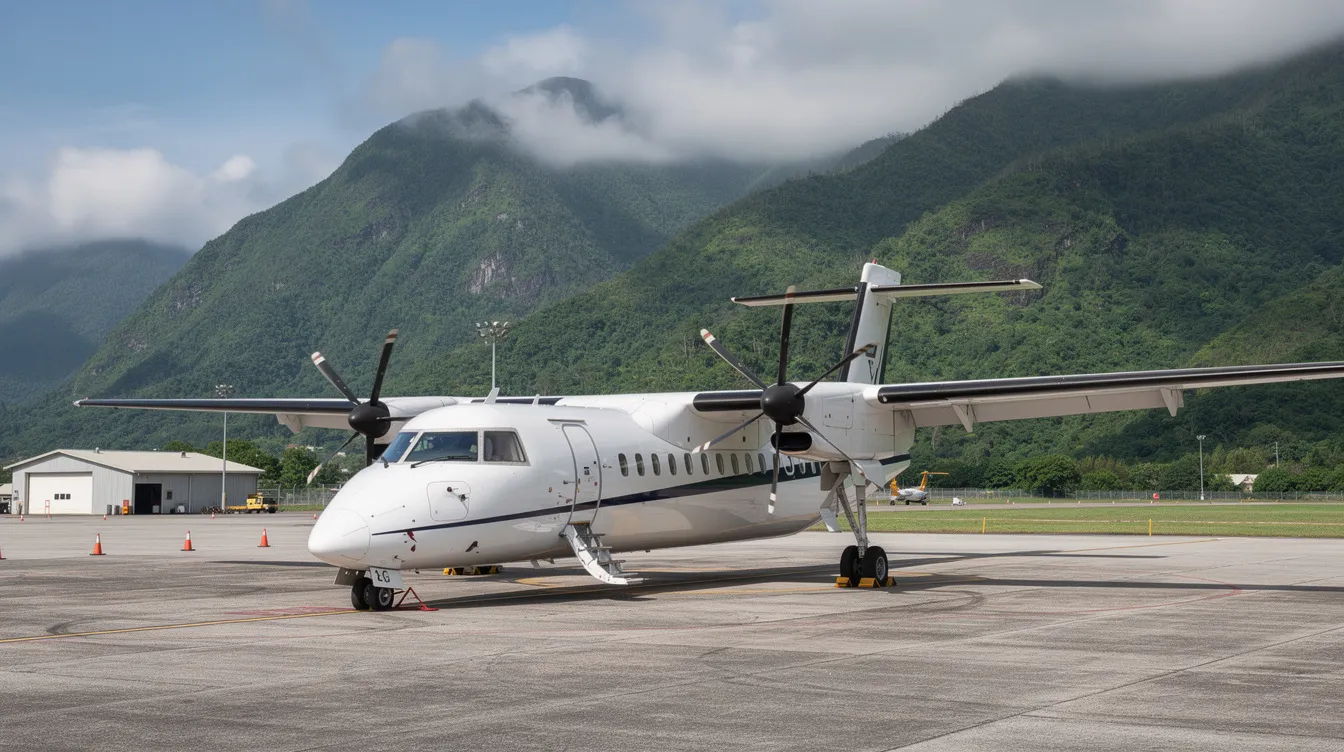
The ATR 42 is one of the most versatile regional turboprops in service today. Built to connect communities across short runways, remote islands, and secondary airports, it offers charter customers a practical way to move 30–50 passengers without the cost penalty of a regional jet. This guide covers everything from performance specs and cabin layout to pricing factors and how to book an ATR 42 charter through Jettly.
The ATR 42 is a twin-engine regional turboprop that seats 40 to 50 passengers, ideal for short to medium route charters.
Cruise speed reaches up to 300 knots (555 km/h) on later variants, with a maximum range of approximately 1,000 nautical miles depending on load and configuration.
Landing distance under about 1,100 m on modern versions allows access to short runways that most jets cannot use, and the aircraft requires less than 4,000 feet for takeoff.
Charter travelers can book various ATR models, including the ATR 42-500 and ATR 42-600, through Jettly's on-demand marketplace with instant pricing.
This guide covers history, technical specs, cabin layout, use cases, pricing factors, and how to book, plus an FAQ section at the end.
The ATR 42 is a family of twin turboprop regional airliners produced by ATR, a Franco-Italian company headquartered in Toulouse, France. Since its introduction in the mid-1980s, the aircraft has been utilized globally by regional airlines, with service in nearly 100 countries. It can accommodate up to 48 passengers in standard airline seating, though charter configurations often seat 30–46 for added comfort.
The different ATR 42 model variants seen on charter and regional routes include the ATR 42-300, ATR 42-320, ATR 42-500, and ATR 42-600. Each version brought improvements in engines, avionics, and cabin comfort while maintaining the aircraft's signature high performance on short runways.
In practical terms, the ATR 42 cruises at roughly 250–300 knots, covers a maximum range of around 1,000 nautical miles, and operates from runways as short as 1,100 m. The ATR 42 offers lower operating costs than similarly sized regional jets. Jettly connects travelers to multiple ATR 42 operators globally, making it straightforward to compare aircraft year, configuration, and pricing before booking. It is designed for short-haul regional routes and can be configured for both passenger and cargo missions.
ATR was created in 1981 as a joint venture between French company Aérospatiale and Italian firm Aeritalia. The focus was on The focus was on developing an efficient high-wing regional turboprop capable of serving markets too thin for jets. The ATR 42, a twin-engine turboprop regional airliner powered by Pratt & Whitney Canada PW120 engines, first flew on August 16, 1984. It was designed for short-haul regional routes and is known for its short-field takeoff and landing capabilities, requiring less than 4,000 feet for both takeoff and landing. The aircraft features a high-wing configuration that provides better propeller clearance, enhancing its ruggedness and ability to operate from runways as short as 1,000 meters.
The ATR 42 typically seats between 40 to 50 passengers, with a spacious cabin that maintains high comfort standards. Charter configurations often accommodate up to 48 passengers, balancing capacity and comfort. Its maximum takeoff weight is 18,600 kg, and it offers a maximum range of approximately 1,000 nautical miles, making it well-suited for connecting smaller communities to major airport hubs and serving markets with low passenger demand.
The ATR 42-300 was delivered on December 3, 1985, followed by the ATR 42-320 variant powered by PW121 engines for improved performance, particularly in hot and high conditions. The ATR 42-500 introduced new PW127 engines, a redesigned cabin, and enhanced cruise speed of up to 350 mph, further improving operational efficiency. The latest ATR 42-600 series, launched on October 2, 2007, features modern avionics and cabin upgrades. Its STOL variant, the ATR 42-600S, can operate from runways as short as 800 meters while carrying 42 passengers.
Operators value the ATR 42 for its lower operating costs compared to similarly sized regional jets, consuming up to 40% less fuel. It achieves a cruise speed of around 300 knots and boasts a dispatch reliability rate exceeding 99.6%, underscoring its dependability. Charter operators must hold Part 121/380 certification to operate the ATR 42, ensuring compliance with stringent safety standards; understanding how Part 135 charter companies are regulated and audited offers useful context for comparing different types of commercial operations. Typical hourly charter rates start at $3,850, offering cost-effective solutions for group travel.
Beyond passenger transport, the ATR 42's flexibility extends to cargo missions and specialized roles such as maritime patrol. Its engines are renowned for ruggedness across all climates, supporting global utilization by regional airlines. This combination of performance, economy, and versatility keeps the ATR 42 a top choice for short regional flights worldwide. Developing an efficient high-wing regional turboprop capable of serving markets too thin for jets. Final assembly takes place in Toulouse.
The ATR 42 first flew on August 16, 1984. Certification followed in 1985, and the ATR 42-300 was delivered on December 3, 1985, with Air Littoral serving as the launch customer. The ATR 42-300 remained the standard production version until 1996, powered by Pratt & Whitney Canada PW120 engines and seating around 42–48 passengers in a typical layout.
The ATR 42-320 followed, featuring more powerful PW121 engines for better performance in hot and high conditions. This made the aircraft more capable at challenging airports in mountainous or tropical regions.
ATR launched the ATR 42-500 next. It was first delivered in October 1995 and brought six-blade propellers, improved acoustic comfort, a higher cruise speed of 350 mph, modernized avionics with an EFIS cockpit, updated PW127 engines, improved cabin design, and extended maximum range. These upgrades made it a recognizable step forward for operators and passengers alike.
The ATR 42-600 series was launched in October 2007, featuring a full glass cockpit, PW127M engines, better takeoff and landing performance, and updated cabin options including the HighLine executive layout. The ATR 42-600S was designed for short takeoff and landing operations, further expanding the airports this aircraft can serve. It can operate from 800 m runways with 42 passengers.
Specialized variants include freighter and quick-change versions, maritime patrol "Surveyor" configurations, and VIP or corporate shuttle layouts used for charter and cargo missions, with Surveyor-type aircraft also used for government missions in Italy.
Exact numbers shift with variant, weight, and weather. The figures below are practical planning ranges useful for charter customers.
Speed: Earlier ATR 42-300/320 models cruise around 240–260 knots (440–480 km/h). Later ATR 42-500/600 versions can reach a cruise speed of 300 knots (approximately 555 km/h), making them competitive with many turboprops in the regional market.
Range: Under full passenger loads, earlier variants manage roughly 460–600 nm. The ATR 42-500 and -600, with optimized loads, stretch to a maximum range of approximately 1,000 nautical miles. Payload, reserves, and winds all affect real-world planning.
Field performance: The ATR 42 requires less than 4,000 feet for takeoff and landing on standard conditions. Typical landing distance figures fall around 966–1,126 m (3,170–3,700 ft) for modern variants, opening up island, mountain, and rural airfields that jets simply cannot reach. The aircraft has a maximum takeoff weight of 18,600 kg.
Fuel efficiency: The ATR 42-600 burns roughly 30% less fuel than comparable regional jets on similar sectors. On a group charter, that efficiency gap directly lowers per-seat costs.
Operational envelope: Service ceiling sits at about 25,000 ft. The aircraft is optimized for sector lengths of roughly 150–500 nm, not long-haul flying. Climb to cruise altitude typically takes 15–20 minutes depending on conditions.
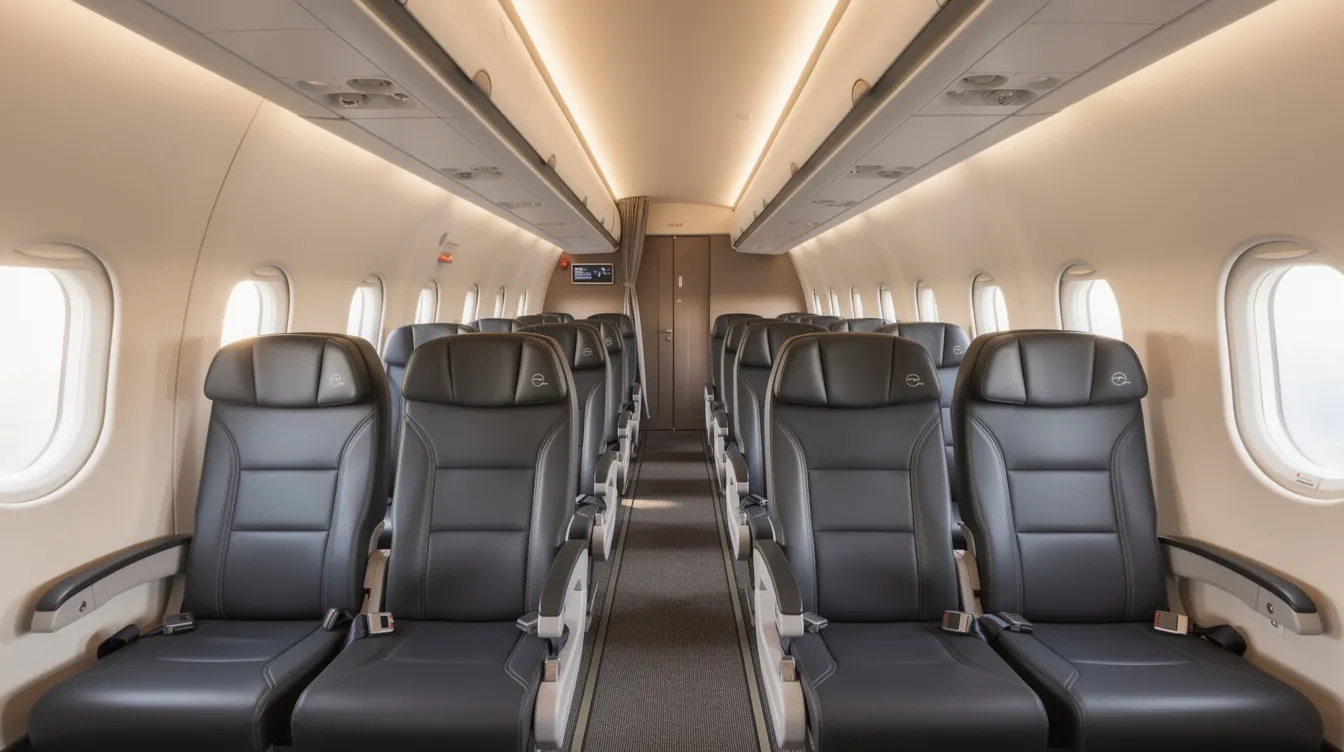
The ATR 42 features a single-aisle, high-wing cabin with 2-by-2 seating. Standard airline layouts fit 40–48 passengers, while charter configurations typically seat 30–46 to provide extra legroom and comfort.
Key dimensions: the cabin runs approximately 14–15 m in length, about 2.5 m wide, and roughly 1.9 m in height. Most adults can walk the aisle with a slight stoop. The fuselage wing span of 24.57 m (80 ft 7 in) supports stable, smooth flight characteristics.
Charter operators may offer several seating layouts: high-density commuter seating, extra-pitch configurations for corporate or sports groups, and mixed passenger-cargo setups for specialized missions. Some aircraft feature HighLine or VIP-style refurbishments with club seats, worktables, and upgraded finishes.
Cabin comfort on the -500 and -600 models benefits from improved noise-reduction technology, modern air conditioning, LED lighting, overhead bins, and a simple galley for snacks and light catering. Checked luggage capacity handles a full passenger load under standard conditions. Bulky items like ski equipment, golf bags, or musical instruments should be flagged in advance through the charter platform to confirm cargo bay clearance.
The ATR 42 fills the gap between smaller turboprops and regional jets. It makes sense when a group is too large for a 30-passenger plane or 19-seat aircraft but doesn't need a full airliner.
Business travel: Corporate shuttles between secondary cities, employee rotations to industrial or energy sites with short runways at remote locations, and conference transfers from hub airports to nearby regional fields often slot naturally into the broader landscape of charter airlines and private operators.
Leisure and family travel: Island-hopping in the Caribbean or Mediterranean islands, ski trips into mountain airports with limited runway length, and multi-family vacations where everyone flies together on one aircraft can sometimes leverage crowdsourced private jet flights and shared seats when groups are flexible on timing.
Group and team movements: Sports clubs, school groups, music tours, and incentive travel all hit the 30–50 seat sweet spot. The cost efficiencies per seat compared with chartering multiple smaller jets are significant, especially when combined with strategies for getting a seat on a private jet affordably.
Special operations: Humanitarian flights into remote strips, cargo-plus-passenger missions using combi configurations, and bespoke trips to communities not served by scheduled airlines or services share many of the same planning steps outlined in guides on how renting a plane works end-to-end.
Jettly's platform allows users to compare ATR 42 options alongside similar turboprops like the ATR 72-500 or Saab 340 to check capacity, range, and price trade-offs for each mission, while broader resources on affordable airplane rental costs and options and private jet charter pricing help benchmark quotes across aircraft categories.
Choosing the right aircraft means weighing capacity, speed, runway needs, and cost. Here is how the ATR 42 stacks up against common alternatives.
|
Feature |
ATR 42-600 |
ATR 72-600 |
Saab 340B |
Small Regional Jet |
|---|---|---|---|---|
|
Seats (charter) |
30–48 |
50–74 |
~30–33 |
50–70 |
|
Cruise speed |
~300 kts |
~275 kts |
~250 kts |
~400+ kts |
|
Range |
~1,000 nm |
~900 nm |
~800 nm |
~1,200+ nm |
|
Runway needed |
<4,000 ft |
~4,500 ft |
~4,000 ft |
~5,500+ ft |
|
Fuel burn vs jets |
~30% lower |
~25% lower |
~35% lower |
Baseline |
ATR 42 vs ATR 72: The ATR 72 seats more passengers but needs longer runways. For groups under 50, the ATR 42 is often the more efficient and flexible choice.
ATR 42 vs Saab 340B: The Saab carries about 33 passengers and is lighter, but the ATR 42 offers higher capacity when a group exceeds that halfway mark of 35+ travelers.
ATR 42 vs regional jets: Jets fly faster but demand longer runways, burn more fuel, and cost more per block hour. On sectors under 500 nm, the ATR 42 typically wins on economics. Travelers comparing these options alongside fractional programs like NetJets may find value in Jettly's role as a NetJets alternative for private flying. For deeper comparisons, see the regional jet guide.
Jettly is a digital private aviation platform that aggregates more than 20,000 aircraft, including multiple ATR 42 and ATR 72 operators worldwide, for on-demand charter, as well as structured products like jet card membership programs for frequent flyers.
Booking flow: Enter your route, dates, and passenger count. The platform returns instant pricing estimates and shows available ATR 42 options with operator details, manufactured year, cabin configuration, and safety credentials. Confirm online, and Jettly handles coordination, following many of the same steps described in broader guides on how renting a plane works. Learn more about the full process in the how to charter a private jet guide.
Pricing factors: Typical hourly charter rate for the ATR 42 starts at $3,850. Total cost depends on flight time, repositioning legs, airport and handling fees at regional fields, and passenger load. Use the charter cost estimator or Jettly's dedicated jet card flight cost estimator for a quick ballpark. For broader context on turboprop charter rates, Jettly publishes updated guides.
Per-seat economics: Spreading costs across 30–48 seats often makes the ATR 42 significantly cheaper per person than chartering multiple light or midsize business jets on the same route; understanding affordable airplane rental costs and options can further clarify when a regional turboprop delivers the best value.
Membership and empty legs: Jettly's membership options and transparent fee structure can reduce costs for frequent users. Empty-leg alerts sometimes include turboprops on repositioning flights, letting travelers tap into discounted empty leg flights for demand-driven savings.
Safety and regulation: Charter operators in the marketplace must hold Part 121/380 certification and comply with regional safety standards. Jettly verifies these credentials during its operator onboarding process, and frequent flyers often combine this with private jet membership plans to lock in predictable access and pricing.
Ready to check real-time ATR 42 availability? Explore options at https://www.jettly.com, or consider joining Jettly's ULTRA high ticket affiliate program if you regularly refer clients for charter flights.
Understanding what to expect operationally helps charter travelers plan with confidence.
Airport access: The ATR 42's short takeoff performance, modest landing distance, and high-wing design let it operate into many regional, island, and mountain airports that larger jets cannot reach. Tools like Jettly's airport locator for private flights help you identify which fields your mission can realistically use. Pilot familiarity with small-field procedures is standard among experienced ATR operators.
Weather and performance: Turboprops handle crosswinds and wet runways well. In hot conditions or at high-elevation airports, performance calculations by the operator ensure safe margins. Later variants with upgraded engines maintain strong climb rates even in challenging conditions.
In-flight experience: Expect cruising altitudes between 15,000 and 25,000 ft, with climb and descent lasting 10–20 minutes each. Noise levels on -500 and -600 models are noticeably lower thanks to six-blade propellers and acoustic insulation. A single flight attendant typically serves larger charter groups.
Catering and services: Light snacks and drinks come standard. Upgraded catering from Jettly Eats in-flight catering, onboard branding, or customized service can be arranged through Jettly's trip coordination tools when discussions happen at the booking stage.
Limits to note: Very short runways may restrict luggage capacity. Remote routes benefit from extra weather contingency planning, and some small regional airports enforce noise curfews or operating-hour restrictions-details your Jettly coordinator will flag in advance.

These answers address common questions focused on charter practicality.
The ATR 42 can accommodate up to 48 passengers in a high-density layout. Most charter operators configure it for 30–46 seats to provide comfortable legroom. For corporate or VIP flights, 30-seat HighLine layouts with club seating and worktables are available on select aircraft.
Hourly rates start at approximately $3,850 in the USA, though final quotes depend on route, season, repositioning requirements, and aircraft year. A 90-minute sector for 40 passengers often works out to a fraction of what multiple light jet charters would cost. Instant quotes are available through Jettly's platform.
Standard checked luggage for a full passenger load fits comfortably in the cargo hold. Oversized or heavy items such as ski equipment, golf bags, or musical instruments should be flagged during booking so the operator can confirm weight and volume clearance. In some cases, reducing the passenger count by a few seats frees additional cargo capacity.
ATR 42 operators must hold appropriate air operator certificates and meet strict regulatory standards. The aircraft was specifically manufactured and equipped for short-runway work, with robust landing gear and high-wing engine placement that keeps propellers clear of debris. Performance data for every runway is calculated before each flight.
Booking two to four weeks in advance is ideal, especially during peak travel periods around January, September, October, or December. Availability can vary by region because ATR has also targeted growth in markets such as China, where it has worked to expand sales and deepen operator presence. Off-peak windows often allow shorter lead times, and last-minute availability through Jettly's marketplace-including same-day options-can sometimes be found when developing schedules align with open aircraft in the network, especially given its access to a broad private charter aircraft fleet.
The ATR 42 delivers an effective balance of cruise speed, solid maximum range for regional missions, and excellent landing distance performance. It is recognized globally for connecting communities, support for short-field operations, and cost-efficient group travel.
Key decision points: a group size around 30–50 travelers, a route that involves short or regional runways, and a priority on keeping per-seat costs manageable without sacrificing reliability. Whether the destination is an island airport, a mountain airstrip, or a secondary city field, the ATR 42 is built to get there.
Through Jettly's on-demand digital platform, travelers can compare ATR 42s with other ATR models and regional aircraft, view instant pricing, and complete bookings online, similar to how partner operators such as Dexter Air Taxi use Jettly as a brokered booking channel. Ready to experience private travel on your terms? Explore ATR 42 charter options or request a tailored quote at https://www.jettly.com.
Share this post:
Jay Franco Serevilla
Jul 24, 2026
|
5
min read
Discover tips and trends in the industry.

5
min read
US Aviation Accidents: History, Safety Lessons, and the Role of Modern Private Air Travel
The history of US aviation accidents highlights significant progress in safety and reliability. Major incidents have led to crucial regulatory changes and technological advancements, benefiting both commercial airlines and private jet charters. Today, platforms like Jettly ensure travelers have access to vetted operators and transparent safety information, enhancing the overall flying experience.
Read More
5
min read
Last-Minute Private Jet Charter: How to Book Fast, Save with Empty Legs, and Fly in 2026
Last-minute private jet charters provide a fast and flexible travel solution for urgent trips, allowing bookings within hours. Jettly's digital marketplace connects travelers to over 20,000 aircraft, offering instant pricing and options for empty leg flights that can significantly reduce costs. This guide outlines how to book quickly, factors affecting pricing in 2026, and tips for choosing the right aircraft.
Read MoreStay updated with our latest insights and tips to elevate your journey with us.
MEMBERSHIPS AND ASSOCIATIONS



Disclaimer: Jettly operates as a charter broker, offering access to a global digital jet charter marketplace. Jettly is not a direct air carrier and does not own or operate aircraft. All advertised flights are conducted by third-party air carriers that are fully licensed and hold the appropriate Part 135 or Part 121 certifications issued by the Federal Aviation Administration (FAA) or equivalent regulatory authorities under U.S. or foreign law. Jettly complies fully with the U.S. Department of Transportation's Part 295 and Part 298 Charter Broker regulations. Jettly does not carry additional liability insurance. Passengers are covered by aircraft operator insurance. TICO: 50023770


