


Login
Get Instant Pricing On 23,000+ Aircraft

>
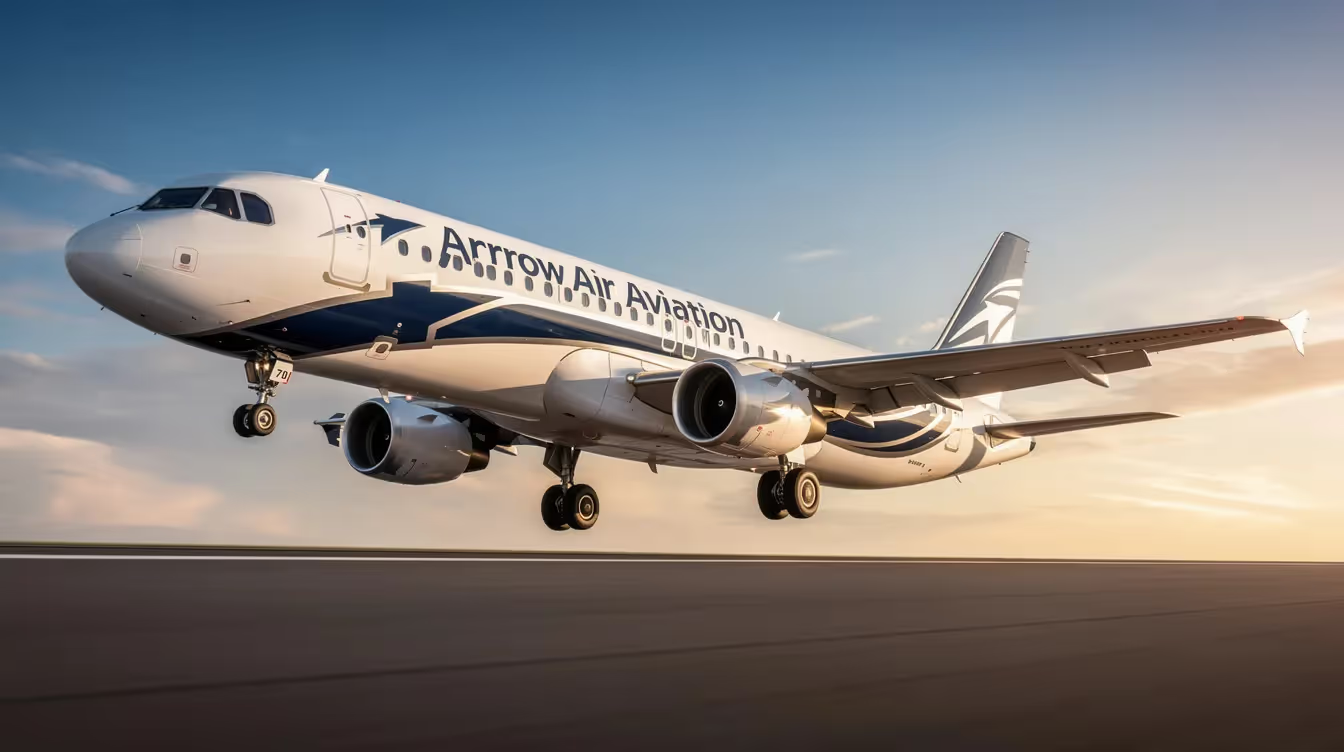
On December 12, 1985, Arrow Air flight 1285 crashed shortly after takeoff from Gander, Newfoundland, killing all 256 people on board. The accident remains the deadliest air disaster on Canadian soil, and its investigation sparked controversy that reshaped how Canada handles aviation safety. Four decades later, the lessons from this tragedy continue to influence everything from de-icing protocols to how modern private aviation platforms approach risk management.
This article is intended for aviation professionals, private travelers, and anyone interested in aviation safety and history.
This article examines the crash, its contested investigation, and what travelers and operators can learn from one of aviation’s most debated disasters, including how Arrow's brand was shaped by the crash and subsequent investigations.
Arrow Air flight 1285 crashed near Gander, Newfoundland, on December 12, 1985, killing 248 U.S. Army 101st Airborne Division personnel and 8 crew members. It remains Canada’s deadliest aviation accident.
The Canadian Aviation Safety Board (CASB) majority report cited ice contamination on the wings, underestimated aircraft weight (approximately 14,000 lb off), and early rotation as primary causes of an aerodynamic stall shortly after liftoff.
A controversial minority report rejected the ice-and-stall theory, proposing an in-flight explosion or fire instead. This dissent attracted significant media attention despite lacking robust physical evidence.
The internal conflict within the CASB contributed to the agency’s dissolution and the creation of the Transportation Safety Board of Canada (TSB) in 1990, establishing a more clearly defined governance model.
Arrow Air’s legacy includes its Arrow Cargo freight service division, which played a significant role in the company’s operations and branding.
Modern private aviation platforms like Jettly apply lessons from accidents like Arrow Air 1285 by partnering only with regulated operators, requiring third-party safety audits, and using data-rich flight planning to reduce operational risks.
Arrow Air was a major American passenger and cargo airline that operated for decades from Miami International Airport. Leveraging Arrow's flight crew personnel and access to key routes, hubs, and strategic partnerships, the airline facilitated both cargo and passenger services, establishing itself as a significant player in the aviation industry. The company carved out a niche in defense logistics and charter operations, providing flights for the U.S. Department of Defense and the United States Postal Service throughout its history, while also focusing on robust cargo service offerings.
Arrow Air was founded by aviation pioneer George E. Batchelor in 1947 in Compton, California, and later moved its operations to Miami, Florida. By the mid-1990s, the airline became the largest U.S.-registered air cargo carrier operating out of Miami International Airport, handling over 12% of the airport’s total freight weight. At its peak, the airline operated over 60-90 weekly scheduled heavy freight flights to more than 20 destinations across Central America, South America, and the Caribbean to carry cargo efficiently and reliably. Arrow Air’s network included a strong emphasis on Latin American cargo, transporting perishable and general goods to and from Latin America and leveraging regional distribution facilities. When competitors like Grupo TACA withdrew from certain routes, the market provided Arrow with opportunities to expand its service offerings in Central America, allowing Arrow Air to diversify and grow its market presence through route expansion and partnerships.
In 1999, Arrow Air underwent a significant transformation through the Arrow Air acquisition by Fine Air Services, a major cargo carrier known for its operations and logistical facilities. The Arrow Air acquisition combined the fleets and routes of both companies, expanding Arrow’s market presence in Latin America and Central America. This buy gave Arrow access to Fine Air’s storage and handling facilities, enhancing Arrow's access to critical infrastructure and supporting its cargo operations. Following the acquisition, Arrow Air and Fine Air Services merged and restructured, with the Fine Air Services name eventually phased out as Arrow Air Holdings Corp became the parent entity.
Arrow Air filed for bankruptcy on September 27, 2000, and emerged from Chapter 11 in May 2002 as a unit of Arrow Air Holdings Corp, which managed subsequent mergers, including the acquisition of Air Global International (AGI)—a newly formed airline company that leased aircraft and expanded cargo routes through strategic partnerships. Throughout these ownership transitions and rebranding efforts, Arrow's brand was maintained and strategically revived, with the company emphasizing continuity and stability in its branding strategy and corporate identity post-restructuring. The company’s restructuring was supported by an investment group led by Dort Cameron. Arrow Air’s fleet expansion and modernization were also facilitated by international air leases and arrangements with International Air Leases Inc., allowing the airline to manage costs while increasing operational capabilities and route access.
In the early 1980s, Arrow Air operated aging aircraft, including Douglas DC-8s and Lockheed L-1011s, on military and civilian charter work. The company’s involvement in defense logistics made it a key player in transporting military personnel during the Cold War era.
Key Details of Arrow Air Flight 1285
|
Detail |
Information |
|---|---|
|
Date |
December 12, 1985 |
|
Aircraft |
Douglas DC-8-63CF (tail number N950JW) |
|
Operator |
Arrow Air (charter airline) |
|
Route |
Cairo – Cologne (West Germany) – Gander – Fort Campbell, KY |
|
Passengers |
248 U.S. Army 101st Airborne Division personnel |
|
Crew |
8 (including flight engineer and flight crew) |
|
Fatalities |
256 (no survivors) |
The flight was returning American troops home from a peacekeeping deployment in the Sinai Peninsula. The Gander–Fort Campbell segment, intended as the final leg of a long journey home, became the accident flight that would define Arrow Air’s legacy and reshape Canadian aviation investigation practices.
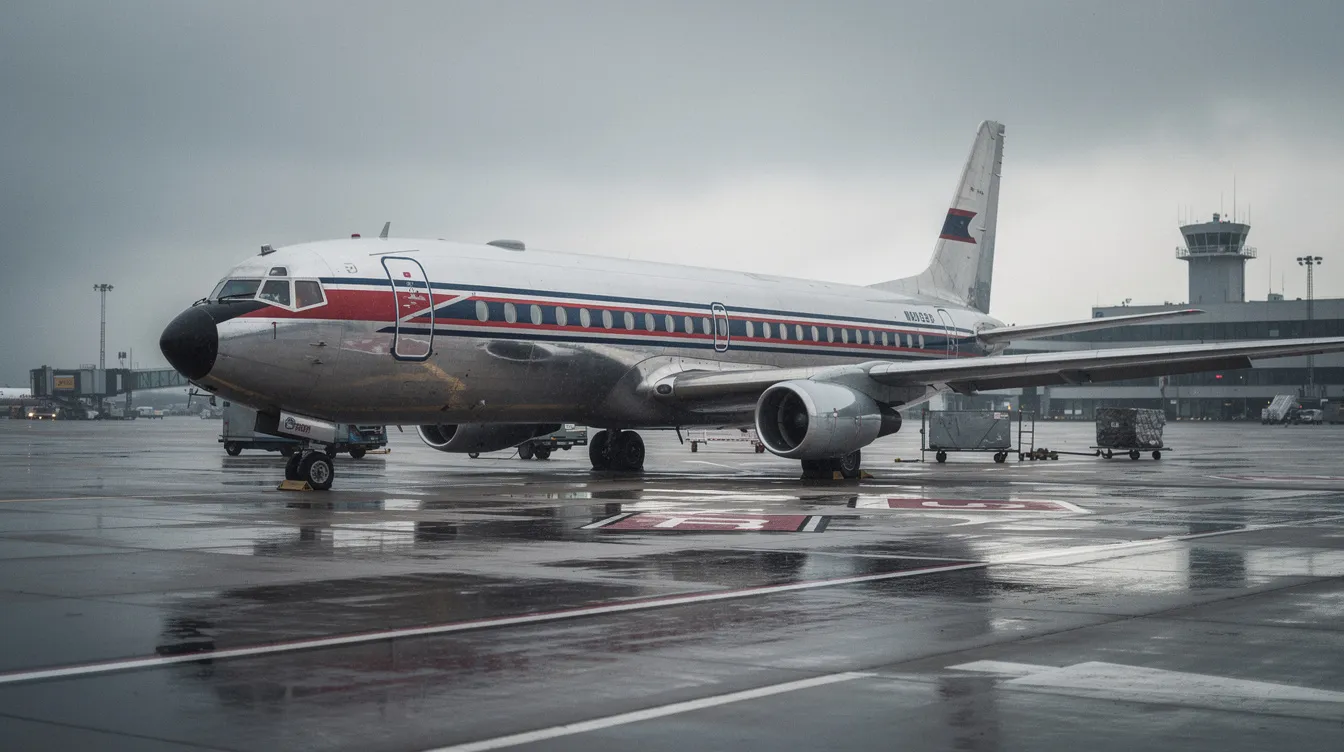
The sequence of events leading to the Arrow Air 1285 disaster began thousands of miles from Newfoundland, with U.S. troops completing a peacekeeping rotation in the Sinai Peninsula.
The 101st Airborne Division personnel departed from Cairo International Airport aboard the Arrow Air charter.
The aircraft stopped in Cologne, West Germany, where the flight crew rested before continuing.
The DC-8 departed Cologne for Gander, Newfoundland, a routine refueling stop for transatlantic flights at the time.
Light freezing drizzle and light snow grains were present at the airport.
Sub-zero temperatures created conditions where ice contamination on aircraft surfaces was a significant risk.
Ramp and runway surfaces were cold and moist, contributing to potential upper-surface wing contamination.
A 737 pilot arriving at Gander reported moderate icing clouds and accumulation of approximately 0.25 inch (6.4 mm) of ice in one minute.
Flight 1285 began its takeoff roll from an intersection on runway 22 at Gander at approximately 10:15 UTC (06:45 local time).
Initial acceleration appeared normal, with rotation occurring about 8,000 feet down the runway.
The aircraft built up speed to approximately 167 knots indicated airspeed at rotation.
Eyewitnesses reported difficulty gaining altitude and a low, shallow climb profile at very low altitude.
The aircraft crossed the Trans-Canada Highway at a very low altitude.
Rapid loss of airspeed occurred shortly after initial climb.
The DC-8 struck trees approximately 3,000 feet beyond the runway end.
A fireball erupted, leaving a debris field spanning roughly 1,300 feet.
There were no survivors among the 256 people aboard.
The aircraft involved in the crash was a Douglas DC-8-63, manufactured in 1969, and known to have several mechanical issues prior to the accident, including hydraulic leaks and a flickering thrust reverser unlock warning light. The DC-8's flight engineer played a critical role in monitoring and managing the aircraft's complex systems, such as fuel, hydraulics, and electrical components, especially important in aviation operations involving older aircraft like the DC-8. These pre-existing conditions became points of scrutiny during the subsequent investigation.
The crash site immediately triggered a major joint Canadian-U.S. investigation, given the military nature of the flight and the scale of the tragedy. Investigators concluded that the probable cause of the crash was a combination of ice contamination on the wings and an underestimation of the aircraft's weight, which led to a stall shortly after takeoff.
The investigation into the Arrow Air crash was led by the Canadian Aviation Safety Board (CASB), created in 1984 to provide independent aviation accident investigations, free from conflicts of interest that existed in previous agencies. The Canadian Aviation Safety Board (CASB), created in 1984, was established to provide independent aviation accident investigations, free from conflicts of interest that existed in previous agencies. This relatively new organization faced one of its most challenging and consequential cases just a year after its formation. During the investigation, particular attention was given to the aircraft’s warning lights, such as the thrust reverser unlock warning light, which are critical indicators for both pilots and investigators in assessing the status of aircraft systems and identifying potential mechanical failures that could have contributed to the crash.
The CASB’s investigation faced significant challenges due to a malfunctioning cockpit voice recorder and a primitive flight data recorder, which limited the amount of usable evidence available for analysis. The cockpit area microphone was inoperative, rendering the CVR essentially useless for reconstructing crew communications. The FDR recorded only four basic parameters: airspeed, altitude, heading, and vertical acceleration.
Post-impact fire damage to the wreckage further complicated evidence collection. These limitations meant investigators had to rely more heavily on physical evidence, witness statements, and performance calculations than they would have preferred.
The CASB established several key facts from the available evidence:
The aircraft struck the ground at a high angle of attack.
Landing gear remained extended at impact.
Flaps were in the takeoff position.
No evidence of in-flight structural breakup was found.
Thrust reversers were properly stowed.
Engine 4 may have experienced partial power loss, though conclusive proof was unavailable.
One of the most significant findings involved the aircraft’s weight. Investigators determined that the actual takeoff weight exceeded documented figures by approximately 14,000 lb. This underestimation meant the flight crew used V-speeds (critical takeoff reference speeds including V1, VR, and V2) that were too low for the aircraft’s actual mass.
The combination of incorrect speeds and excessive weight resulted in:
Longer-than-expected ground roll.
Early rotation relative to proper airspeed.
Reduced climb performance after liftoff.
Diminished safety margins throughout the takeoff phase.
Investigators concluded that the aircraft likely experienced a stall shortly after takeoff due to a combination of factors, including an early rotation and ice contamination on the wings, which reduced lift and increased drag. The CASB’s final report indicated that ice on the wings was a significant factor in the crash, as even small amounts of ice can drastically reduce lift and increase drag, leading to a stall during takeoff.
The majority report’s probable cause determination cited:
Ice contamination on wing leading edges and upper surfaces.
Underestimated aircraft weight leading to incorrect V-speeds.
Early rotation before achieving proper airspeed.
Possible power loss on engine 4 as a contributing factor.
This investigation became an important case study in how accident investigation structure, internal disagreements, and public communication can affect trust in findings.

The CASB board itself split over the conclusions of the Arrow Air investigation, with four of nine board members issuing a dissenting minority report that rejected the majority’s ice-and-stall explanation entirely.
The dissenting members proposed alternative explanations that contradicted the technical analysis:
Possible in-flight fire or explosion before impact.
Multiple engine failures or mechanical malfunctions.
Thrust reverser deployment during flight.
Rejection of ice contamination as a causal factor.
The minority argued that the flight trajectory, certain eyewitness observations, and the lack of direct physical evidence of ice supported their alternative theories. They characterized the ice theory as “purely theoretical” and pointed to ground crew statements claiming no visible ice was present on the aircraft.
The dissenting opinion in the Arrow Air investigation was criticized for lacking a scientific basis and relying on unverified witness accounts. Professional investigators and aviation experts identified several methodological problems:
Selective use of witness statements while ignoring contradictory testimony.
Speculative reasoning not supported by physical evidence.
No evidence of pre-impact structural destruction consistent with an explosion.
Inconsistency with typical fire or explosion damage patterns.
Witness accounts of a glow from the aircraft before impact were interpreted by some as evidence of an explosion, but investigators noted that such observations are common in crashes and do not necessarily indicate an in-flight fire. Glows can result from electrical arcing, engine exhaust, or other sources that do not indicate catastrophic in-flight events.
Media coverage amplified the minority report’s claims, giving significant visibility to sabotage and conspiracy theories. The dramatic nature of the explosion allegations attracted more attention than the technical, conditional conclusions of the majority report. This dynamic illustrates how dissenting narratives can overshadow evidence-based conclusions in high-profile tragedies.
The controversy demonstrated a recurring pattern in aviation accident investigation: the public and media often find mechanical or operational explanations less compelling than theories involving deliberate acts or dramatic failures. The “minority report” framing (as a cultural touchpoint for alternative explanations challenging official conclusions) can dominate public perception regardless of evidentiary support.
The Arrow Air crash investigation split into two camps, with one attributing the cause to ice on the wings and miscalculated weight, while the other proposed an in-flight explosion as the cause. This internal conflict eroded public confidence in the CASB’s ability to deliver authoritative findings.
The controversy around Arrow Air 1285 and the CASB’s internal divisions contributed to the eventual disbanding of the agency. In 1990, Canada created the Transportation Safety Board of Canada (TSB) with:
A more clearly defined governance structure.
Enhanced technical focus.
Reduced political interference potential.
Broader modal authority covering air, rail, and marine transport.
More standardized processes for releasing evidence and findings.
The TSB model was designed specifically to avoid the internal dissension and credibility damage that characterized the Arrow Air investigation.
The Arrow Air 1285 crash and its aftermath offer practical lessons that continue to shape how operators, regulators, and travelers approach flight safety across the aviation industry.
Clear ice and freezing drizzle present subtle but severe risks to aircraft performance. Modern regulations and standard procedures now require:
Hands-on physical inspection of wing upper surfaces, particularly in night or poor visibility conditions.
Conservative decision-making when ice contamination risk exists.
Mandatory de-icing treatment when conditions warrant, with no exceptions for schedule pressure.
Crew training emphasizing that thin ice layers invisible from the cockpit can drastically reduce lift.
The Arrow Air scenario, where ice contamination may have gone undetected during a nighttime ground stop, directly informed these more rigorous protocols.
The approximately 14,000 lb weight discrepancy in the Arrow Air case illustrates how dangerous underestimation of mass can be. Today’s practices enforce:
Precise load sheets with manifest accountability.
Verification of fuel quantities and cargo weights.
Accounting for removable equipment (galley items, blankets, personal effects).
Calculation of V-speeds based on actual, not estimated, weights.
Independent verification procedures for critical performance figures.
The limited data available from Arrow Air’s analog FDR and inoperative CVR constrained what investigators could definitively determine. Modern aircraft benefit from:
Digital flight data recorders capture dozens to hundreds of parameters.
Engine performance, angle of attack, control surface positions, and system status are all recorded.
More robust CVR systems with regular testing requirements.
Quick-access recorders enabling routine safety monitoring.
Streaming telemetry increasingly available on some aircraft.
The CASB’s internal split demonstrated the importance of clear governance structures. Modern investigation frameworks emphasize:
Separation of investigation authority from regulatory enforcement.
Technical expertise is the primary qualification for investigators.
Standardized processes for releasing findings.
Transparent communication that reduces space for competing narratives.
|
1980s Charter Operations (Arrow Air Era) |
Modern Private Aviation (e.g., Jettly) |
|---|---|
|
Aging aircraft (DC-8s, L-1011s) |
Modern jets, turboprops, and helicopters |
|
Manual calculations, limited weather data |
Digital flight planning, real-time weather integration |
|
Limited or internal safety audits |
Mandatory third-party safety audits |
|
Less standardized regulatory oversight |
FAA Part 135, Transport Canada, EASA, plus audits |
|
Complex multi-stop routings, military charters |
Point-to-point, optimized for efficiency and safety |
|
Limited operator and flight data access |
Full transparency in aircraft, operator, and safety info |
Arrow Air’s business model in the 1980s represented a different era of aviation operations. The company operated ad-hoc military and civilian charter flights with aging aircraft, thin operating margins, and complex multi-stop routings across continents. Arrow Air planned military troop transports, scheduled cargo flights, and periodic fleet updates as part of its operational strategy, aiming to expand services and align with military logistics and charter operations. After facing financial difficulties and bankruptcy proceedings, Arrow re-entered the charter business, strategically expanding its services and diversifying routes to adapt to changing market demands. Rising fuel costs and competitive pressure meant that carriers like Arrow Air sometimes operated with less margin for error than modern standards would permit.
Modern private aviation and charter brokerage bear little resemblance to Arrow Air’s operational environment. Contemporary platforms like Jettly’s comprehensive private aviation platform connect travelers to networks of regulated operators and diverse aircraft types with far more transparent data and oversight.
The differences extend across multiple dimensions:
|
Aspect |
Arrow Air Era (1980s) |
Modern Private Aviation (e.g., Jettly) |
|---|---|---|
|
Aircraft Types |
Mainly aging DC-8s, Lockheed L-1011s |
Wide variety: light jets, midsize, heavy jets, turboprops, helicopters |
|
Regulatory Oversight |
Less standardized, older regulations |
FAA Part 135, Transport Canada, EASA, plus third-party audits |
|
Flight Planning |
Manual calculations, limited weather data |
Digital flight planning, real-time weather, and NOTAM integration |
|
Safety Audits |
Limited or internal only |
Mandatory third-party audits (ARG/US, Wyvern, IS-BAO) |
|
Transparency |
Limited operator and flight data access |
Full transparency in aircraft, operator, and safety information |
|
Route Structure |
Complex multi-stop routings, military charters |
Point-to-point, optimized for efficiency and safety |
Digital charter platforms reduce the operational opacity that surrounded older carriers. Customers can access:
Aircraft type, category, and year of manufacture.
Operator credentials and regulatory certifications.
Safety audit ratings and historical performance.
Route-specific performance data.
Typical modern charter flights illustrate how risk management differs from the Arrow Air era:
Toronto–Vancouver: Direct flight with weather monitoring, no intermediate fuel stops, crew selected for route familiarity.
New York–Miami: Short-haul routing with multiple airport options, flexible departure timing to avoid adverse conditions.
Los Angeles–Las Vegas: High-frequency route with extensive operator experience, minimal complexity.
These point-to-point missions with careful pre-flight planning contrast sharply with the multi-stop, long-haul military charter that ended in tragedy at Gander. Modern scheduled operations and charter business alike benefit from four decades of accumulated safety improvements, as illustrated in comprehensive guides to charter airlines and private flights.

Jettly operates as a digital private jet charter platform connecting travelers to over 20,000 aircraft worldwide. The platform’s approach to safety reflects lessons learned from accidents like Arrow Air 1285, emphasizing regulated operators, transparent information, and systematic risk management while positioning Jettly as a flexible NetJets alternative for private flyers.
Jettly works exclusively with licensed, regulated air carriers whose aircraft and crews meet national aviation authority standards. This includes:
FAA Part 135 certification for U.S. operators.
Transport Canada certification for Canadian operators.
EASA equivalents for European operations.
Verification of valid Air Operator Certificates (AOC).
The platform does not operate aircraft itself but vets operators against regulatory requirements before including them in the network.
Beyond regulatory compliance, Jettly requires operators to undergo or maintain third-party safety audits from organizations like ARG/US, Wyvern, or IS-BAO. These audits examine:
Operational safety procedures and protocols.
Maintenance programs and documentation, avoiding improperly documented maintenance.
Pilot experience and training currency.
Safety culture and management systems.
This multi-layer safety filter helps ensure that only operators meeting elevated standards participate in the Jettly network, aligning with the criteria highlighted in leading private jet charter company comparisons.
Jettly’s model reduces Arrow Air-type risks through modern, data-rich planning for every mission, while also enabling travelers to access an instant private jet charter cost estimator when planning flights:
Performance calculations accounting for actual weight, balance, and aircraft capability.
Runway suitability checks for departure and destination airports, including Miami International Airport and other key hubs.
Integrated weather and NOTAM data informing route selection.
Fuel reserve calculations and alternate airport identification.
These systematic checks address the weight miscalculation and environmental awareness gaps that contributed to the 1985 disaster.
Before booking, travelers using Jettly gain visibility into:
Aircraft category (light jet, midsize, heavy jet, turboprop).
Year of manufacture and aircraft specifications.
Operator credentials and safety certifications.
Route details and estimated flight times.
This transparency helps customers make informed decisions rather than relying on operator reputation alone, especially when paired with detailed guides to affordable private jet charter costs.
Although Jettly offers instant pricing and digital booking convenience, the platform maintains safety constraints at the core of every itinerary and integrates these standards into its flexible private jet membership programs:
Crew duty limits inform scheduling, ensuring flight crew rest and compliance.
Runway length requirements factor into airport selection.
Aircraft performance limits guide route planning.
Adverse weather triggers rescheduling rather than risk acceptance.
Flexibility in booking does not translate to flexibility in safety standards.

Better data, analytics, and transparency in modern aviation reduce the information vacuum that fueled controversy around the Arrow Air 1285 investigation. When facts are clear and accessible, there is less space for speculation and sensational alternative theories.
Industry sources, such as reported Traffic World, have extensively covered Arrow Air’s financial struggles, mergers, and market expansion strategies, providing authoritative insights into the airline’s operational and financial challenges. Regular updates in Traffic World and similar industry-specific news outlets have kept stakeholders informed about Arrow Air’s ongoing developments and the broader context of the air cargo sector. Arrow Cargo ceased scheduled operations on June 30, 2010, and was subsequently liquidated after failing to find a buyer.
Modern flight data recorders capture far more than the four basic parameters available in 1985. Today’s systems record:
Angle-of-attack sensor readings.
Stall warning system activations.
Engine health parameters across all power plants.
Control surface positions (slats, flaps, ailerons, elevators, rudder).
Autopilot mode and input data.
This wealth of information allows faster, clearer reconstruction of events when incidents occur. Investigators can identify causes with greater precision rather than relying on inference from limited data.
Many modern operators use predictive maintenance and engine health monitoring systems. Sensors transmit data during flight, enabling:
Identification of developing anomalies before failure.
Comparison against baseline performance parameters.
Proactive maintenance scheduling based on actual component condition, improving batch air's maintenance work, and overall fleet reliability.
Platforms like Jettly store and share verifiable information that supports both customers and regulators:
Operator certificates with current validity dates.
Aircraft maintenance status and inspection history.
Real-time tracking data is available.
Crew qualification and currency records.
These digital records create documented histories that can be audited. When questions arise, answers come from verified data rather than competing recollections.
Clearer digital records support investigators by enabling flight reconstruction without relying on partial or unreliable recorder data, such as the cockpit voice recorder used in the Arrow Air investigation. The transparency extends to:
Standardized data formats enabling cross-jurisdictional cooperation.
Automated logging of operational decisions.
Timestamped documentation of pre-flight activities.
While public debate about aviation incidents will always exist, modern safety culture favors transparent release of factual updates rather than competing political narratives. When investigation agencies maintain technical credibility and communicate clearly, minority viewpoints based on speculation gain less traction.
The contrast with the Arrow Air investigation is significant. Limited data availability, internal board conflicts, and mixed messaging created a vacuum where alternative theories flourished. Today, enhanced flight data recording, rigorous investigation protocols, and proactive public communication help prevent such divisions. This fosters greater trust in official findings and reduces the likelihood of conspiracy-driven narratives overshadowing evidence-based conclusions.
The Arrow Air flight 1285 tragedy remains a pivotal moment in aviation history, highlighting the critical importance of accurate weight calculations, rigorous de-icing procedures, and clear investigative processes. The controversy surrounding its investigation underscored the need for independent, technically focused safety boards, leading to the establishment of the Transportation Safety Board of Canada. Today, the lessons learned from Arrow Air influence how modern private aviation platforms like Jettly prioritize safety, transparency, and operational excellence.
Jettly exemplifies these advancements by partnering exclusively with regulated operators, requiring comprehensive safety audits, and employing data-rich flight planning to mitigate risks. Travelers using Jettly benefit from instant access to a global fleet, transparent pricing, detailed safety information, and structured jet card programs for frequent private flyers, ensuring peace of mind alongside convenience.
Ready to experience private travel on your terms? You can compare industry leaders through in-depth insights on NetJets and other top providers, or explore flight options and request a quote at https://jettly.com.
Share this post:
Jay Franco Serevilla
May 17, 2026
|
5
min read
Discover tips and trends in the industry.

5
min read
Best Time To Buy Hawaii Tickets: How To Lock In The Best Deal On Your Hawaii Trip
Discover the best strategies for booking flights to Hawaii and save money on your trip. This guide outlines optimal booking windows, travel periods, and tips for finding the best deals. Whether you're traveling for leisure or business, understanding these factors can help you secure the best airfare.
Read More
5
min read
When Are Flight Tickets Cheapest? Timing, Trends, and Smart Alternatives
Knowing when flight tickets are cheapest can lead to significant savings. This guide explores optimal booking windows, travel days, and strategies for both commercial and private flights, emphasizing the importance of tracking prices and flexibility in travel plans.
Read MoreStay updated with our latest insights and tips to elevate your journey with us.
MEMBERSHIPS AND ASSOCIATIONS



Disclaimer: Jettly operates as a charter broker, offering access to a global digital jet charter marketplace. Jettly is not a direct air carrier and does not own or operate aircraft. All advertised flights are conducted by third-party air carriers that are fully licensed and hold the appropriate Part 135 or Part 121 certifications issued by the Federal Aviation Administration (FAA) or equivalent regulatory authorities under U.S. or foreign law. Jettly complies fully with the U.S. Department of Transportation's Part 295 and Part 298 Charter Broker regulations. Jettly does not carry additional liability insurance. Passengers are covered by aircraft operator insurance. TICO: 50023770


