



Login
Get Instant Pricing On 23,000+ Aircraft

>
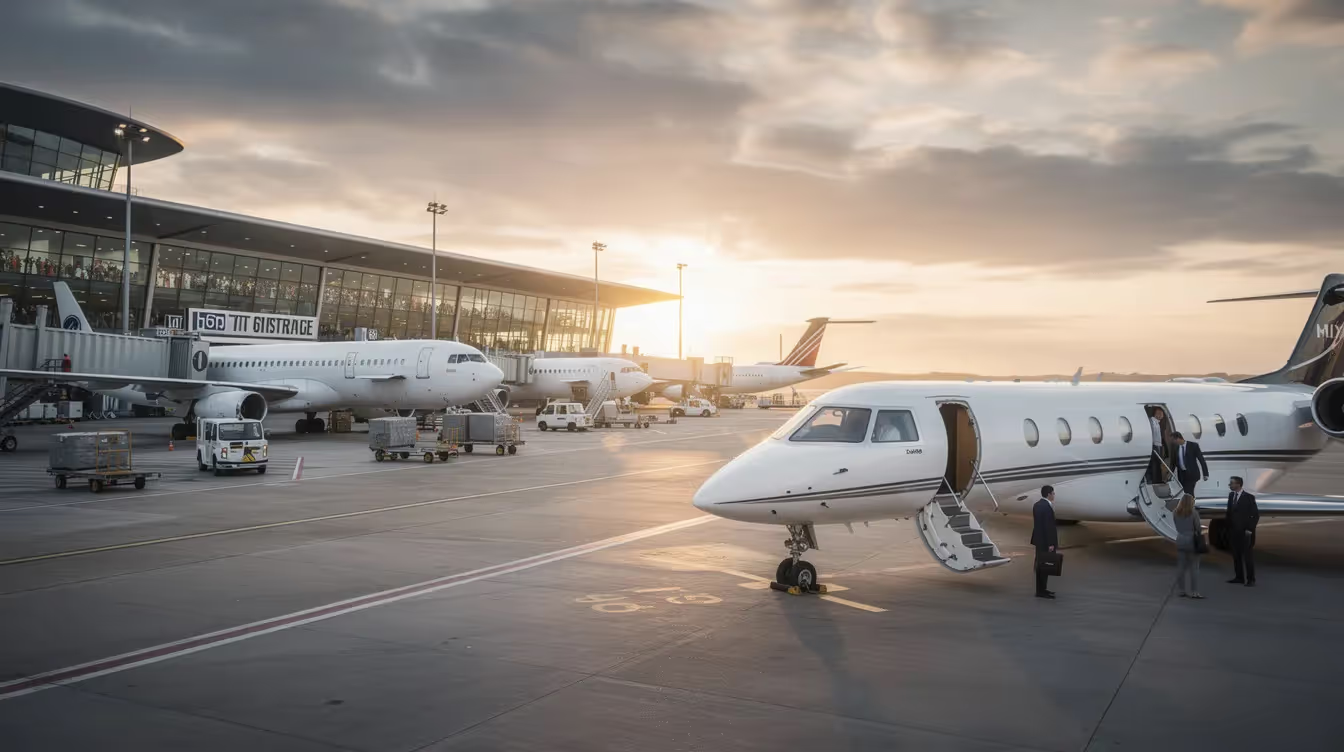
When airline strikes hit, travelers increasingly search for an airline strike private jet solution to keep moving when airlines stop. In recent years, labor actions by air traffic controllers, pilots, and ground staff have caused thousands of flights to vanish from departure boards across Europe and beyond. During these disruptions, demand for private jet charters surges as travelers seek reliable alternatives to reach their destinations.
This guide is for travelers, corporate planners, and anyone affected by airline strikes who need reliable alternatives. We cover why strikes are increasing, how private jets provide solutions, what to expect when booking, and how to prepare for future disruptions. The topic matters more than ever, as the increasing frequency of strikes and operational uncertainties makes it essential to have a dependable backup plan.
A private jet charter is a service that allows individuals or groups to rent an entire aircraft for their exclusive use, rather than purchasing individual seats on a scheduled commercial flight. Unlike commercial airlines, which typically serve around 500 airports worldwide, private jets can access over 5,000 airports globally, providing far greater flexibility in routing and destination choices. Private jet travel offers personalized scheduling, allowing passengers to set their own departure times and avoid the overcrowded terminals and long lines common during airline disruptions. This flexibility enables quick adjustments to itineraries in response to delays or cancellations, and allows travelers to bypass congested hubs by flying into secondary or regional airports. Private jet companies frequently report record demand during airline disruptions, as travelers seek to avoid mass cancellations and maintain control over their travel plans.
The impact of airline strikes has been significant. Eurocontrol recorded over 100,000 flights delayed or canceled across Europe between 2022 and 2024 due to industrial actions. Pilots, cabin crew, baggage handlers, and air traffic controllers have all contributed to a wave of uncertainty that makes scheduled commercial travel feel unreliable during peak periods. Airline strikes can also financially impact airlines, with costs sometimes exceeding £150 million due to lost revenue and operational inefficiency.
High demand combined with global events, such as jet fuel shortages, can drive charter prices up by as much as 20%. Additionally, limited aircraft availability during crises often means clients must pay for both outbound and return legs, especially when planes return empty, further increasing costs.
Private jet charter has emerged as a practical backup for those who cannot afford to wait. Jettly operates as a digital marketplace connecting travelers with over 20,000 available aircraft worldwide. The platform offers instant pricing and rapid booking—often within hours—focusing on schedule certainty rather than luxury language. When airlines stop, private aviation keeps moving, positioning Jettly as a compelling NetJets alternative for flying private.
Airline and airport strikes have intensified since the pandemic ended. Europe saw over 200 strike days affecting air traffic control and ground crew between 2022 and 2024. In the United States, regional carriers like Envoy and Republic faced pilot shortages that sparked labor disputes, canceling thousands of flights during 2023 and 2024 negotiations.
Several factors are driving this trend. Contract disputes over pay have become common as pilots demand 40-50% raises after years of restraint during the pandemic. Post-COVID staff shortages hit hard, with some airports reporting 20-30% deficits in baggage handlers and cabin crew. Rising fuel and operating costs—up roughly 50% since 2021, according to IATA—have squeezed margins and made negotiations tougher.
Different groups can strike, each with a distinct effect on flight operations. Pilots halt cockpit operations entirely. Cabin crew disrupts boarding and service. Baggage handlers delay luggage processing and ground turns. Security staff block passenger screening at terminals. Air traffic controllers shut down airspace management across entire regions.
Strike timelines vary unpredictably. Some walkouts happen with just hours of warning—Lufthansa issued 2-hour notices in 2023. Others are pre-announced 48-72 hours ahead but still create cascading delays. IATA notes that industrial actions now account for 15-20% of European flight disruptions, up from roughly 5% before 2022.
Private jets continue to operate during airline strikes because they rely on independent operators not tied to striking unions. These aircraft use separate terminals called fixed-base operators, which handle check-in, fueling, and ground services away from commercial chaos. When airline-specific pilot or cabin crew walkouts happen, private flights proceed unimpeded.
Charter flights can depart from secondary airports, bypassing the most congested hubs. London Luton or Biggin Hill replaces Heathrow. Paris Le Bourget substitutes for Charles de Gaulle. Teterboro in New Jersey offers an alternative to JFK. During France’s 2023 air traffic control strikes, private operators rerouted via regional fields that maintained 80-90% uptime.
Full air traffic control or national airspace closures do affect private jets equally—no aircraft can fly through closed airspace. But airline-only strikes leave private flights viable roughly 90% of the time.
Private jet companies frequently report record demand during airline disruptions as travelers seek to avoid mass cancellations and overcrowded commercial flights. Passengers benefit from personalized scheduling and access to more airports—private jets fly to over 5,000 airports worldwide, compared to roughly 500 served by commercial airlines. This extensive private charter aircraft network enables flexible routing and itinerary control, allowing quick adjustments in response to disruptions or delays.
Executives chartered flights for board meetings during Lufthansa’s 2023 summer strikes, reaching Frankfurt when commercial options vanished
Families repatriated after cancellations by booking Rome-to-London light jets when ITA Airways walked out
Sports teams secured same-day travel to events during the US regional carrier disputes
During the UK’s 2011 public sector strikes, Paris-London private flights operated from £500 per person on turboprops
2022 German ground strikes prompted Milan-Munich charters, saving travelers 6-12 hours versus rebooking waits
Demand for private charter flights out of the Middle East has surged due to significant disruptions in commercial airline operations caused by the ongoing US-Israeli conflict with Iran. Private flights accounted for 31% of departures from Muscat International Airport during this crisis. The number of private jet flights from the Omani capital spiked dramatically from a typical 10 to 15 flights per day to 98 flights in a single day, highlighting the surge in demand as travelers sought evacuation options through operators such as Dexter air taxi private jet services.

Jettly’s platform streamlines urgent bookings through a straightforward process. Input your route and dates to get instant matches from the global fleet. Filter results by time, aircraft type, and departure airport. Review real-time pricing without negotiation. Confirm with payment, and dispatch can happen within 2-4 hours during strike periods.
The digital interface displays estimated costs, flight durations, and aircraft specifications, including range and passenger capacity, through a private jet charter cost estimator. This transparency differentiates Jettly from traditional broker negotiations, where pricing often remains opaque until late in discussions.
On-demand charters suit one-off urgent trips. Private jet memberships cut commissions by 10-20% and add priority support for repeat travelers who face high-demand situations regularly.
During strike surges, availability can drop 30-50% while prices rise 20-40%, reflecting surge dynamics similar to other transport sectors. This increase also aligns with the impact of limited aircraft availability and repositioning needs, where clients often pay for both legs of a journey when planes return empty.
Search by route, time, and passenger count
Select aircraft and departure airport from available options
Review instant quote with all-in pricing
Pay and confirm booking
Receive flight details and crew contact information
Having precise details ready accelerates the booking process. Prepare your exact or flexible departure and arrival airports, date and time windows, passenger count, luggage volume and weight, and any special requirements like pets or medical needs.
Flexibility on secondary airports can cut wait times significantly. Prioritizing Teterboro over JFK, for example, often yields faster aircraft availability. Pre-submitting corporate billing details or payment proof speeds up contracting, potentially saving 1-2 hours during high-demand periods.
Prices during airline strikes typically run 20-50% higher than normal due to increased demand, limited aircraft availability, and repositioning needs. When many travelers try to leave a region simultaneously, operators face crew duty limits under the Federal Aviation Administration and FAA regulations, plus slot constraints at busy airports, making it essential to understand affordable private jet charter pricing.
Popular strike-escape routes include London to Paris or Geneva in Europe, New York to Chicago or Florida destinations in North America, and connections like Frankfurt to Rome or Toronto to Vancouver.
Aircraft categories suit different missions, and a jet card flight cost estimator can help forecast typical one-way pricing:
|
Route |
Aircraft Type |
Passengers |
Strike-Period Price Range |
|---|---|---|---|
|
London–Geneva |
Light Jet (Citation CJ3) |
6-8 |
$9,000–$15,000 |
|
London–Paris |
Turboprop (Pilatus PC12) |
4-9 |
$3,000–$7,000 |
|
NYC–Chicago |
Midsize Jet (Hawker 800) |
8-9 |
$18,000–$28,000 |
|
Toronto–Vancouver |
Heavy Jet (Gulfstream G550) |
12-16 |
$45,000–$65,000 |
|
Frankfurt–Rome |
Light Jet |
6-8 |
$12,000–$18,000 |
Repositioning legs, crew scheduling, and airport slots all influence final pricing when demand spikes.
Empty leg flights are repositioning segments flown without passengers—essentially the plane returning to base after a drop-off. These empty leg flights can be discounted 30-75% off standard charter rates, sometimes costing $2,000-$10,000 for legs that would normally run $10,000 or more.
Disruptions generate more empties as operators reposition aircraft to chase demand across the region. Jettly users can monitor these opportunities through platform filters or crowdsource private jet flights and share empty seats to reduce individual trip costs.
Pros and cons of empty legs:
Pro: Significant cost savings (up to 75% off)
Pro: Quick availability on specific routes
Con: Fixed routes and times with limited flexibility
Con: High mismatch rate—roughly 80% of empties don’t align with traveler needs
Con: No scheduling guarantees

Private jets offer schedule sovereignty. Travelers depart on their timeline rather than waiting 24-72 hours for airline rebooking. Alternate airports bypass 50-70% of terminal delays. FBO efficiency means 15-30 minutes total ground time versus 2-4 hours in commercial lines, which is why many travelers compare top private jet charter companies when planning for strike contingencies.
Time math illustrates the value. A New York to London trip by private jet totals roughly 8 hours door-to-door. The same journey during commercial disruptions can stretch to 14+ hours with rebooking waits, security queues, and delayed departures.
Corporate travelers gain productivity benefits: onboard meetings, secure discussions, and arriving rested for time-sensitive negotiations. Families appreciate customized catering, accommodation for children, and flexibility for mobility or medical needs, often supported by dedicated in-flight catering for private jets.
Commercial during strike vs. Private charter during strike:
|
Factor |
Commercial |
Private |
|---|---|---|
|
Departure control |
Airline schedule, often cancelled |
On-demand, traveler sets time |
|
Airport experience |
Crowded terminals, long queues |
FBO with 15-min processing |
|
Rebooking wait |
24-72 hours typical |
2-4 hour dispatch possible |
|
On-time rate |
Below 50% during strikes |
Above 95% when the airspace is open |
|
Privacy |
Shared cabin, public areas |
Private cabin, confidential |
The value lies in certainty and time saved rather than luxury alone.
Private jets cannot bypass closed airspace. Full air traffic control strikes, like France’s 2023 closures, ground 100% of operations, including private aircraft. Airport shutdowns and government-imposed flight bans affect everyone equally.
Severe weather, war-related restrictions (such as the Middle East conflicts affecting routing near Iran, Qatar, Oman, or Dubai), and equipment failures still apply. Private aviation follows the same safety regulations as commercial operations.
In some countries, strikes may also involve airport ground services that private aircraft depend on. This can limit operations at certain fields, though secondary airports often remain unaffected.
Charter operators in Jettly’s network operate in accordance with strict regulatory frameworks, including those set by the FAA and EASA. In the United States, the Federal Aviation Administration’s Part 135 charter rules govern crew qualifications, maintenance requirements, and operations. In Europe, EASA regulations set equivalent standards for crew training and flight times. Aircraft manufacturers also play a key role in ensuring that safety features and maintenance standards are met for all chartered aircraft.
Even in crisis periods, safety protocols remain constant. Crew duty-time rules prevent fatigue-related risks. Maintenance checks happen on schedule. No corners are cut regardless of how urgently passengers need to fly.
Reputable operators manage availability through crew scheduling systems and backup aircraft arrangements. Many carry third-party safety ratings from organizations like ARGUS or Wyvern, indicating they’ve passed rigorous audits. Dispatch rates among quality operators remain above 98% even during high-demand periods.
Last-minute charters are no less safe than planned flights. The same airplane, the same crew qualifications, and the same oversight apply whether booking happens three months or three hours before takeoff.
Private aviation carries a higher per-passenger emission footprint than commercial flights, particularly when aircraft fly lightly loaded. This reality deserves acknowledgment rather than avoidance.
Efficient aircraft selection reduces impact. Turboprops and light jets consume 30-50% less fuel than heavy jets on short regional hops. Avoiding unnecessary repositioning saves additional emissions. Understanding the global fleet of private jets and choosing the right aircraft for the length and passenger load of your trip makes a meaningful difference.
Some operators and passengers choose to purchase carbon offsets through recognized programs like Gold Standard, typically costing $50-200 per trip for full neutralization. Jettly can support environmentally aware choices where these options are available.
An executive team needed to reach Frankfurt for a merger negotiation during widespread European air traffic control actions in March 2023. Commercial options had evaporated across the region.
They chartered a midsize jet departing London within three hours of their scheduled airline cancellation. The flight used an alternate field unaffected by the strike. While colleagues at competitors waited two days for rebooked flights, this group completed their negotiation on time. People familiar with the matter reported that the deal closed successfully.
A family of six found themselves stranded in Rome during a December holiday period when their airline’s cabin crew walked out. Their original connection through a major hub had been cancelled along with thousands of other flights.
They chartered a light jet from Rome’s Ciampino airport to London, bypassing the chaos at Fiumicino. The 1.5-hour flight connected them to a stable British Airways long-haul departure for their repatriation flights home. Total time from booking to London arrival: under four hours.
An NBA-affiliated group faced event travel during the 2024 US regional airline strikes affecting February schedules. Over 1,000 commercial flights had been cancelled across their planned route.
A heavy jet accommodating 12 passengers departed New York for Florida the same day they contacted the charter company. The group reached their scheduled event without delay while commercial passengers remained stuck in rebooking queues, illustrating the reliability advantages highlighted in many charter airline guides.
These cases reveal clear patterns for travelers who might face similar situations, including practical strategies on how to get a seat on a private jet easily.
Action-oriented takeaways:
Book within 12 hours of strike announcements for 70% better rates
Remain flexible on departure airports to find available aircraft faster
Budget $10,000-$50,000 for critical legs requiring guaranteed travel
Monitor union news through sources like BALPA or airline-specific feeds
Pre-set your Jettly profile with traveler and payment details before disruptions hit, and review options for buying a seat on a private jet if you don’t need the whole aircraft
Proactive preparation makes the difference between scrambling and departing smoothly. Monitor labor news affecting your regular routes. Subscribe to airline and airport alerts for advance warning of potential walkouts.
Setting up a Jettly profile in advance—with basic traveler information and payment details—slashes booking time to minutes when demand spikes. The platform’s access to over 20,000 aircraft globally means options remain available even during peak disruption periods.
Jettly’s transparent pricing tools shine during crises when quick decisions matter. The digital interface shows real-time availability and costs without negotiation delays. When an airline urgently needs a private jet solution, this speed becomes invaluable.
The platform serves travelers who need certainty over luxury language. Whether facing a summer air traffic control walkout or a holiday ground staff dispute, having a backup plan means the difference between waiting and arriving, and services like Zenflight instant-book private jet charters demonstrate how quickly travelers can pivot away from commercial disruptions.
According to a recent report, official statements from airline spokespersons have emphasized the importance of having contingency plans in place for travelers during strike periods, and some travel professionals even leverage Jettly’s ULTRA high ticket affiliate program to introduce clients to these contingency options.
Ready to secure a backup plan before the next airline strike? Explore flight options or request a quote at https://www.jettly.com.
Share this post:
Jeff Ryan Serevilla
Apr 19, 2026
|
5
min read
Discover tips and trends in the industry.
5
min read
Boeing 767-300 Range: Performance, Routes, and Private Charter Alternatives
The Boeing 767-300ER is a widely used long-haul aircraft known for its impressive range of approximately 5,980 nautical miles. This guide explores its performance, typical routes, and how it compares to private jet charter options, making it essential for travelers and aviation enthusiasts alike. Understanding the capabilities of the 767-300ER can help in planning smarter trips, whether flying commercially or considering private charter alternatives.
Read More
5
min read
Boeing 737-300: Second-Generation Classic Airliner for Airlines and Private Charter
The Boeing 737-300 is a pivotal second-generation airliner that transformed commercial aviation since its introduction in the mid-1980s. Although many airlines have retired this model, it remains in service for cargo, VIP, and private charter operations worldwide, showcasing its adaptability and enduring value. This article delves into the aircraft's legacy, specifications, and its relevance in today's aviation landscape.
Read MoreStay updated with our latest insights and tips to elevate your journey with us.
MEMBERSHIPS AND ASSOCIATIONS



Disclaimer: Jettly operates as a charter broker, offering access to a global digital jet charter marketplace. Jettly is not a direct air carrier and does not own or operate aircraft. All advertised flights are conducted by third-party air carriers that are fully licensed and hold the appropriate Part 135 or Part 121 certifications issued by the Federal Aviation Administration (FAA) or equivalent regulatory authorities under U.S. or foreign law. Jettly complies fully with the U.S. Department of Transportation's Part 295 and Part 298 Charter Broker regulations. Jettly does not carry additional liability insurance. Passengers are covered by aircraft operator insurance. TICO: 50023770


