



Login
Get Instant Pricing On 23,000+ Aircraft

>
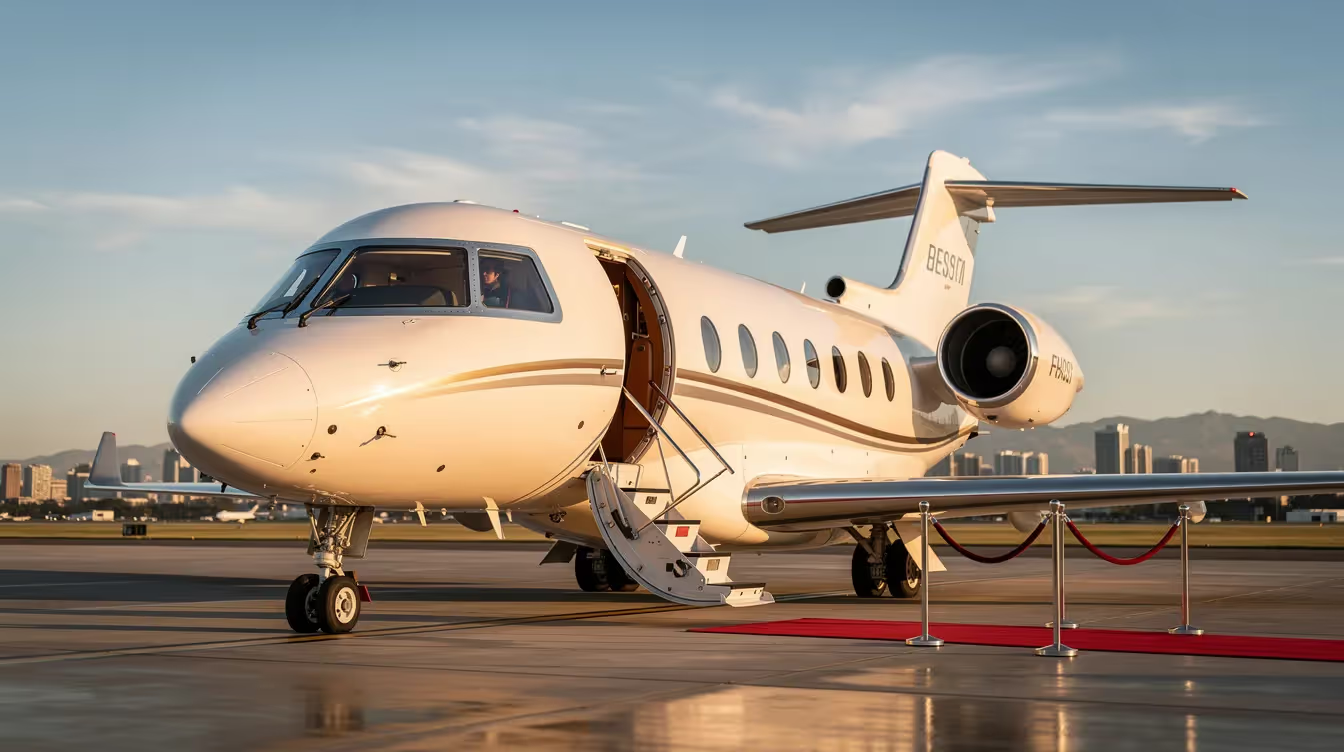
A $15 million budget for a private jet provides access to some of the most versatile and luxurious light, midsize, and super-midsize aircraft on the market, ideal for business and family travelers seeking performance, comfort, and global reach. This price point balances acquisition cost with operating efficiency and is increasingly accessible through charter services rather than outright ownership.
– Modern jets in this range typically offer standing-room cabins for 8–12 passengers and can fly nonstop across continents or oceans.
– Buyers can choose between new light jets or recent-model midsize/super-midsize jets with advanced technology and comfort features.
– Ongoing costs such as crew, maintenance, and fuel often exceed the initial purchase price over time, making charter an appealing alternative for many.
– Leading platforms like Jettly enable travelers to access $15M-class jets on-demand, eliminating long-term capital commitments and providing flexibility.
– Environmental considerations are addressed through newer fuel-efficient aircraft, Sustainable Aviation Fuel, and integrated carbon offset programs.
A $15 million private jet typically means a brand-new light or super-light jet like the Embraer Phenom 300E, or a late-model midsize or super-midsize aircraft with transcontinental or transatlantic range and luxurious standing-room cabins for 8–12 passengers. For many business and leisure travelers, this price point represents a sweet spot between personal aircraft and the ultra-long-range heavy jets that command $70 million or more. Increasingly, travelers access these aircraft through charter platforms like Jettly rather than committing capital to full ownership.
A $15 million budget in 2025–2026 typically covers a brand-new light or super-light jet (Phenom 300E, Citation CJ4 Gen2, Pilatus PC-24), a high-end used super-midsize jet (Legacy 600, Gulfstream G450), or a late-model midsize jet (Challenger 350, Legacy 450/500), positioning buyers in a practical range for most domestic, regional, and transatlantic missions.
The purchase price represents only 40–60% of the total ownership cost over 10 years. Annual operating costs for a modern light or midsize jet often reach $800,000–$1.5 million when factoring in crew salaries, hangar fees, insurance, maintenance reserves, and fuel.
Time savings remain the core value proposition. Using private terminals and smaller airports can save 4–6 hours on a single transcontinental trip compared to commercial airlines by avoiding check-in queues, security lines, and connection delays.
Jettly provides access to aircraft in the $8 million–$60 million range on-demand, without jet cards, long-term contracts, or tying up capital in a depreciating asset.
Sustainability is increasingly integrated into private aviation. Sustainable Aviation Fuel (SAF), which can reduce lifecycle CO₂ emissions by 50–80%, is increasingly available at major airports, allowing private jet operators to significantly lower their carbon footprint. Carbon offset programs also make flights effectively carbon-neutral with no extra effort from travelers.
Newer private jets often feature next-generation engines and aerodynamic enhancements, reducing fuel consumption by 10–20% per nautical mile compared to older models, contributing to both cost savings and environmental benefits.
This article compares full ownership, jet card programs, and on-demand charter, profiles specific aircraft in the $15M range, and answers common questions in the FAQ section.
In the current market, $15 million sits in a strategic position between small personal aircraft and the large cabin jets favored for intercontinental travel. This budget works well for most business aviation missions and family travel needs across North America, Europe, and similar regional networks.
At this price point, buyers typically choose between brand-new light or super-light jets such as the Embraer Phenom 300E or Cessna Citation CJ4 Gen2, or relatively young pre-owned midsize and super-midsize jets like the Bombardier Challenger 350, Embraer Legacy 450/500, Legacy 600, or Gulfstream G450. The most fundamental price driver for private jets is the aircraft's size and range, with typical aircraft in the $15 million range fitting high-performing midsize or older super-midsize jets that offer superior range and cabin comfort over smaller light jets.
Super-midsize jets in this category often feature a 6-foot-tall cabin, allowing most adults to stand upright, and include cabin configurations such as a "club-four" seating arrangement. These aircraft typically accommodate 8 to 12 passengers and have ranges frequently exceeding 3,000–4,000 nautical miles, enabling nonstop or one-stop transcontinental and transatlantic flights.
Pre-owned jets' value is influenced by airframe and engine hours, with higher flight hours accelerating depreciation. New jets command higher prices due to the latest technology, full warranties, and lower immediate maintenance needs, but depreciate fastest in their first few years.
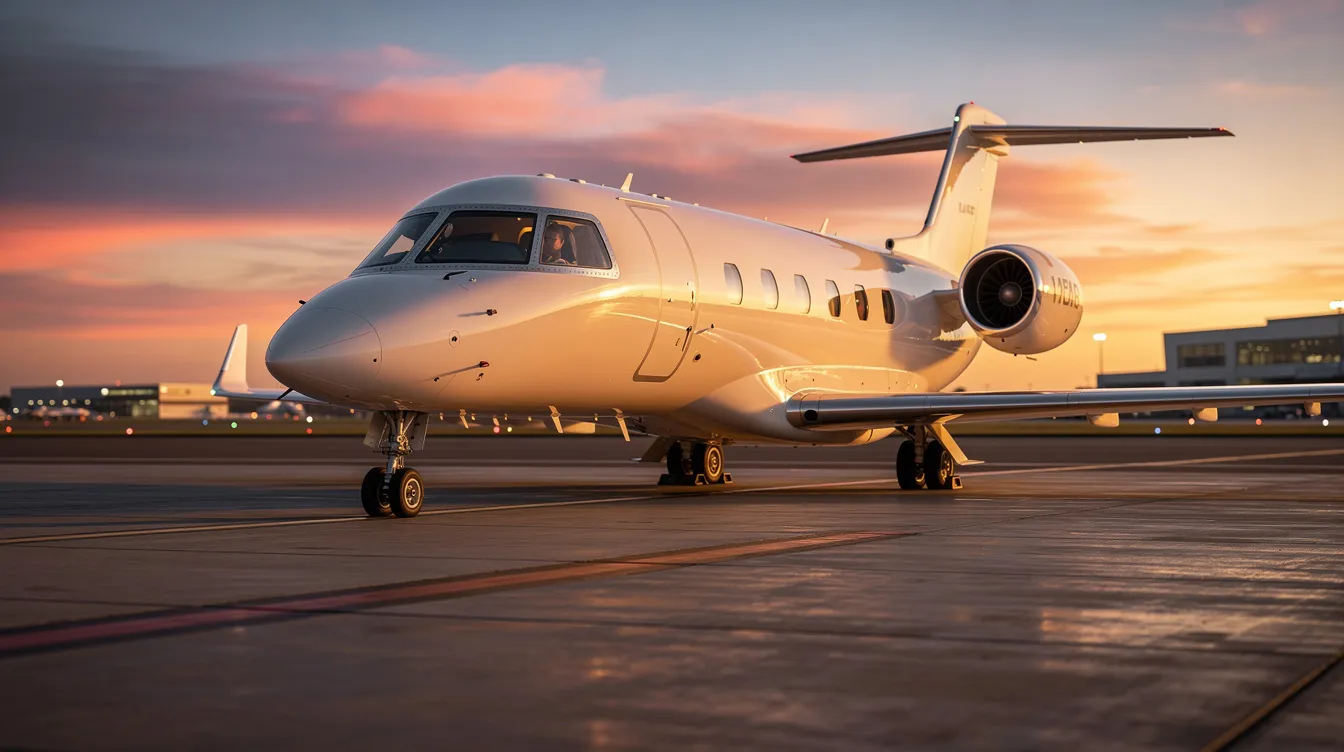
Light jets and super-light jets dominate new deliveries around the $15M threshold because they balance speed, fuel efficiency, and the capability to access smaller airports with shorter runways.
Embraer Phenom 300E carries a 2025 list price of approximately $11–$13 million. It cruises at ~465 mph, delivers around 2,010 nm range, and seats 6–8 passengers. Popular routes include New York–Miami or Los Angeles–Denver without fuel stops.
Cessna Citation CJ4 Gen2 lists around $13 million new, achieving ~475 mph cruise speed and roughly 2,165 nm range. The spacious cabin accommodates 8–10 passengers with stand-up height, making it suitable for US coast-to-coast travel with a fuel stop.
Pilatus PC-24 commands $13–$14 million, cruising at ~440 mph with approximately 2,000 nm range and 8–10 seats. Its standout feature is runway performance—it can operate from strips as short as 2,935 feet, including unpaved surfaces, opening access to thousands of smaller airports unavailable to larger business jets.
Light jets such as the Learjet 75 Liberty and Phenom 100EV are designed for shorter regional trips and typically seat up to 10 passengers, offering a balance of performance and comfort.
Cabin characteristics at this level include quiet interiors (under 82 dB), configurable club seating, an enclosed lavatory, a compact galley for hot beverages and snacks, and high-speed Wi-Fi supporting video calls and streaming. These aircraft cover North American or European networks in 2–3 hours, making them ideal for travelers who value time savings over cabin size.
Many of these jets are available on Jettly’s platform for on-demand charter, giving travelers the same flying experience without paying the acquisition price and annual fixed costs of aircraft ownership.
A $15 million budget also reaches into the market for relatively young midsize and super-midsize jets, particularly aircraft built between 2017 and 2022, depending on total airframe hours and condition.
Bombardier Challenger 350 units from 2017 to 2022 often trade around $13–$16 million. With approximately 3,200 nm range, 8–10 seats, and a 6-foot cabin height, this aircraft handles New York–Los Angeles nonstop or London–Dubai with one stop. Collins Pro Line avionics and over 100 cubic feet of baggage capacity make it a workhorse for corporate travelers.
Citation Sovereign+ typically trades at $10–$14 million pre-owned. It offers ~3,000 nm range, 9–12 seats, and strong short-field performance for accessing airports that larger jets cannot reach.
Embraer Legacy 450/500 often lists at $11–$15 million, delivering 2,900–3,100 nm range with 8–9 seats. The flat-floor cabin and modern fly-by-wire controls appeal to owners seeking both comfort and advanced technology.
Legacy 600 and Gulfstream G450 models, often associated with this price range, provide transatlantic range and multiple living zones designed for comfort and functionality, including areas for dining, meetings, and relaxation.
Midsize and super-midsize cabins generally offer stand-up height (~6 feet), a more spacious galley capable of hot meals, and better baggage capacity than light jets—features that matter on longer trips or with larger groups of passengers.
Buyers must factor in depreciation (often 10–15% per year over the first decade) and potential upgrade needs for connectivity or cabin refresh, which can significantly shift the total cost of ownership beyond the purchase price.
Jettly’s customers frequently charter these midsize types for transcontinental flights, multi-city roadshows, or family holidays where nonstop range and extra space matter.
A $15 million budget generally does not purchase a brand-new, large cabin jet or ultra-long-range aircraft. Models like the Gulfstream G700 or Bombardier Global 7500 exceed $70–$80 million new, placing them in an entirely different category.
At $15M, buyers considering large cabin jets are typically looking at older airframes—early-2000s Gulfstream aircraft (GIV, GV) or Falcon 900 variants. These may have significantly higher hourly operating costs and upcoming heavy maintenance events that can generate six-figure invoices.
A 15–20-year-old large-cabin Gulfstream might cost 50–80% more per flight hour than a 5-year-old midsize jet due to aging engines and scheduled overhauls. The Rolls-Royce engines on older Gulfstream models, for example, can require $1–$2 million for major repairs.
Many travelers who only fly a few times per month can instead charter modern large cabin jets through Jettly on the occasions they truly need that capacity, avoiding the unpredictable maintenance downtime and higher annual budgets associated with older heavy iron.
Aircraft in this price segment have evolved into quiet, connected spaces that function as a flying office, meeting room, and family retreat. The cabin experience on a modern $15M jet centers on productivity and rest rather than mere aesthetics.
Luxury private jets in the $15 million range often come equipped with high-speed Wi-Fi and advanced cabin management systems, ensuring comfort and connectivity for passengers.
Typical cabin zones in a $15M light or midsize jet include a forward club seating area, a conference or dining zone, and a rear divan or lounge. Some configurations feature sliding doors that create separate areas for meetings and rest.
Seats often convert to fully flat beds, enabling true rest on red-eye flights like Los Angeles–New York or London–Doha. Depending on the layout, 4–8 passengers can sleep flat on overnight sectors.
Most aircraft at this level feature an enclosed lavatory (often at the rear) with vanity areas, plus a compact but efficient galley for hot meals and snacks prepared by crew or catered in advance.
Customization of a private jet's interior can include high-end finishes like wood veneers and premium fabrics, as well as unique amenities such as lounges, dining rooms, and bedrooms. Luxury private jets often feature multiple distinct living zones, with interiors designed to provide comfort and functionality, including areas for dining, meetings, and relaxation.
A Phenom 300E, for example, typically offers a 6-seat club layout plus a belted lavatory seat. A Challenger 350 might feature double club seating plus a 3-place divan, yielding 4–6 lie-flat positions for overnight travel.
Jettly’s booking platform allows customers to view interior photos and layout diagrams of specific aircraft before confirming a charter, helping match cabin style to trip needs.
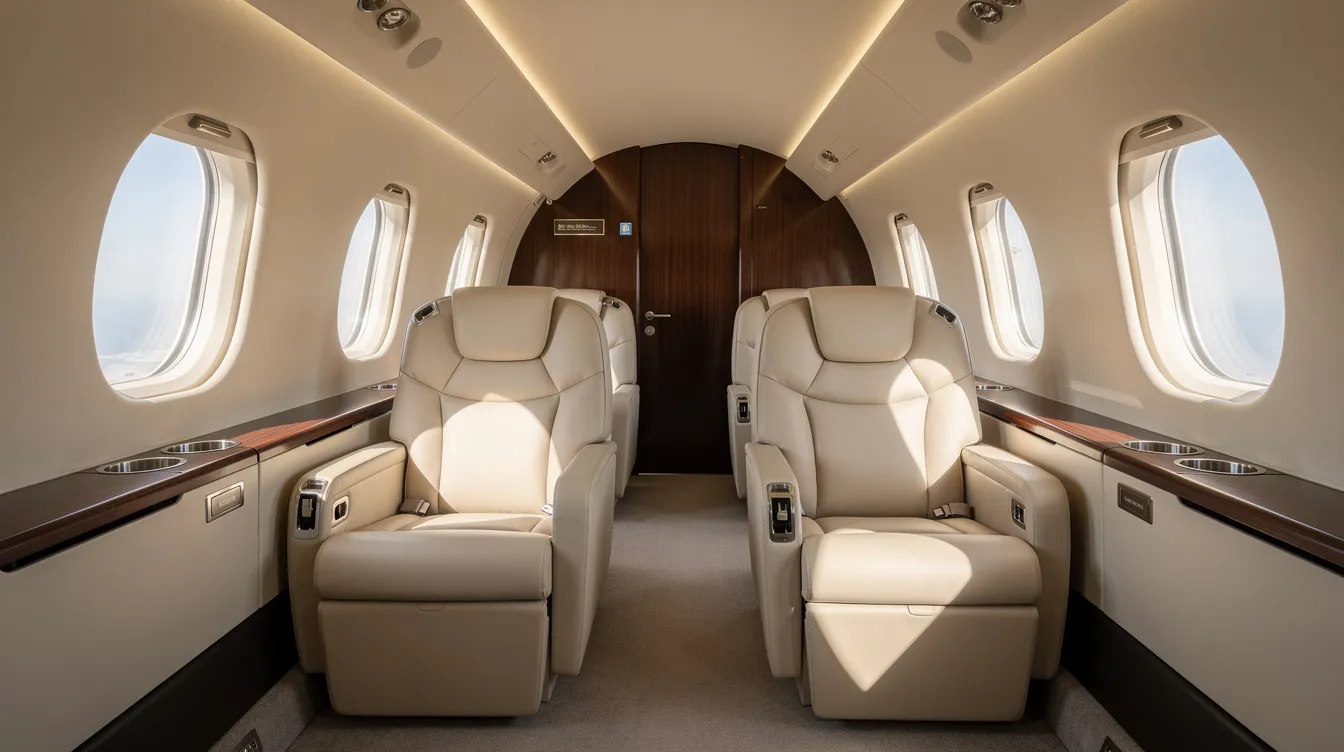
High-speed connectivity is now standard on luxury private jets valued at $15M, particularly for business aviation travelers who need to work securely in flight.
Typical systems include Ku- or Ka-band satellite Wi-Fi, VPN support, and cabin management touchscreens that control lighting, temperature, and entertainment. Garmin auto radar and other advanced avionics support the flight deck, while passengers enjoy sweeping views through large windows and seamless connectivity.
Video conferencing, secure email, and cloud-based collaboration tools work smoothly on newer setups, transforming a 3-hour flight into productive office time. For families, streaming entertainment and custom content libraries support long legs like Toronto–Vancouver or Paris–Dubai.
Jettly’s charter advisors can filter for aircraft with specific connectivity requirements—streaming-capable Wi-Fi, private office areas, or Bombardier Vision flight displays—based on corporate travelers’ needs.
Interiors at this level feature soft leather seating, real wood or carbon-fiber veneers, and muted color palettes designed for long-haul comfort. Premium materials throughout the cabin door panels and sidewalls create a residential feel.
Optional extras include upgraded soundproofing packages, LED mood lighting, heated stone countertops in the galley, and branded bedding for overnight flights. A 2024-built Legacy 450, for instance, might feature fully electric, swiveling seats that remember preset recline positions.
Jettly’s customers often prioritize quiet cabins and ergonomic seating over extravagant materials. Productive meetings, restful sleep, and quality family time are the real luxuries that time-poor travelers value.
The $15 million acquisition price represents only part of the financial commitment. Over 10 years, operating costs, maintenance, and crew expenses can exceed the initial purchase decision—a reality that shifts private jet ownership economics dramatically.
Total costs are split into fixed annual expenses (crew, hangar, insurance, training, management) and variable costs per flight hour (fuel, maintenance reserves, landing fees, catering). Exact figures vary by region, fuel prices, and usage patterns.
Consider a straightforward example: an owner flying 250 hours per year in a midsize jet might face annual budgets of $1.2–$1.5 million when combining fixed and variable expenses. For many travelers flying under ~200–250 hours per year, chartering through a platform like Jettly delivers the same aircraft experience with fewer financial and administrative obligations.
Fixed costs accumulate regardless of how often the aircraft flies:
Crew salaries: $250,000–$350,000 per year for light jets, $350,000–$500,000 for midsize (captain, first officer, sometimes a dedicated flight attendant)
Hangar and parking: $40,000–$120,000 annually, depending on airport, region, and hangar type
Insurance: $40,000–$80,000 per year, higher for larger aircraft or complex operations
Training: Recurrent simulator and safety training often exceeds $50,000–$80,000 annually
Management fees: $40,000–$100,000 per year if using a professional management company
Combined, these annual fixed costs typically range from about $450,000 to $900,000 per year for a modern light or midsize jet.
Some owners offset costs by allowing their aircraft to be used for third-party charter under Part 135, but this adds utilization and wear while requiring expert oversight.
Charter users on Jettly do not directly handle any of these fixed categories—they pay a clear trip price that already reflects operator costs.
Variable costs scale with each flight hour:
Light jets: $1,650–$2,600 per flight hour
Midsize jets: $2,350–$3,700 per hour
Older large cabin aircraft: $4,000–$6,500 per hour
Components include fuel (often 30–40% of hourly cost), engine and airframe maintenance reserves, landing and handling fees, and catering or special requests.
Benchmark figures for popular models:
Phenom 300E: approximately $2,500–$3,000 per hour
Challenger 350: roughly $3,500–$4,500 per hour
Newer jets enrolled in comprehensive maintenance programs (JSSI, Rolls-Royce CorporateCare, or OEM programs) may have more predictable costs but require regular program payments that add to the per-hour calculation.
Jettly’s charter quotes typically show an all-in trip price, simplifying budgeting compared with the detailed spreadsheets required for full ownership.
Enrollment in engine and airframe maintenance programs protects residual value by reassuring future buyers that major events have been budgeted for and handled properly.
Unscheduled events—such as an engine repair not covered by a program—can generate six-figure invoices and unpredictable downtime. Parts availability for popular models is generally strong, but older airframes may face longer lead times.
For popular models around $15M, serious buyers often insist on full program enrollment as part of the purchase conditions, which can influence the sale price. NBAA IFR reserves and proper maintenance documentation ensure a safe return on the owner’s investment when selling.
Charter clients on Jettly indirectly benefit from these programs because reputable operators keep aircraft fully covered, ensuring reliability and minimizing cancellations.
Long-term financial planning for ownership should look beyond the first few years and consider exit strategy—depreciation patterns and market volatility can significantly impact residual value.

A $15M aircraft budget does not automatically make full ownership the most rational choice. The right path depends primarily on annual flight hours, trip patterns, and the desire for flexibility versus control.
Three main models exist:
Full ownership: 100% of an aircraft, fully customized, with all responsibilities
Jet cards / fractional ownership: Prepaid hours with guaranteed availability and fixed hourly rates
On-demand charter: Pay-per-trip access to many aircraft types without long-term commitments
Consider a company flying 120 hours per year between New York, Chicago, and Miami. At that usage level, fixed ownership costs spread across fewer flight hours often exceed charter pricing, making on-demand access more cost-effective than purchasing a $15M jet.
Jettly specializes in on-demand and membership-based access, putting 20,000+ aircraft—including $15M-class jets—within reach of corporate and leisure travelers worldwide.
Full ownership typically becomes economically rational at around 250–300 flight hours per year, especially when missions are predictable and complex (frequent international travel, remote destinations requiring specific runway performance).
Key benefits include total customization of the interior, the ability to select and retain a known crew, maximum control over schedules, and potential tax-planning advantages (subject to expert advice).
Tradeoffs include capital tied up in a depreciating asset, exposure to maintenance and market risk, regulatory compliance responsibilities, and the need for either internal flight department staff or an external management company.
A multinational CEO flying 350+ hours annually between North America, Europe, and the Middle East who values guaranteed aircraft availability and a consistent crew represents the ideal ownership candidate.
Even some owners continue to charter additional aircraft through Jettly for overflow trips or different mission profiles—sending a team on a separate jet to a different event, for example.
Jet cards and fractional programs serve travelers flying around 50–200 hours per year who want guaranteed access to aircraft categories without buying a full jet.
The structure involves upfront or periodic payments in exchange for hour blocks, fixed or capped hourly rates, and guaranteed availability with specified notice periods and peak-day rules.
Programs from industry competitors (NetJets, Flexjet, Wheels Up, XO, VistaJet) offer strong fleets but often require multi-year commitments, initiation fees, and complex terms.
For some travelers, jet cards can still be more rigid and expensive than on-demand charter, especially if travel patterns change or annual usage falls short of expectations.
Jettly’s on-demand and membership options deliver transparent pricing and aircraft choice without forcing a single provider’s fleet or long-term financial lock-in.
On-demand charter allows travelers to pay only for trips they actually fly, selecting aircraft from a global pool based on route, passenger count, and the buyer’s preferences.
Jettly’s platform provides instant online search, real-time indicative pricing, and access to over 20,000 aircraft worldwide—spanning light jets, midsize, large cabin jets, turboprops, and helicopters.
This model works best for travelers flying under 150–200 hours per year, or those with variable schedules and destinations where a single-owned aircraft cannot efficiently operate all missions.
Jettly offers membership structures designed to lower per-trip costs and provide concierge-style support without committing to a single aircraft or fixed annual hours.
A Toronto-based entrepreneur using Jettly to book 1–2 trips per month across North America—often on Phenom 300E or Citation CJ3 aircraft—avoids both acquisition costs and jet card contracts while enjoying the same time savings as owners.
Choosing the wrong aircraft—whether owned or chartered—adds unnecessary cost, time, and complexity to every trip. A systematic approach prevents expensive mistakes.
Steps to consider:
Define mission profile
Match range and performance to routes and airport access
Prioritize safety, technology, and cabin comfort
Decide between ownership, jet cards, and on-demand charter based on actual hours and risk tolerance
Jettly can serve as a low-risk way to “test drive” different aircraft types on real trips before considering a purchase decision.
Start by listing your top 10–20 routes over the past year (or expected next year). Note the distance, passenger count, and luggage needs for each.
Frequent 1–2 hour regional hops (Paris–Geneva, Los Angeles–Las Vegas) may favor efficient light jets. Regular 5–6 hour legs (New York–San Francisco, London–Riyadh) may justify midsize or larger aircraft.
Consider overnight versus daytime travel, the need for lie-flat beds, and how often passengers need to work versus rest onboard.
A family flying from New York to Nassau with 6 passengers and golf bags might be best served by a light jet with good baggage capacity rather than a heavy jet with empty seats and higher operating costs.
Jettly’s team shares aircraft suggestions based on a client’s historical or projected travel log, making aspirational thinking concrete.
Basic range bands:
Light jets: 1,800–2,200 nm, ideal for most domestic US or intra-European routes
Midsize jets: 2,800–3,500 nm, suitable for nonstop US coast-to-coast and many North America–Europe pairs with favorable winds
Runway performance determines airport access. Aircraft like the Pilatus PC-24 can use shorter or unpaved runways, bringing travelers closer to final destinations—regional ski resorts, island strips, and smaller airports that commercial airlines cannot serve.
Jettly’s search tools filter options based on runway length and airport category, often revealing airports that reduce total travel time compared to flying into large hubs.
Choosing an aircraft with more long-range capability than needed increases acquisition and operating costs without meaningful time savings if most flights are short.
Key safety credentials to verify:
Operators audited to standards such as ARGUS Platinum, Wyvern Wingman, or IS-BAO Stage II/III
Two experienced, type-rated pilots on every flight
Up-to-date avionics with modern safety features (synthetic vision, enhanced ground proximity warning systems, advanced autopilot)
Part 91 (private operations) differs from Part 135 (commercial charter), with charter flights subject to stricter oversight and duty-time rules that enhance security and reliability.
Jettly sources flights from vetted operators that comply with relevant regulatory frameworks. Customers can request details on safety ratings as part of the booking process.
Safety and crew quality should always outweigh marginal design or interior preferences when facing tradeoffs.
Private jets, including those valued at around $15M, emit more CO₂ per passenger than commercial flights. However, technology and operational practices are improving, and travelers have meaningful options for reducing impact.
Jets in the 15 million dollar segment often feature next-generation engines and aerodynamic enhancements:
Winglets and advanced wing designs reduce drag and fuel consumption by 5–10%.
Composite materials lighten airframes, requiring less fuel per mile.
Modern engine technology, like the Pratt & Whitney PW535E1 on the Phenom 300E, offers superior fuel efficiency compared to previous generations.
Overall, a new-production light jet may burn 10–20% less fuel per nautical mile than an equivalent aircraft from 15 years ago.
SAF represents the most promising near-term solution for reducing aviation's lifecycle carbon emissions:
What It Is: Fuel produced from sustainable feedstocks (used cooking oils, agricultural waste, synthetic processes) that can reduce lifecycle CO₂ emissions by 50–80%.
Current Availability: 30–50% blends available at major hubs, including Van Nuys, Teterboro, London Farnborough, and select European airports.
How to Access: Owners and Jet Card members can request SAF for eligible flights, often at a modest premium over conventional jet fuel.
Premium aviation providers now integrate carbon neutrality directly into their service:
How Offsets Work: Investments in verified climate projects (reforestation, renewable energy, carbon capture) that counterbalance flight emissions.
Quality Matters: Look for offsets verified by Gold Standard, Verra VCS, or equivalent certifications.
Seamless Integration: Programs build offsetting into every leg automatically—no extra effort, no extra cost to the traveler.
For clients accessing jets through curated fleets, this model allows flying on the newest, most efficient aircraft without owning an older, less-efficient jet outright.
This FAQ addresses practical questions about purchasing, operating, and chartering aircraft in this price range. Answers reflect 2025–2026 market conditions and may evolve with aircraft prices, fuel costs, and regulatory changes.
Yes, $15 million typically covers a brand-new light or super-light jet (Phenom 300E, Citation CJ4 Gen2, Pilatus PC-24) with standard options. Some well-equipped aircraft push slightly above this figure, while negotiated discounts or pre-owned options can bring them under $15M.
Large cabin jets and ultra-long-range aircraft remain well above this budget for new purchases, though certain older large-cabin airframes may be available under $15M pre-owned.
Many travelers use Jettly to charter and compare multiple models in real-world conditions before committing to a purchase decision.
Industry benchmarks suggest full ownership becomes cost-effective around 250–300 flight hours annually, assuming a predictable schedule and consistent passenger mix.
Below 200 hours per year, fixed costs spread across fewer flight hours typically make per-hour ownership cost substantially higher than charter alternatives.
Potential owners can use Jettly for a year to accurately track their private flight hours and mission types before committing capital.
For pre-owned aircraft, a well-managed transaction typically takes 45–90 days from letter of intent to closing, including pre-purchase inspection, negotiations, financing, and registration.
New aircraft delivery slots may be months or years out, depending on manufacturer backlogs and chosen configuration.
Those needing immediate access often begin with a charter through Jettly while a purchase is evaluated or finalized.
Yes, owners and charter clients can significantly reduce and offset emissions by combining efficient aircraft, Sustainable Aviation Fuel where available, and high-quality carbon offsets.
Charter travelers can request SAF and carbon-neutral options through Jettly when operators and departure locations support them, typically at a modest surcharge.
As SAF production scales, availability and affordability are expected to improve across more airports in the world.
Many travelers prioritize flexibility, capital preservation, and simplicity—especially when annual usage falls below 200–250 hours. Jettly provides access to the same aircraft that cost $8–$60M new without jet cards, fractional shares, or multi-year commitments.
Benefits include transparent pricing, instant online booking, the ability to switch between light, midsize, and large cabin jets trip-by-trip, and integrated services like ground transportation and catering.
Chartering through Jettly also allows travelers to experiment with different aircraft before making an informed purchase decision if ownership eventually makes sense.
Full Ownership: Best for those flying 250+ hours annually who want total control and customization, but requires a $15M+ upfront purchase and $800,000–$1.5M per year in operating costs. Typical jets include Phenom 300E, Challenger 350, and Legacy 500. Highest control but highest ongoing commitment.
Jet Card / Fractional: Suits those flying 50–200 hours per year, with buy-ins from $150K–$1M for prepaid hour blocks and fixed/capped hourly rates. Provides guaranteed access to a fleet of light, midsize, and large cabin jets but with less customization than ownership.
On-Demand Charter: Ideal for 0–200 hours per year. No upfront costs—pay only per trip. Access any aircraft from light jets to heavy jets with all-in trip pricing. Offers the highest flexibility and no long-term financial commitment.
You can acquire a brand-new light or super-light jet (like the Embraer Phenom 300E, Cessna Citation CJ4 Gen2, Pilatus PC-24) or a late-model pre-owned midsize or super-midsize jet with transcontinental range and luxury cabins.
The purchase price is only 40–60% of the 10-year ownership cost. Annual operating expenses for a $15M jet often reach $800,000–$1.5 million, including crew, maintenance, insurance, hangar, and fuel.
Full ownership makes sense if you fly 250+ hours a year. For fewer hours, jet cards or on-demand charter provide similar access and flexibility with less financial risk and no responsibility for ongoing costs.
Yes, platforms like Jettly offer on-demand charter, allowing you to fly in $15M-class jets without ownership, jet cards, or long-term contracts.
Expect standing-room cabins, club seating, lie-flat beds, advanced Wi-Fi, high-end finishes, enclosed lavatory, and dedicated galley areas for meals and beverages.
Modern $15M jets use fuel-efficient engines and advanced aerodynamics. Many operators offer Sustainable Aviation Fuel and carbon offset programs to reduce environmental impact.
Pre-owned jets may be delivered in 45–90 days after purchase, while new jets can take several months to years depending on factory slots and customization.
Risks include depreciation, high ongoing costs, unpredictable maintenance expenses, and tying up capital in an asset that may lose value faster than expected.
A 15-million-dollar private jet typically delivers a high-performance light, midsize, or super-midsize aircraft capable of saving 4–6 hours on every transcontinental trip, offering a quiet, connected cabin for work and rest. These aircraft can access thousands of smaller airports, eliminating the hassles of commercial hubs and creating real-time savings.
Ownership at this level brings substantial ongoing costs and operational responsibilities. For many travelers, on-demand charter through a digital platform like Jettly delivers similar aircraft access without tying up capital in a depreciating asset or managing crew salaries, hangar fees, and maintenance programs.
Sustainability is increasingly important in private aviation, and travelers can actively reduce their carbon footprint through efficient aircraft selection, Sustainable Aviation Fuel, and carbon offset programs integrated into charter offerings.
Private jet travel also provides enhanced privacy, allowing high-profile individuals to avoid public attention and maintain discretion during their journeys.
Think in terms of annual flight hours, mission profiles, and flexibility needs before deciding between buying, joining a jet card program, or chartering. Whether you ultimately purchase a 15-million-dollar private jet or simply charter one when needed, the smartest first step is understanding your travel patterns and exploring modern charter options.
Ready to experience private travel on your terms? Explore flight options or request a quote at https://www.jettly.com and compare real aircraft, real prices, and real time savings on your next trip.
Share this post:
Jay Franco Serevilla
Apr 14, 2026
|
5
min read
Discover tips and trends in the industry.

5
min read
Delta Boarding Zones: How Delta Air Lines Boarding Works (and What It Means for Private Flyers)
Delta Air Lines utilizes a structured boarding system with eight numbered zones plus pre-boarding, determining the order in which passengers board based on cabin class, fare type, and loyalty status. Understanding this system is crucial for travelers considering commercial flights versus private jet charters, as it impacts overhead bin space and wait times. For those seeking a more streamlined experience, private jet options like Jettly eliminate the complexities of boarding zones altogether.
Read More
5
min read
Delta Basic Economy: What Changed, What It Includes, and When to Avoid It
Delta Air Lines has rebranded its Basic Economy fare to Delta Main Basic as of October 1, 2025, maintaining its core restrictions while altering the booking experience. This fare class is the most restrictive in Delta's lineup, making it suitable primarily for solo travelers on short flights who prioritize low prices over flexibility. For most travelers, considering higher fare options like Delta Main Classic or private jet charters may provide better value.
Read MoreStay updated with our latest insights and tips to elevate your journey with us.
MEMBERSHIPS AND ASSOCIATIONS



Disclaimer: Jettly operates as a charter broker, offering access to a global digital jet charter marketplace. Jettly is not a direct air carrier and does not own or operate aircraft. All advertised flights are conducted by third-party air carriers that are fully licensed and hold the appropriate Part 135 or Part 121 certifications issued by the Federal Aviation Administration (FAA) or equivalent regulatory authorities under U.S. or foreign law. Jettly complies fully with the U.S. Department of Transportation's Part 295 and Part 298 Charter Broker regulations. Jettly does not carry additional liability insurance. Passengers are covered by aircraft operator insurance. TICO: 50023770


