



Login
Get Instant Pricing On 23,000+ Aircraft

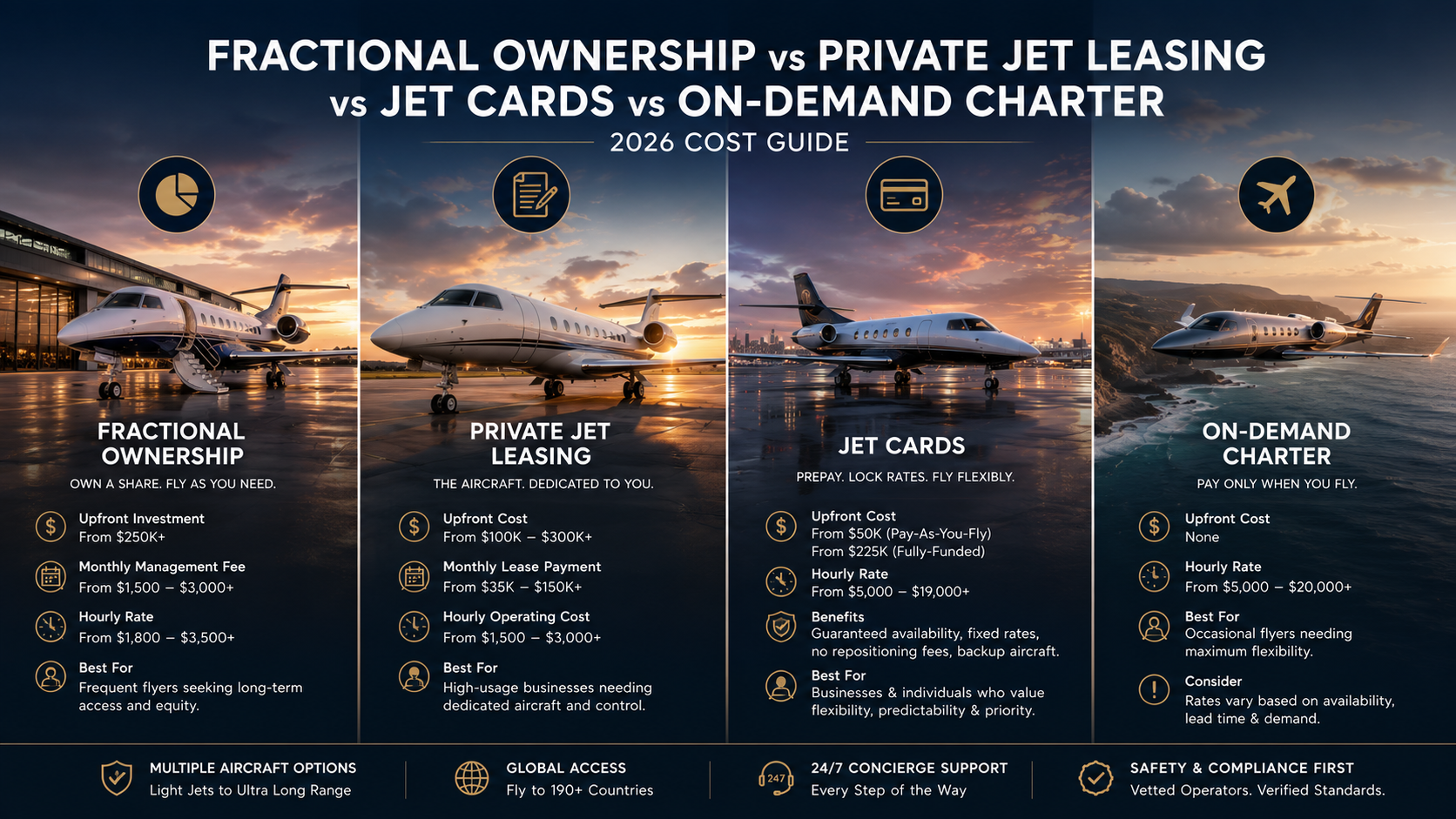
Navigating private jet access models can be complex, with options like fractional ownership, leasing, jet cards, and on-demand charter each offering unique pricing structures. Understanding these models is crucial for making informed decisions based on your flying habits and financial commitments. This guide breaks down the costs and benefits of each option, helping you choose the best fit for your travel needs.
Jay Franco Serevilla
Jul 25, 2026
|
5
min read



View all
In 2026, Jettly revolutionizes private jet travel with real-time flight tracking, providing travelers with live updates on aircraft positions, ETAs, and status notifications. This technology enhances trip planning, allowing for better coordination of ground transport and instant pricing based on current data. With over 20,000 aircraft available, Jettly ensures a seamless and predictable travel experience for its users.
Jay Franco Serevilla
Oct 23, 2026
|
5
min read

View all
Tracking Southwest Airlines arrival flights is crucial for smooth pickups and connections. This guide covers real-time status checks, key terms, and how private jet charters through Jettly offer more control over arrival times. Understanding flight status updates can significantly enhance your travel experience.
Jay Franco Serevilla
Oct 23, 2026
|
5
min read

View all
Flight tracking by tail number allows users to monitor specific aircraft using their unique registration codes. This method is particularly useful in private aviation, where flights often lack public schedules. Jettly utilizes this technology to enhance safety, operational efficiency, and customer communication for charter services.
Jay Franco Serevilla
Oct 23, 2026
|
5
min read

View all
Understanding flight timing is crucial for optimizing private jet travel. This guide covers essential aspects like departure windows, time zones, and how to leverage platforms like Jettly for efficient scheduling. By mastering these details, travelers can significantly reduce wasted time and enhance their overall travel experience.
Jay Franco Serevilla
Oct 23, 2026
|
5
min read

View all
This guide provides an in-depth look at jet fuel types, standards, and performance metrics essential for private jet travelers and aviation professionals. It covers key specifications like flash point, freezing point, and density, which are crucial for aircraft safety and operational efficiency. Understanding these factors helps ensure reliable private jet operations and informed charter decisions.
Jeff Ryan Serevilla
Oct 23, 2026
|
5
min read

View all
Certain aircraft have gained notoriety for their poor safety records, particularly the Fokker F28 and McDonnell Douglas MD-11, which exhibit high hull loss rates. While the Boeing 737 family has the highest total fatalities, this is largely due to its extensive use rather than inherent danger. Understanding these statistics is crucial for travelers assessing aviation safety.
Jeff Ryan Serevilla
Oct 22, 2026
|
5
min read
Explore our latest articles and updates.

5
min read
Range of 777: How Far Each Boeing Variant Can Fly
The Boeing 777 family features an impressive range, from 5,240 nautical miles for the 777-200 to 9,500 nautical miles for the upcoming 777-8. This extensive range allows airlines to operate virtually every long-haul route, making the 777 a staple in commercial aviation. Understanding these capabilities is essential for both travelers and operators in optimizing flight planning.
Read More
5
min read
Capacity of the Boeing 737-800: Seating, Layouts, and Comparisons
The Boeing 737-800 is a versatile aircraft with a seating capacity ranging from 162 to 189 passengers, depending on the airline's configuration. It is widely used for short- to medium-haul flights due to its fuel efficiency and reliability. Understanding its layout options helps travelers set expectations for comfort and plan their journeys effectively.
Read MoreJoin our community and receive the latest blog updates directly in your inbox.
MEMBERSHIPS AND ASSOCIATIONS



Disclaimer: Jettly operates as a charter broker, offering access to a global digital jet charter marketplace. Jettly is not a direct air carrier and does not own or operate aircraft. All advertised flights are conducted by third-party air carriers that are fully licensed and hold the appropriate Part 135 or Part 121 certifications issued by the Federal Aviation Administration (FAA) or equivalent regulatory authorities under U.S. or foreign law. Jettly complies fully with the U.S. Department of Transportation's Part 295 and Part 298 Charter Broker regulations. Jettly does not carry additional liability insurance. Passengers are covered by aircraft operator insurance. TICO: 50023770


