


Login
Get Instant Pricing On 23,000+ Aircraft

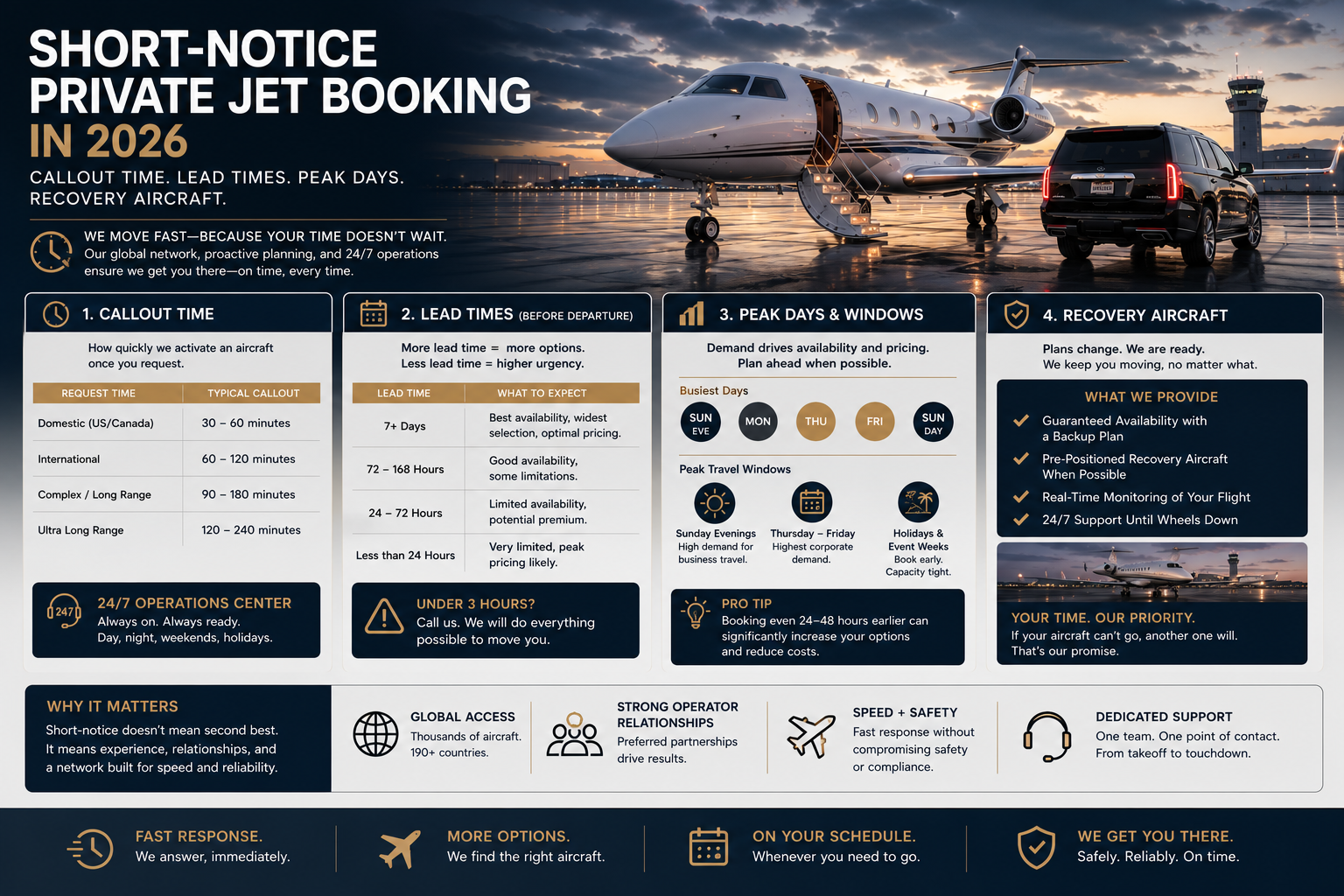
Short-notice private jet booking requires understanding key factors like callout time, lead times, and peak-day rules. While ordinary days may allow flights within hours, peak travel days necessitate longer planning and flexibility. This guide helps you navigate the complexities of private aviation to ensure a smooth booking experience.
Jay Franco Serevilla
Jul 25, 2026
|
5
min read



View all
Witham Field, also known as Martin County Airport (KSUA), is a key hub for private jet travelers in Stuart, Florida, offering convenient access to the Treasure Coast region. The airport features three runways, on-site customs services, and full-service FBOs, making it ideal for both business and leisure aviation needs. Witham Field provides a less congested alternative to larger airports like Palm Beach International, often resulting in faster arrivals and departures for travelers. Jettly facilitates private jet charters to and from Witham Field, enhancing the travel experience with tailored services and quick customs processing.
Jay Franco Serevilla
May 15, 2026
|
5
min read

View all
The Super Bowl significantly boosts private jet travel, with around 1,000 jets arriving in the San Francisco Bay Area for the event, leading to a surge in demand of over 1,100% compared to typical levels. Jettly facilitates this process by offering access to over 20,000 aircraft and coordinating logistics, including airport slot reservations, which are essential due to strict FAA and NFL regulations during the event. Travelers are advised to book their private jets weeks in advance to secure availability and avoid delays, as airports like San Jose Mineta serve as primary hubs. Jettly's platform simplifies the booking process, providing transparent pricing and comprehensive support for a seamless travel experience.
Jay Franco Serevilla
May 15, 2026
|
5
min read

View all
The Dash 8-200 is a twin-engine regional turboprop airliner that seats 37-39 passengers and is designed for short-haul routes, offering improved performance and fuel efficiency compared to its predecessor, the Dash 8-100. With a maximum range of 1,125 nautical miles and the ability to operate from short runways, it is particularly suited for regional airlines and charter operators in remote areas. The aircraft's operational reliability, low operating costs, and flexible cabin configurations make it a popular choice for various missions, including corporate shuttles and emergency transport. Jettly provides charter options for the Dash 8-200, allowing travelers to customize their flight experience with tailored services and competitive pricing.
Jay Franco Serevilla
May 15, 2026
|
5
min read

View all
Powered sailplanes, or motor gliders, combine the aerodynamic efficiency of traditional gliders with onboard propulsion systems, allowing for self-launching and extended flights. They are categorized into sustainer, self-launching, and touring motor gliders, each offering unique performance characteristics and operational flexibility. While powered sailplanes excel in sport and recreational aviation, providing pilots with enhanced safety and independence, they are not as practical for time-sensitive travel compared to private jet charters, which offer speed and comfort. As electric and hybrid technologies advance, powered sailplanes are likely to influence broader trends in private aviation toward lower emissions and improved efficiency.
Jay Franco Serevilla
May 15, 2026
|
5
min read
View all
Powered sailplanes, or motor gliders, combine the aerodynamic efficiency of traditional gliders with onboard propulsion systems, allowing for self-launching and extended flights. They are categorized into sustainer, self-launching, and touring motor gliders, each offering unique performance characteristics and operational flexibility. While powered sailplanes excel in sport and recreational aviation, providing pilots with enhanced safety and independence, they are not as practical for time-sensitive travel compared to private jet charters, which offer speed and comfort. As electric and hybrid technologies advance, powered sailplanes are likely to influence broader trends in private aviation toward lower emissions and improved efficiency.
Jay Franco Serevilla
May 15, 2026
|
5
min read

View all
Kelly Field, located in San Antonio, Texas, is one of the oldest active airfields in the U.S., operating since 1917 and serving as a significant military training and logistics hub through multiple conflicts, including both World Wars and the Cold War. Today, it functions as part of Joint Base San Antonio and Port San Antonio, supporting military readiness and a thriving aerospace industry, with an 11,500-foot runway suitable for heavy cargo and private jets. Private travelers can access Kelly Field through charter services like Jettly, making it a strategic alternative to San Antonio International Airport for business and government-related travel. The airfield's integration with educational and workforce development initiatives further enhances its role in the local economy and aerospace sector.
Jay Franco Serevilla
May 15, 2026
|
5
min read
Explore our latest articles and updates.

5
min read
When to Buy Cheap Plane Tickets: Timing Tips for Commercial and Private Flights
To secure cheap plane tickets, book domestic flights 1 to 3 months in advance and international flights 2 to 6 months ahead, with midweek days like Tuesdays and Wednesdays generally offering the lowest fares. Prices fluctuate due to dynamic pricing algorithms, making the day of booking less significant than the timing of travel; early bookings are crucial for peak seasons and holidays. Private jet travelers can benefit from significant savings through last-minute empty leg flights, while commercial travelers should utilize price alerts and flexible travel dates to find the best deals. Overall, understanding seasonal trends and booking windows is essential for maximizing savings on both commercial and private flights.
Read More
5
min read
When Is the Flight Cheapest? (For Commercial & Private Jet Travel)
Timing is crucial for securing the cheapest flights, whether for commercial or private jet travel. Domestic flights are typically cheaper on Tuesdays and Wednesdays, with the best booking window being 1 to 3 months in advance, while international flights should be booked 2 to 8 months ahead. Private jet travelers can find significant savings by monitoring empty leg flights and being flexible with departure times. Utilizing tools like price alerts and flight comparison platforms, such as Jettly, can further enhance the chances of finding the best deals.
Read MoreJoin our community and receive the latest blog updates directly in your inbox.
MEMBERSHIPS AND ASSOCIATIONS



Disclaimer: Jettly operates as a charter broker, offering access to a global digital jet charter marketplace. Jettly is not a direct air carrier and does not own or operate aircraft. All advertised flights are conducted by third-party air carriers that are fully licensed and hold the appropriate Part 135 or Part 121 certifications issued by the Federal Aviation Administration (FAA) or equivalent regulatory authorities under U.S. or foreign law. Jettly complies fully with the U.S. Department of Transportation's Part 295 and Part 298 Charter Broker regulations. Jettly does not carry additional liability insurance. Passengers are covered by aircraft operator insurance. TICO: 50023770


