


Login
Get Instant Pricing On 23,000+ Aircraft

>

Understanding where to buy jet fuel is essential for aircraft owners, operators, and those involved in private aviation. Jet fuel procurement involves navigating various suppliers, pricing models, and fuel types to ensure reliable and cost-effective refueling. For many private jet travelers, platforms like Jettly simplify this process by including fuel costs in charter pricing, removing the need for direct fuel purchases. This guide explores the key options for buying jet fuel, how pricing works, and how Jettly supports seamless private jet travel without the complexity of fuel logistics.
Jet fuel and other aviation fuels are primarily purchased through Fixed-Base Operators (FBOs) at airports, dedicated fuel suppliers, and contract fuel programs. Prices and availability vary significantly by airport and region, with location-based pricing significantly impacting operational budgets for jet fuel procurement.
This guide covers where to buy jet fuel, how pricing works, and how using Jettly’s on-demand charter platform can remove the need for direct fuel purchasing for many private flyers.
Most charter customers don’t buy fuel directly. When booking a private jet through platforms like Jettly, fuel is bundled into the total charter rate, eliminating separate fuel invoices and logistics.
Aircraft owners and operators purchase fuel at FBOs or through contracts. Flight departments and private owners typically negotiate fuel arrangements through FBO retail purchases, contract fuel programs, or aviation fuel cards.
Common fuel types include Jet A, Jet A-1, and avgas. Jet A is standard in North America, Jet A-1 is widely used internationally, and aviation gasoline (avgas) serves piston-engine aircraft.
Pricing fluctuates based on crude oil, taxes, and local competition. The national average price for Jet A fuel is $7.94 per gallon, though rates at individual FBOs can vary considerably.
This article walks through FBOs, contract programs, fuel cards, major suppliers, and how to estimate costs via Jettly.
Aviation fuel is purchased by a specific set of buyers: commercial airlines, corporate flight departments, charter operators, military and government agencies, and private aircraft owners. Each group approaches fuel procurement differently based on volume, routes, and operational requirements.
Most leisure and business travelers using private jets on-demand—including those booking through Jettly—do not purchase jet fuel directly. Fuel is included in the hourly charter rate or total trip price, so there’s no separate fuel invoice or negotiation required.
If you own or operate an aircraft such as a Cessna Citation, Gulfstream G550, or Pilatus PC-12, you’ll likely buy fuel at FBOs, through contract fuel programs, or using aviation fuel cards tied to volume agreements. Fuel represents one of the highest variable costs in aviation, often accounting for 25–35% of direct operating costs for business jets. This cost is influenced by global crude prices, refining capacity, airport taxes, and local competition among suppliers.
In North America and Europe, fuel uplift is usually arranged through the FBO and billed via the operator’s chosen payment method or contract. In remote regions, operators may need to request fuel 48–72 hours in advance due to limited storage or delivery schedules.
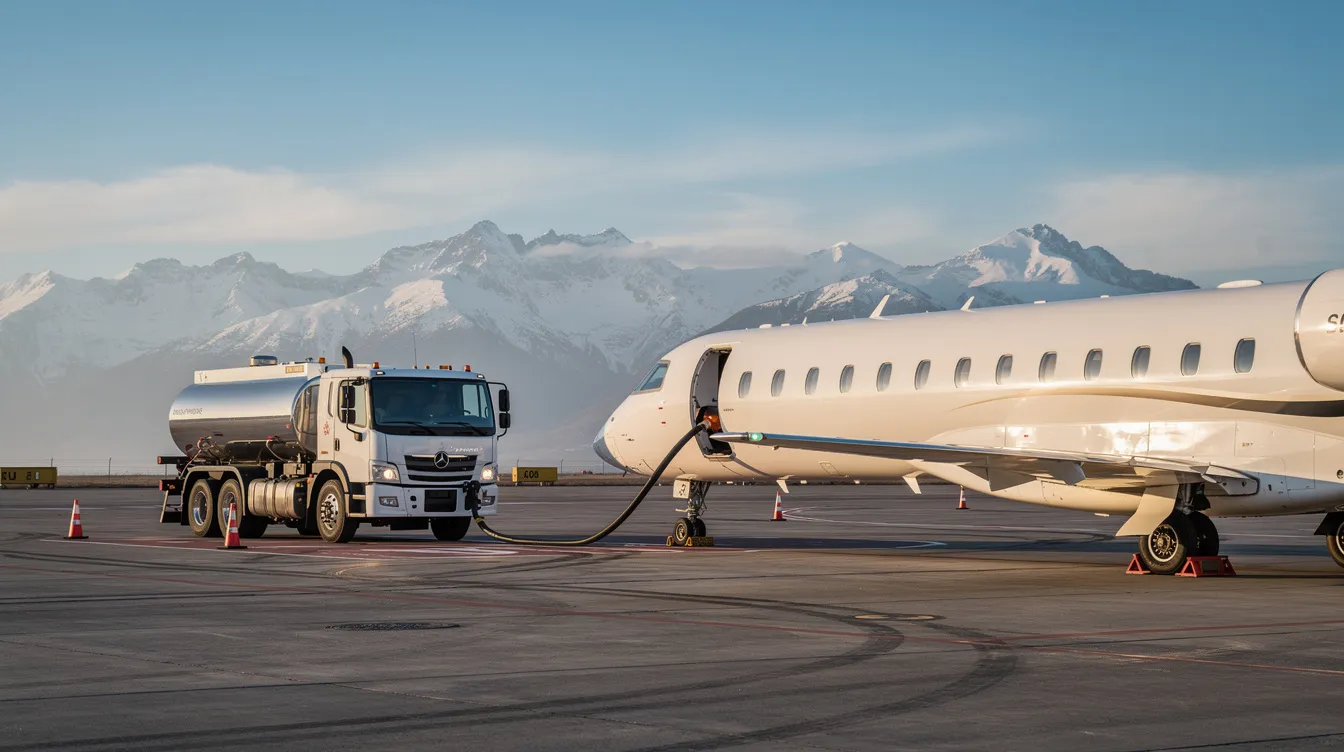
Jet fuel and other aviation fuels are typically purchased through three main channels: FBOs at airports, contract fuel providers, and large integrated fuel companies or distributors. Each channel serves different operational needs and volume requirements.
Fixed-Base Operators (FBOs) are the most common retail touchpoint for general aviation and business jets. Companies like Signature Aviation (with 200+ U.S. locations), Atlantic Aviation, and numerous regional independents provide fueling services at airports across the United States, Canada, and Europe. Aviation fuel suppliers often utilize pipelines, waterways, and tanker trucks for the transportation and delivery of aviation fuels to airports and distribution centers. Pipelines are a prevalent mode for transporting aviation fuel over long distances, facilitating seamless and rapid delivery to airports and distribution centers. Waterways serve as vital routes for transporting aviation fuel to coastal airports and terminals, where it is offloaded and distributed to nearby aviation facilities. Tanker trucks play a crucial role in delivering aviation fuel directly to airports and other aviation facilities, transporting fuel from storage terminals to on-site storage facilities.
At an FBO, buyers can purchase Jet A or avgas directly at posted retail rates, or access lower prices using membership discounts, contract fuel programs, or fuel cards.
Large corporate and commercial operators often contract directly with fuel suppliers and wholesalers—including major oil companies and distributors—for scheduled deliveries and into-plane services at hubs and key stations. These arrangements provide predictable pricing and guaranteed supply.
Military and government operations source jet fuel through dedicated programs such as those managed by the Defense Logistics Agency. DLA Energy provides energy to military services and federal agencies at over 4,000 locations worldwide, managing various petroleum products, including jet fuels and lubricants, in addition to other energy products. The major jet fuels procured by DLA Energy include JP5, JP8, and Jet A1, which are used for military and commercial aviation. JP5 is a high-flash jet fuel specifically used by the U.S. Navy for shipboard operations, while JP8 is a kerosene-based jet fuel comparable to commercial jet fuel. These military channels operate with separate specifications, security procedures, and payment systems distinct from commercial aviation and are trusted for their reliability and quality.
For most small operators and private aircraft owners, the easiest way to buy jet fuel is directly from FBOs at departure and destination airports, using tools like an airport locator platform to identify suitable fields along a route.
The basic process works as follows:
Select an airport along your route
Choose an FBO on the field
Request fuel uplift (e.g., “2,000 lbs of Jet A” for a Bombardier Challenger 350)
Confirm the payment method before or after the flight
Many airports list FBOs and current fuel prices on tools like AirNav, SkyVector, or individual FBO websites. Prices are typically quoted in USD per gallon in North America and in local currency per liter elsewhere. Fixed-Base Operators (FBOs) provide “into-plane” fueling services using fuel trucks or stationary fuel farms, delivering fuel directly to the aircraft on the ramp.
Larger airports like Teterboro (TEB), Van Nuys (VNY), and London Luton (EGGW) often have multiple FBOs competing for business. Buyers can compare prices, handling fees, and services—such as hangar space, de-icing, and crew lounges—when deciding where to uplift fuel. This competition can result in savings of $0.20–$0.50 per gallon compared to single-FBO airports.
Fuel quality is tightly regulated under standards like ASTM D1655 and DEF STAN 91-091. Buyers should still expect documentation of fuel testing, filtration (typically 3–10 micron elements per EI 1529 standards), and traceability to refinery batches, especially for turbine aircraft using Jet A or Jet A-1. Additives may also be injected during fuel loading to enhance performance, address specific operational challenges, and ensure compliance with industry or military requirements.

Contract fuel programs and aviation fuel cards are designed to give operators predictable discounts and simpler billing when buying aviation fuel worldwide, much like structured jet card programs for frequent private flyers.
Contract fuel programs offer discounted rates below standard retail prices for fuel purchases. Typical programs are membership- or usage-based services in which the operator signs up once and can then access negotiated jet fuel prices at participating FBOs and airports. Major providers include CAA (covering 300+ FBOs), Avfuel (9,000+ global locations), and World Fuel Services.
Fuel cards function like charge cards linked to a contract fuel provider. Operators buy fuel using a fuel card to bypass standard retail desk pricing in contract fuel programs. Pilots and dispatchers can pay for jet fuel, avgas, and some services like ground handling without using personal or corporate credit cards.
Key benefits of contract fuel programs:
|
Benefit |
Description |
|---|---|
|
Cost savings |
5–15% off posted retail prices |
|
Consolidated billing |
Single monthly invoice across all locations |
|
Visibility |
Detailed per-leg fuel cost tracking |
|
Reduced admin |
Up to 70% less paperwork according to industry reports |
Smaller operators should compare annual membership fees, discount levels, airport coverage, and any minimum uplift requirements before committing to a particular program. Some providers require a 200–500-gallon minimum to waive ramp fees, and 10–20% of U.S. airports may not participate in certain networks.
Aviation fuels fall into two main categories: jet fuel for turbine engines and aviation gasoline (avgas) for many piston aircraft.
Commercial airlines and most business jets use Jet A or Jet A-1, both kerosene-based fuels meeting stringent specifications. Jet A is standard in North America with a freezing point of -40°C per ASTM D1655. Jet A-1 is a widely used commercial jet fuel that meets the Aviation Fuel Quality Requirements and is commonly used in international aviation, with a lower freezing point of -47°C per DEF STAN 91-091, making it suitable for long-haul routes at high altitudes.
Avgas is a type of aviation fuel specifically designed for small piston engine-powered aircraft, differing from jet fuels used in turbine engines. Common variants include 100LL (100 octane, low lead), used by single-engine and light twin piston aircraft like the Cessna 172, Piper PA-28, and Beechcraft Baron. Avgas typically costs more per gallon than Jet A—often $6–9 versus $4–6—due to lower production volumes and lead content.
Some FBOs, especially at smaller regional airports, may only offer one type of aviation fuel. Operators should confirm the availability of Jet A, Jet A-1, or avgas before planning a fuel stop.
Sustainable aviation fuel (SAF), produced from renewable feedstocks like waste oils and agricultural residues, is increasingly offered at selected major airports and sits alongside a range of jet fuel types such as Jet A and Jet A-1. Available since around 2020, SAF is usually blended up to 50% with conventional jet fuel per ASTM D7566 and priced at a premium.
Jet fuel pricing is dynamic, influenced by global crude oil markets, refining margins, regional supply and demand, and local airport factors like taxes and fees.
Fuel prices for business aviation are typically quoted as a base price plus various surcharges, and understanding the cost to fuel a private jet helps operators budget accurately:
Federal excise tax (19.4¢/gallon in the U.S.)
State and local taxes (up to 30¢/gallon in some states)
Airport throughput fees
FBO handling charges ($0.10–$0.30/gallon)
The national average price for Jet A fuel is $7.94 per gallon, though actual rates at FBOs can range from under $4 at competitive locations to over $8 at remote or island airports. Location-based pricing significantly impacts operational budgets for jet fuel procurement.
|
Factor |
Impact on Price |
|---|---|
|
Multiple FBOs on the field |
Lower prices due to competition |
|
Remote/island location |
Premium of 30–50% above average |
|
Hub airport |
Competitive pricing, volume discounts |
|
Limited storage |
Higher prices, minimum uplifts |
Strategies operators use to manage fuel costs:
Tankering: Uplift extra fuel from cheaper airports where weight and performance allow
Contract discounts: Lock in rates below volatile spot prices
Route optimization: Schedule fuel stops at airports with historically lower prices
Price tracking: Use apps like ForeFlight Fuel Pro or AirNav to compare real-time rates

The best place to buy jet fuel depends on who you are: a private aircraft owner, a corporate flight department, a charter operator, or a traveler using on-demand charter through platforms like Jettly.
For owners of light jets or turboprops, purchasing fuel directly from FBOs at home base and regularly used airports makes the most sense. Many suppliers and FBOs offer an interactive map on their websites, allowing owners to easily locate global distribution networks for aviation fuels and lubricants. Adding a contract fuel program or fuel card provides better rates on cross-country or international trips without complex administration.
Flight departments operating aircraft such as Gulfstream, Bombardier, or Dassault models benefit from combining direct supplier contracts at key hubs with contract fuel programs for outstation coverage. This approach ensures global availability and consistent jet fuel pricing while reducing procurement time and supports better forecasting of overall private jet operating costs.
Fuel is usually integrated into hourly charter pricing, but operators still optimize where they uplift. Smart operators choose airports with lower jet fuel costs near popular routes like New York–Miami or Los Angeles–Las Vegas, improving margins while keeping client quotes competitive, and may also use platforms that crowdsource private jet flights and share empty seats to offset costs further.
Travelers who only charter private jets and do not own aircraft generally do not need to worry about where to buy aviation fuel. Platforms like Jettly present an all-in trip cost that already includes fuel, supported by tools such as a private jet charter cost estimator that factors fuel into the total price and eliminates the need to understand fuel logistics or negotiate with suppliers.
Jettly operates a digital marketplace for private jet charter, connecting travelers with thousands of private charter aircraft worldwide. Fuel is typically included in charter quotes, so customers see a single, transparent trip price rather than separate jet fuel line items.
Jettly’s instant pricing engine factors in the operator’s fuel costs, airport fees, and positioning flights. Whether a Phenom 300 or a Global 7500, the platform’s algorithms pull real-time fuel pricing data and build it into each quote automatically.
For frequent travelers considering aircraft ownership primarily to control costs, using Jettly’s on-demand private jet charter can eliminate the need to manage fuel contracts, negotiate with suppliers, or monitor daily aviation fuel prices, serving as a flexible alternative to fractional models like NetJets. The platform handles the complexity, letting customers focus on schedule, aircraft type, and route.
Jettly works with regulated operators who manage their own fuel purchasing strategies—FBO relationships, contract fuel, SAF availability—so the traveler doesn’t have to. For those who fly regularly, private jet memberships can bundle this expertise and access into a predictable monthly model. This approach saves significant time and administrative burden; some industry estimates suggest fuel management alone can cost owners $10,000+ monthly in staff and oversight time.
Learn more about Jettly’s charter options at https://www.jettly.com
For longer-range flights or routes through remote regions, ensuring jet fuel availability is a critical part of flight planning.
Dispatchers and pilots use airport directories, NOTAMs, and direct FBO communication to verify which aviation fuels (Jet A, Jet A-1, avgas) are available, along with operating hours and advance notice requirements. Tools like SkyVector and FltPlan.com aggregate availability data and flag potential issues, while regional resources such as dedicated pages for private jet charter in cities like Kolkata highlight local airport capabilities and fuel services.
Some smaller airfields or island airports may need 24–72 hours’ notice to confirm a fuel delivery, particularly outside North America and Western Europe. In Alaska, for example, barge-dependent locations may quote $7+ per gallon and require multi-day advance coordination.
Long-range business jets like the Global 7500 or Gulfstream G650ER may choose tech stops at fuel-efficient airports when crossing the North Atlantic or Pacific. Pilots consider runway length, customs services, and jet fuel pricing when selecting stops at locations like Gander (CYQX) or Shannon, just as travelers evaluating affordable aeroplane rental options weigh location and operating costs when planning trips.
Customers using Jettly for charter normally have these logistics handled by the operator and flight planning teams, who build fuel stops into the itinerary where needed.
Growing focus on sustainability in aviation has made fuel choices increasingly relevant to environmental impact.
Sustainable aviation fuel (SAF) is derived from sources like waste oils, agricultural residues, or synthetic processes. It’s designed to reduce lifecycle CO₂ emissions by up to 80% compared with conventional jet fuel. SAF is drop-in compatible, meaning it works in existing jet engines without modification when blended with traditional Jet A or Jet A-1.
Sustainable Aviation Fuel (SAF) focuses on primary European airports or premium US West Coast terminals. Airports in California (SFO, LAX), Scandinavia, and parts of Western Europe currently offer SAF, typically at premiums of $1–3 per gallon above conventional fuel. As of 2026, SAF represents about 0.5% of global jet fuel supply, with industry targets of 10% by 2030.
Operators interested in uplifting SAF should coordinate early with FBOs or fuel suppliers, as availability and price premiums vary widely and may require advance booking.
Many private aviation travelers, including Jettly customers, also explore carbon offset programs and more efficient routing as part of their broader sustainability approach. Jettly offers offset options through verified programs like Gold Standard and emphasizes affordable private jet charter strategies that balance cost with responsible travel.

This section answers common questions about buying jet fuel and how it relates to private jet charter, complementing broader guides on how much a private jet costs overall.
On-demand charter customers almost always see jet fuel included in the quoted trip price, so there’s no separate fuel invoice. In rare cases during periods of extreme price volatility—like the 2022 crude spikes above $120/barrel, explored in depth in analyses of the cost to fuel a private jet—some operators may apply fuel surcharges. However, platforms like Jettly work to provide transparent, all-in pricing that accounts for current fuel market conditions.
Many FBOs allow small uplifts but may charge higher per-gallon prices or additional ramp/handling fees for very small purchases. Some locations publish minimum uplift requirements—often 200–500 gallons—with ramp fees waived above that threshold. Checking with the FBO in advance helps avoid unexpected charges, especially when making brief stops.
Most FBOs accept major credit cards like Visa, Mastercard, and American Express. However, professional operators typically use aviation fuel cards or contract fuel accounts instead. These options offer better rates, consolidated billing, and detailed reporting for fleet management while avoiding the 3% transaction fees common with consumer cards.
Helicopters typically purchase Jet A or Jet A-1 from the same FBOs that serve business jets, as most turbine-powered helicopters use standard jet fuel. Small piston aircraft buy avgas from self-serve pumps or full-service FBOs, depending on the airport’s facilities. Self-serve avgas pumps are common at general aviation airports and often offer savings of $0.50–$1.00 per gallon over full-service options.
Aircraft operators calculate expected fuel burn based on aircraft type, distance, payload, and weather using performance charts and flight planning software. For travelers using Jettly, the process is simpler: request a quote and receive an all-inclusive charter price where the underlying jet fuel cost is already factored in, similar to other modern charter airline and private flight platforms that bundle fuel and fees into a single rate. There’s no need to calculate burn rates or check FBO prices yourself, and resources that explain how to get a seat on a private jet easily can help you choose the most convenient booking route without worrying about fuel logistics.

Jet fuel and other aviation fuels are primarily bought through FBOs, contract fuel programs, and large suppliers. The best purchasing strategy depends on whether you’re an aircraft owner, operator, or charter customer.
Most travelers who use Jettly’s on-demand private jet charter do not need to buy jet fuel directly. Fuel is already built into the charter pricing, simplifying both budgeting and logistics. There’s no need to track daily prices, negotiate with FBOs, or manage fuel cards; those comparing different access models can instead use tools like a jet card flight cost estimator to see how prepaid hours might fit their flying profile.
For aircraft owners and operators, success comes from comparing FBO rates, considering contract fuel programs and fuel cards, and planning fuel stops strategically. The goal is to manage costs without compromising safety or schedule.
Ready to experience private travel on your terms? Explore flight options, estimate trip costs (including fuel), or request a quote at https://www.jettly.com. If you share aviation content or serve high-end travelers, you can also earn commissions through Jettly’s ULTRA high-ticket affiliate program. Let Jettly handle the fuel logistics while you focus on getting where you need to go.
Share this post:
Jay Franco Serevilla
May 15, 2026
|
5
min read
Discover tips and trends in the industry.

5
min read
White Cloud Aviation & Private Charter Around Lake Havasu
White Cloud Aviation in Lake Havasu City offers specialized flight training and private jet charter services, making it an ideal destination for pilots and leisure travelers. With year-round flying conditions and a focus on cloud aviation skills, students can enhance their training while enjoying seamless travel through platforms like Jettly.
Read More
5
min read
BAJ Jets: How Digital Platforms Like Jettly Are Changing Private Jet Travel
BAJ jets, or Book-A-Jet platforms, are revolutionizing private aviation by providing digital access to over 20,000 aircraft worldwide. Platforms like Jettly offer live pricing, transparent quotes, and flexible booking options, making private jet travel more accessible than ever. This article explores how these platforms work, their pricing models, and the overall booking experience.
Read MoreStay updated with our latest insights and tips to elevate your journey with us.
MEMBERSHIPS AND ASSOCIATIONS



Disclaimer: Jettly operates as a charter broker, offering access to a global digital jet charter marketplace. Jettly is not a direct air carrier and does not own or operate aircraft. All advertised flights are conducted by third-party air carriers that are fully licensed and hold the appropriate Part 135 or Part 121 certifications issued by the Federal Aviation Administration (FAA) or equivalent regulatory authorities under U.S. or foreign law. Jettly complies fully with the U.S. Department of Transportation's Part 295 and Part 298 Charter Broker regulations. Jettly does not carry additional liability insurance. Passengers are covered by aircraft operator insurance. TICO: 50023770


