



Login
Get Instant Pricing On 23,000+ Aircraft

>
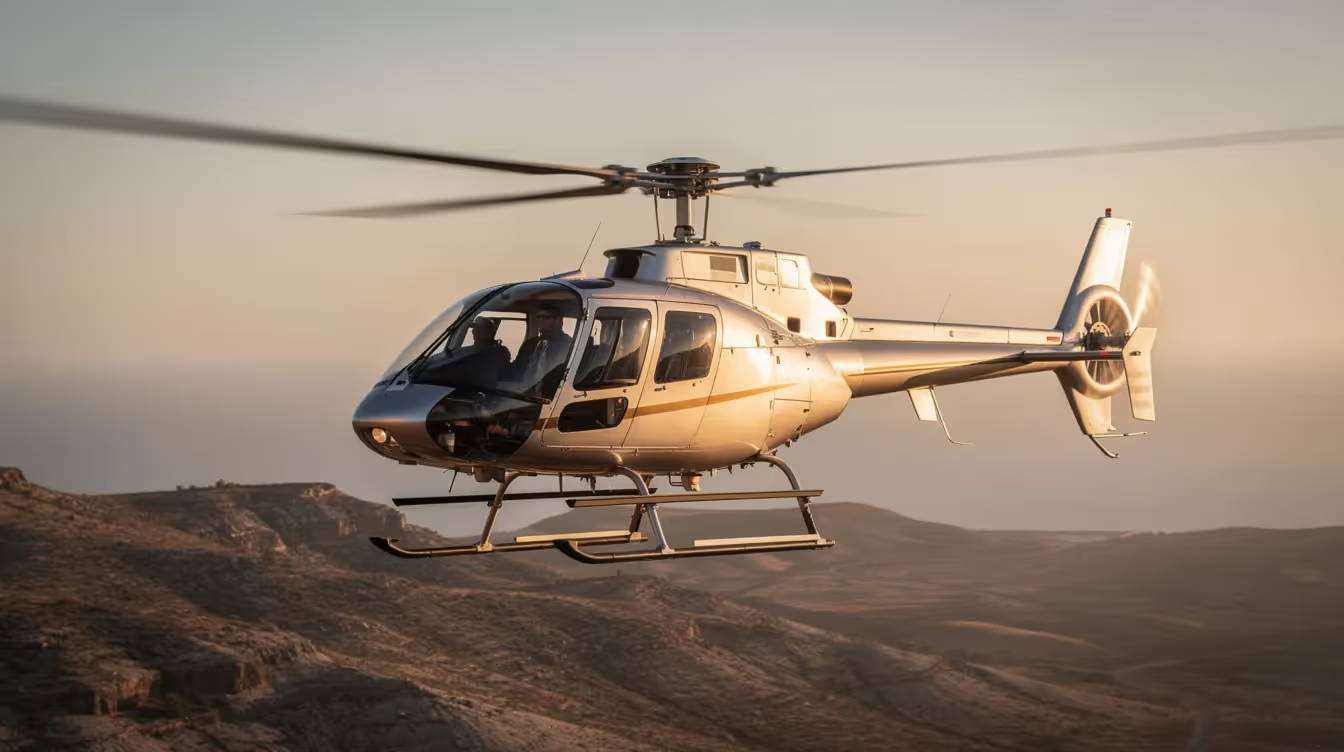
The Robinson R66 represents a practical step into turbine helicopter capability for private travelers, commercial operators, and public safety agencies. As the first turbine-powered helicopter from Robinson Helicopter Company, the R66 marks a significant milestone in the company's product development and expansion into turbine technology. This guide covers the R66's design, performance, operating costs, and mission versatility, providing essential information for private travelers, commercial operators, and public safety agencies considering turbine helicopter options. The R66 matters because it delivers affordable turbine capability and versatility, making turbine-powered flight accessible to a broader range of users. For those exploring helicopter charter without ownership, platforms like Jettly provide access to similar turbine helicopters with transparent pricing and instant digital booking.
The Robinson R66 is a five-seat, single-engine turbine helicopter powered by the Rolls-Royce RR300, with FAA certification granted in October 2010 and over 1,500 units delivered by early 2024.
Core performance includes cruise speeds up to 125 knots, approximately 350 nautical miles range, useful load of around 1,400 pounds, and a service ceiling of approximately 14,000 feet.
The aircraft offers turbine smoothness and reliability at lower purchase and operating costs than many competing turbine helicopters, positioning it as a natural upgrade from piston models like the R44.
Jettly can arrange on-demand charter on turbine helicopters comparable in role and size to the R66, with transparent pricing and instant booking through its digital platform.
The Robinson R66 is a light, single-engine turbine helicopter manufactured by Robinson Helicopter Company in Torrance, California. Robinson began accepting orders for the R66 in February 2010, with full-scale production commencing in 2011. The FAA granted type and production certification on October 25, 2010, marking the company’s first turbine-powered model.
The aircraft seats five—one pilot plus four passengers—in a side-by-side cockpit configuration with a rear bench. A separate cargo compartment accessible externally distinguishes it from earlier Robinson models, providing dedicated space for luggage or equipment.
This compartment can carry up to 300 pounds (140 kg), enhancing the helicopter’s utility for various missions.
The helicopter is powered by the Rolls-Royce RR300 turboshaft engine, derived from the proven RR250 series. This engine delivers 270 shaft horsepower for takeoff and 224 shaft horsepower for continuous operation, enabling the R66 to perform well at high altitudes up to 14,000 feet. The powerplant drives a two-blade main rotor and a two-blade tail rotor, mounted on fixed skid landing gear that keeps weight and maintenance needs low.
Typical missions include private and business transport, sightseeing tours, flight training, utility work like pipeline inspection, and dedicated police variants. The R66 is positioned as a turbine evolution of the piston-engine R44, delivering better performance, payload, and altitude capability for operators ready to step up from piston helicopters.
With its versatile configuration and robust engineering, the R66 provides a strong foundation for further discussion of its design and construction.
The Robinson R66 is constructed from advanced composites, aluminium alloy, and chromoly steel, emphasising its robust build quality and modern design features.
The fuselage utilises aluminium alloy, while high-stress components like the mast and transmission supports are made from chromoly steel, and lightweight composite materials are used in select areas. This hybrid construction balances strength, durability, and weight, resulting in an empty weight of nearly 1,290 pounds, which is lower than the piston-powered R44. This lower empty weight allows for a higher useful load and better fuel efficiency, further enhancing operational cost advantages.
The R66 is designed with a two-bladed semi-rigid main rotor system and a fixed skid landing gear, both contributing to its straightforward maintenance and predictable handling. The helicopter maintains the responsive control feel characteristic of the Robinson line. The symmetrical horizontal stabiliser on the tail boom enhances longitudinal stability, reducing pilot workload during hovers and transitions.
Inside, the cabin measures 58 inches wide with large transparent panels—including an optional impact-resistant windshield tested to withstand 2.2-pound bird strikes at 100 knots. The R66's cabin is narrower than that of the Bell 505, which impacts passenger comfort. The five-seat arrangement prioritises forward visibility and basic soundproofing for passenger comfort.
The separate cargo compartment at the rear holds up to 300 pounds, accessed externally without disturbing passengers. This feature proves valuable for charter operations, training flights carrying equipment, and law-enforcement missions requiring gear storage.
With its robust construction and thoughtful cabin design, the R66 sets the stage for impressive performance, which is detailed in the next section.
The Robinson R66 is powered by a Rolls-Royce RR300 turboshaft engine, which delivers 270 shaft horsepower for takeoff and 224 shaft horsepower for continuous operation. A turboshaft engine, such as the Rolls-Royce RR300 used in the R66, is a type of gas turbine engine optimised to produce shaft power for helicopter rotors.
The Rolls-Royce RR300 turboshaft engine mounts at a 30-degree angle behind the transmission, allowing ground-accessible maintenance. This compact powerplant evolved from the RR250 family with a single-stage centrifugal compressor for simplicity and reliability, with 2,000-hour TBO intervals. The engine uses manual controls without FADEC, requiring pilot monitoring for engine management, which adds a level of pilot engagement in operation.
Power ratings reach up to 300 shaft horsepower maximum, derated to 270 shp for takeoff (five-minute limit) and approximately 224 shp continuous for normal operation.
|
Specification |
Value |
|---|---|
|
Normal cruise speed |
Up to 125 knots |
|
Never-exceed speed (VNE) |
140 knots |
|
Range with reserves |
~350 nautical miles |
|
Endurance |
~3.7 hours |
|
Fuel capacity |
73.6 gallons (~493 lb Jet-A) |
|
Empty weight |
~1,290 lb |
|
Maximum gross weight |
2,700 lb |
|
Useful load |
~1,400 lb |
|
Payload with full fuel |
~920 lb |
|
Climb rate (sea level) |
1,000 ft/min |
|
Service ceiling |
14,000 ft |
The service ceiling and climb performance make the R66 suitable for higher-elevation airports and hot-weather operation, where piston helicopters often struggle. Fuel consumption averages 23 gallons per hour—higher than the R44’s 15 gph of avgas, but offset by smoother turbine operation and lower direct operating costs compared to many legacy turbines. The RR300 engine is designed to result in lower maintenance costs compared to other turbine engines and piston engines, contributing to overall operating cost efficiency.
With its efficient powerplant and strong performance metrics, the R66 is well-suited for a wide range of missions, which are explored in the next section.
The Robinson R66 is utilised in a variety of roles, including law enforcement operations with infrared imaging equipment, utility work with external cargo hook capacity, and private or business travel.
Robinson offers mission-specific configurations of the R66, particularly for public safety and utility roles.
The R66 NxG Police variant comes factory-equipped with a WESCAM MX-10 multi-sensor EO/IR imaging system, SX-7 Starsun searchlight, dual audio controllers, mapping systems, and tactical radios. An all-glass Garmin TXi cockpit integrates engine and systems data, reducing workload during surveillance and patrol missions that can extend to three hours. The R66 is utilised for law enforcement operations with specific equipment such as infrared imaging.
Police configurations typically include cockpit video camera capability, recording systems, and operator consoles supporting traffic monitoring, search-and-rescue coordination, and tactical operations.
Other mission fits include:
External cargo hook kits can be installed for utility work, providing a 1,200 lb capacity for external loads
Corporate or VIP interior packages
Training-optimised layouts
ENG (electronic news gathering) setups with FLIR and searchlight
The platform’s modularity allows operators to serve tourism, charter, training, and specialised missions with relatively straightforward equipment changes. A lithium-ion battery option can be installed to improve cold-weather starting reliability across all variants.
With its adaptable mission configurations, the R66 transitions seamlessly into advanced avionics and safety features, discussed in the following section.
Early R66 models shipped with electromechanical instruments, but later and upgraded aircraft feature optional Garmin G500H or TXi glass cockpit suites. These integrate primary flight display, synthetic vision, moving maps, terrain and traffic alerts via ADS-B, and engine monitoring to enhance situational awareness. Additionally, the newly announced R66 NxG model introduces an all-glass digital cockpit as a modern feature, further advancing avionics capabilities.
Hydraulic flight controls across cyclic, collective, and pedals reduce control forces, easing pilot fatigue during longer flights or demanding manoeuvring. The external power receptacle allows ground-based starting without draining onboard batteries.
Safety-oriented design features include:
Crash-resistant fuel system with a puncture-resistant aluminium enclosure
Energy-absorbing seats and five-point harnesses
Proven two-blade rotor design from the R22/R44 family
FAA Part 27 certification compliance
Many operators enhance safety through strict 100-hour inspection schedules, recurrent pilot training, and optional equipment like two-axis autopilots or stability augmentation systems. The developing next generation of avionics continues to support improved safety margins.
With its advanced avionics and safety features, the R66 offers a secure and modern flying experience, leading to a discussion of its operating costs and ownership considerations.
As of Q2 2024, the list price of the Robinson R66 Turbine is $1,000,000. This positions the R66 well below competitors like the Bell 206B, which costs significantly more. The R66 is designed to be more affordable and cost-effective than comparable helicopters, including the Bell 206B, making it a popular choice for private and business travel.
The annual operating cost for a Robinson R66 helicopter is approximately $299,875. Annual operating costs for active use typically fall in the $250,000–$350,000 range at 300–400 flight hours, though actual figures vary with region, fuel prices, and maintenance programs; prospective charter clients can benchmark these numbers against broader helicopter rental cost guidelines.
|
Cost Category |
Typical Range |
|---|---|
|
Insurance |
$20,000–$30,000/year |
|
Hangar |
$10,000–$20,000/year |
|
Training |
$5,000–$10,000/year |
|
Fuel (at $5/gal) |
$150–$200/hour |
|
Maintenance reserves |
$100–$150/hour |
|
Engine overhaul |
~$100/hour |
Compared to the Bell 505, the R66 often has lower direct operating costs due to its lighter airframe, efficient engine, and simpler two-blade rotor system. The R66 has a lower empty weight than the R44, allowing for a higher useful load and better fuel efficiency, which further enhances its cost advantages, especially for operators comparing different affordable aircraft rental options.
For travellers who want R66-class capability without ownership commitments, Jettly arranges on-demand charters on turbine helicopters and other private charter aircraft. This approach eliminates maintenance planning, crew management, and capital requirements while providing flexible access for business travel, aerial tours, or point-to-point transfers.

With a clear understanding of costs and charter options, let's explore how the R66 is used in real-world scenarios.
The R66 serves as a versatile bridge between entry-level piston helicopters and larger, more complex turbine models.
Short-haul transfers between regional cities
Airport-to-destination connections (e.g., NYC heliports to Hamptons resorts in 30 minutes versus two-hour drives)
Same-day multi-stop itineraries for executive site visits
Family transfers to remote vacation properties
Operators planning sightseeing, utility, or shuttle services can leverage tools like Jettly’s airport locator and charter platform to identify suitable departure points and landing sites for R66-class helicopters.
Sightseeing tours with high cabin visibility (Niagara Falls, coastal flights)
Aerial photography and video production
Pipeline patrol and powerline inspection
Environmental surveys
Urban patrol and traffic monitoring
Search-and-rescue coordination
Tactical surveillance with MX-10 imaging systems
A practical scenario: A corporate team flies from a major city airport to an inland manufacturing facility—60 nautical miles, taking 30 minutes by R66 versus 90 minutes by ground transport. Fly Karoo Air in South Africa received Robinson’s 12,000th helicopter (an R66) in 2017 for regional safari charter and tour operations.
Robinson announced it had sold 700 R66S by December 2015, and as of early 2024, this number had increased to 1,500.
Jettly users can access similar turbine helicopters on a per-mission basis, with instant digital quotes and transparent pricing powered by a private jet charter cost estimator that makes helicopter travel competitive with multi-hour drives.
With these diverse use cases, the R66 demonstrates its flexibility and value across multiple sectors, setting the stage for a comparison with other helicopter types.
Many owners and charter customers view the R66 as a logical upgrade from the piston-powered R44 and a cost-focused alternative to legacy turbine models, especially when stepping up from more budget-friendly aircraft choices.
|
Specification |
R66 |
R44 |
|---|---|---|
|
Continuous power |
224 shp |
205 hp |
|
Cruise speed |
120 knots |
109 knots |
|
Useful load |
~1,400 lb |
~1,000 lb |
|
Fuel consumption |
23 gph |
15 gph |
|
New price |
~$879,000 |
~$440,000 |
Compared to the Bell 206B JetRanger, the R66 offers a lighter airframe (1,290 lb vs 1,500 lb empty weight), lower acquisition cost, and approximately 20% lower direct operating costs. The simpler two-blade rotor requires less maintenance than Bell’s four-blade system.
Passenger benefits include turbine smoothness, the dedicated baggage hold, and a wider cabin feel. The flexible configuration options and modern Rolls-Royce engine contribute to reliable performance across varying conditions.
Jettly enables side-by-side comparison of different helicopter types—piston, turbine, smaller and larger models—helping users select the best fit for each mission based on price, range, and cabin size, and also provides guidance on affordable private jet charter pricing.
With these comparisons, the R66’s position in the market becomes clear, leading to a discussion of environmental and operational considerations.
Turbine helicopters like the R66 burn Jet-A fuel and produce emissions, driving operators toward efficiency-focused practices.
The RR300 represents a modern, efficient small turbine with improved fuel consumption and maintenance intervals compared to older engines in its class. Its compact single-stage compressor design contributes to both reliability and efficiency.
Operational practices that improve environmental performance include cost- and route-optimisation strategies similar to those used in managing single private flight costs:
Careful route planning to minimise flight time
Flying at economical cruise power settings (100–110 knots)
Maximising passengers per flight when possible
Multi-stop itineraries that reduce total flight hours
Some charter providers participate in carbon-offset programs through organisations like NBAA or IBAC. Jettly users can inquire about offset options or compare efficient aircraft choices when booking, aligning with rising ESG awareness in the industry, while also following best practices for renting an aircraft for private travel.
With environmental and operational factors in mind, the next section explains how to access R66-class helicopters through Jettly.

Jettly operates as a digital private aviation marketplace connecting customers with a global network of aircraft, including light turbine helicopters comparable in capability to the R66, and also offers an ULTRA high-ticket affiliate program for partners referring new flyers.
Travellers use the platform to request on-demand helicopter charters or even participate in crowdsourced private flights with shared seats for:
Point-to-point business transfers
Airport connections to remote destinations
Sightseeing flights in regions where fixed-wing aircraft cannot land
The process is straightforward: enter route and dates, view instant pricing where available, compare helicopter options by size, range, and hourly cost, then confirm booking and payment through the platform or through flexible private jet membership plans.
Jettly’s transparent pricing model eliminates long-term ownership commitments while providing the flexibility to choose the right aircraft for each trip, positioning it as a compelling NetJets alternative for private flying. Users are not locked into a single helicopter type or operator.
Ready to explore helicopter travel on your terms? Learn more about Jettly’s charter options and request a quote at https://www.jettly.com, ensuring you work with properly certified Part 135 charter operators through vetted partners like Dexter Air Taxi and other providers. For additional information about the Robinson R66, such as operating costs or technical specifications, please contact us.
With access options clarified, the following section addresses common questions about the R66.
The R66’s five-seat cabin, large windows, and relatively smooth turbine operation make it a comfortable entry point for first-time helicopter passengers. The turbine powerplant produces less vibration than piston engines, and the spacious 58-inch cabin width provides adequate room without feeling cramped.
Safety and comfort depend heavily on operator standards and pilot experience. Reputable charter providers match aircraft and routes to passenger expectations, whether booking a whole helicopter or a single seat. Jettly users can explore options similar to buying a seat on a private jet and discuss concerns about flight duration, turbulence expectations, and seating layout with the charter team before confirming a booking.
Like all light helicopters, the R66 is sensitive to weather—particularly strong winds above 25 knots, low visibility below 1,000-foot ceilings, icing conditions, and thunderstorms. Most R66 operations are conducted under visual flight rules (VFR).
Operators use weather forecasts, regulatory minima, and company policies to determine whether a planned flight can depart safely, may need a delay, or should be cancelled. Jettly users booking helicopters should allow 1–2 hours of flexibility during seasons with rapidly changing weather, especially in mountainous or coastal regions, and can also coordinate premium onboard dining through Jettly’s in-flight catering service.
The separate cargo compartment on the R66 accommodates 300 pounds—equivalent to three or four soft-sided bags or small suitcases. Exact limits depend on passenger count and fuel load, as total payload with full fuel runs approximately 920 pounds.
Soft bags are preferred over rigid cases to maximise available space and simplify loading. When booking via Jettly, passengers should share the number of travellers and approximate baggage weight to ensure the selected helicopter—or an alternative such as the Eurocopter EC30 light utility helicopter—can safely accommodate everything.
Many R66 aircraft are equipped and certified for night visual flight rules (VFR) operations, with position lights, anti-collision lighting, and optional night vision goggle (NVG) compatibility in police variants.
Most R66S in service are not equipped for full IFR operations like larger twin-engine helicopters, so bad-weather flexibility remains limited. Travellers needing higher dispatch reliability in poor weather can ask Jettly about alternate aircraft types with enhanced avionics or twin-engine capability.
Lead time can range from same-day arrangements on lower-demand routes to several days or weeks for peak travel periods. Weekends, holidays, and major events near cities and resorts typically see higher demand, so using tools like a jet card flight cost estimator can help travellers plan budgets for future trips.
Booking as early as possible improves options and availability. Jettly’s digital platform allows users to check availability and pricing quickly, making it easier to secure an appropriate turbine helicopter for desired dates and times or to combine helicopter use with jet card program benefits for fixed-rate private flying.
With these answers, prospective travellers and operators can make informed decisions about the R66.
The Robinson R66 stands out as an affordable, reliable, and versatile light turbine helicopter suitable for a range of missions from private travel to law enforcement. Its combination of performance, cost-efficiency, and modern features makes it a popular choice for operators stepping up from piston helicopters or seeking turbine capability without excessive complexity. For travellers and businesses seeking flexible access to R66-class helicopters without ownership, Jettly offers a seamless digital platform for on-demand charter. With transparent pricing, instant booking, and a wide network of vetted operators, Jettly simplifies private helicopter travel, making turbine-powered flight accessible and convenient. Ready to experience the benefits of turbine helicopter travel? Explore available flights or request a quote today at https://jettly.com.
Share this post:
Jay Franco Serevilla
Apr 16, 2026
|
5
min read
Discover tips and trends in the industry.

5
min read
Helidosa Aviation Group: Private Jet Charter, Safety Insights, and Alternatives
Helidosa Aviation Group is a leading private aviation operator in the Dominican Republic, offering a range of services including private jet charters and helicopter tours. Established in 1992, the company has expanded its fleet and services to cater to leisure and business travelers across the Caribbean and Americas. While Helidosa boasts a strong safety record, it has faced incidents that travelers should consider when booking.
Read More
5
min read
Jet Number: How Private Jet Tail Numbers, Registration, and Tracking Really Work
Every private jet has a unique jet number, also known as a tail number, which serves as its identification in the aviation world. This alphanumeric code is crucial for air traffic control, legal records, and flight tracking, ensuring safety and compliance. Understanding jet numbers can enhance the private jet booking experience, providing travelers with essential information about the aircraft.
Read MoreStay updated with our latest insights and tips to elevate your journey with us.
MEMBERSHIPS AND ASSOCIATIONS



Disclaimer: Jettly operates as a charter broker, offering access to a global digital jet charter marketplace. Jettly is not a direct air carrier and does not own or operate aircraft. All advertised flights are conducted by third-party air carriers that are fully licensed and hold the appropriate Part 135 or Part 121 certifications issued by the Federal Aviation Administration (FAA) or equivalent regulatory authorities under U.S. or foreign law. Jettly complies fully with the U.S. Department of Transportation's Part 295 and Part 298 Charter Broker regulations. Jettly does not carry additional liability insurance. Passengers are covered by aircraft operator insurance. TICO: 50023770


