


Login
Get Instant Pricing On 23,000+ Aircraft

>
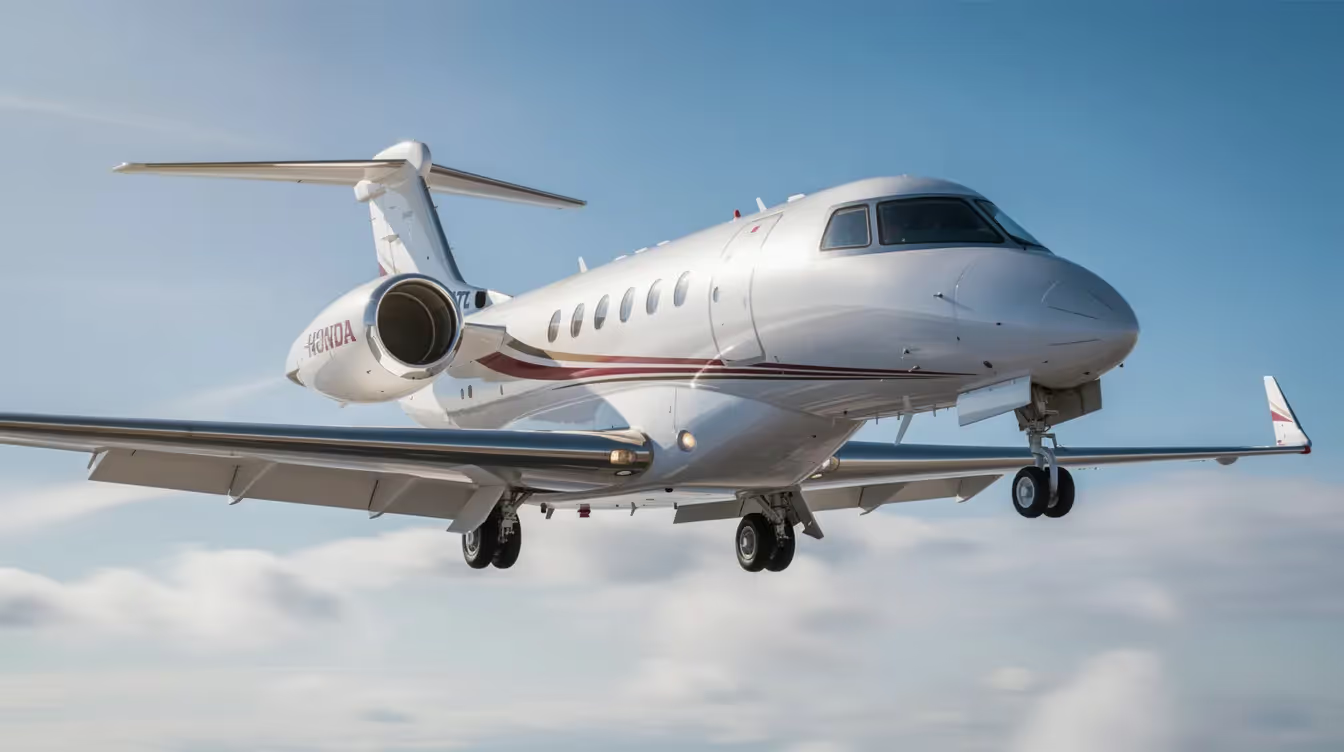
This article provides a comprehensive overview of HondaJet pricing, including both new and pre-owned models, and explores the full spectrum of ownership costs, such as acquisition, operating expenses, and depreciation. It also compares these costs to charter alternatives, helping prospective buyers and charter customers make informed decisions. Understanding the true cost of HondaJet ownership versus chartering is essential for anyone considering private jet travel, as it impacts budgeting, flexibility, and long-term value.
The price of Honda jet aircraft in 2025–2026 generally ranges from about $2.5 million for early used HA 420 models to $5 million+ for HondaJet Elite and Elite S aircraft; new HondaJet Elite II pricing is commonly discussed in the mid- to high-$6 million range, before options.
Current listings for HondaJet aircraft range from $2,525,000 to $4,650,000, with the Elite II models commanding premium pricing for the latest technology. The average pricing for HondaJet aircraft on the market is approximately $3,723,333, reflecting strong demand in the very light jet segment.
Ownership cost is more than the purchase price. Fixed costs, variable costs, and operating costs, financing, maintenance, insurance, and depreciation can push the annual budget to $500,000–$1,200,000+.
The Hondajet, produced by Honda Aircraft Company, is a very light jet / light jet with strong cruise speed, fuel efficiency, and efficient engines, but it still requires a sizable operating budget.
For many passengers who fly under 150–200 hours per year, chartering through Jettly can be more flexible than buying a private jet.

“Honda Jet” usually refers to the HA-420 family built by Honda Aircraft Company, including the original Honda Jet, HondaJet Classic, HondaJet Elite, Elite S, and HondaJet Elite II. This guide explains the price of Honda jet aircraft, including acquisition cost, operating costs, and charter alternatives.
Used early HA-420 aircraft often trade around $2.3M–$3.2M, depending on year, total flight hours, maintenance status, and condition. Later HondaJet Elite aircraft can sit around $3M–$4.8M+, while Elite S and Elite II examples command higher prices.
The price of a HondaJet typically ranges from $2.5 million to $13 million, depending on the model and specifications. Factory premium options can increase the overall base price of the aircraft, and expensive optional upgrades, such as enhanced cockpit features, can significantly increase the price of new deliveries.
Prices also move with market demand, total time, avionics upgrades such as Hondajet APMG, and enrollment in engine maintenance plans. Jettly is not an aircraft sales company; it helps travelers access charter aircraft without buying one.
Honda Aircraft Company is a Honda Motor Co. subsidiary based in Greensboro, North Carolina. The company developed the HA-420 as a production model twin-turbine business jet, with FAA type certificate approval and first delivery following certification of the line.
The family evolved in stages:
|
Variant |
Market role |
|---|---|
|
Original HA-420 |
Early, very light business jet |
|
Hondajet APMG |
advanced performance modification group upgrade |
|
HondaJet Elite |
Improved avionics, range, and cabin refinements |
|
HondaJet Elite S |
Higher capability and updated systems |
|
HondaJet Elite II |
Latest certified model with extended range |
The HondaJet features an over-the-wing engine mount (OTWEM) configuration, which reduces aerodynamic interference drag by approximately 15-20%, allowing for improved performance and cabin space. Its composite fuselage, aft fuselage engine placement, wing design, and GE Honda HF120 engines help explain its efficiency.
The HondaJet Elite II has a maximum range of 1,547 nautical miles (2,865 km) and a maximum cruise speed of 422 knots (782 km/h). The HondaJet Elite II is certified for single-pilot operations, making it accessible for owner-operators transitioning from high-performance piston aircraft.
In the news, Honda Aircraft Company updates, Honda announced improvements such as increased range, increased fuel capacity, and avionics enhancements across later models.
Purchase price is the largest single line item, but buyers usually model the total cost of ownership over 5–10 years.
Approximate 2025–2026 market ranges:
Pre-owned early HA-420 HondaJet: low- to mid-$2M range.
Later HA-420 and HondaJet Elite: often $3M–$4M+.
HondaJet Elite S and Elite II: commonly mid-$4M to $6M+ used, with new Elite II aircraft typically above that range.
Acquisition costs for a HondaJet are estimated to be between $5 million and $6 million, with annual fixed costs around $200,000, though real owner budgets vary widely.
Aircraft value depreciates based on usage, with high flight hours negatively impacting value. Total flight hours and the number of takeoffs and landings heavily affect aircraft valuation. Market depreciation rates vary based on flight hours and market conditions, and private jet valuations are highly sensitive to market dynamics and specific aircraft conditions.
Early-generation HondaJets can lose up to half of their value within the first 5 years. Being on a dedicated Engine Maintenance Program can increase resale value by covering future overhauls, and enrollment in engine maintenance plans significantly impacts an aircraft’s value.
Demand for light jets rose after COVID-19 as more business travelers shifted away from commercial aviation, pushing used prices higher in 2021–2023 before some normalization. A listed sale price may differ from the final transaction value, especially when brokers, lenders, and pre-buy inspections are involved.
For travelers who want private travel, not an asset to sell later, Jettly can be a cleaner option, especially after understanding how much a private jet really costs.
Honda jet specifications matter because range, fuel burn, cruise speed, cabin layout, and runway performance affect both value and operating economics.
|
Specification |
Value/Description |
|---|---|
|
Seating |
Usually 4–5 passengers, with a single pilot option |
|
Range |
About 1,200+ NM for earlier aircraft and 1,547 NM for Elite II |
|
Cruise Speed |
422 knots maximum cruise speed on Elite II |
|
Altitude |
Up to FL430 for smoother cruise and better fuel efficiency |
|
Cabin |
Compact but efficient cabin space, enclosed lavatory on many configurations, rear baggage space, and a practical seat layout |
|
Runway |
Takeoff distance and landing distance vary by weight, weather, and airport elevation |
|
Engine Fuel Burn |
The twin GE Honda HF120 engines consume roughly 112 to 120 gallons of Jet-A per hour. The GE Honda HF120 engines used in the HondaJet burn approximately 96 gallons of fuel per hour at typical cruise settings, providing competitive efficiency compared to other very light jets. |
That fuel profile helps on 300–800 NM missions where the aircraft can climb, cruise, and land efficiently. Upgrades such as the advanced performance modification group package can improve payload, handling, and avionics, raising market appeal for older aircraft.
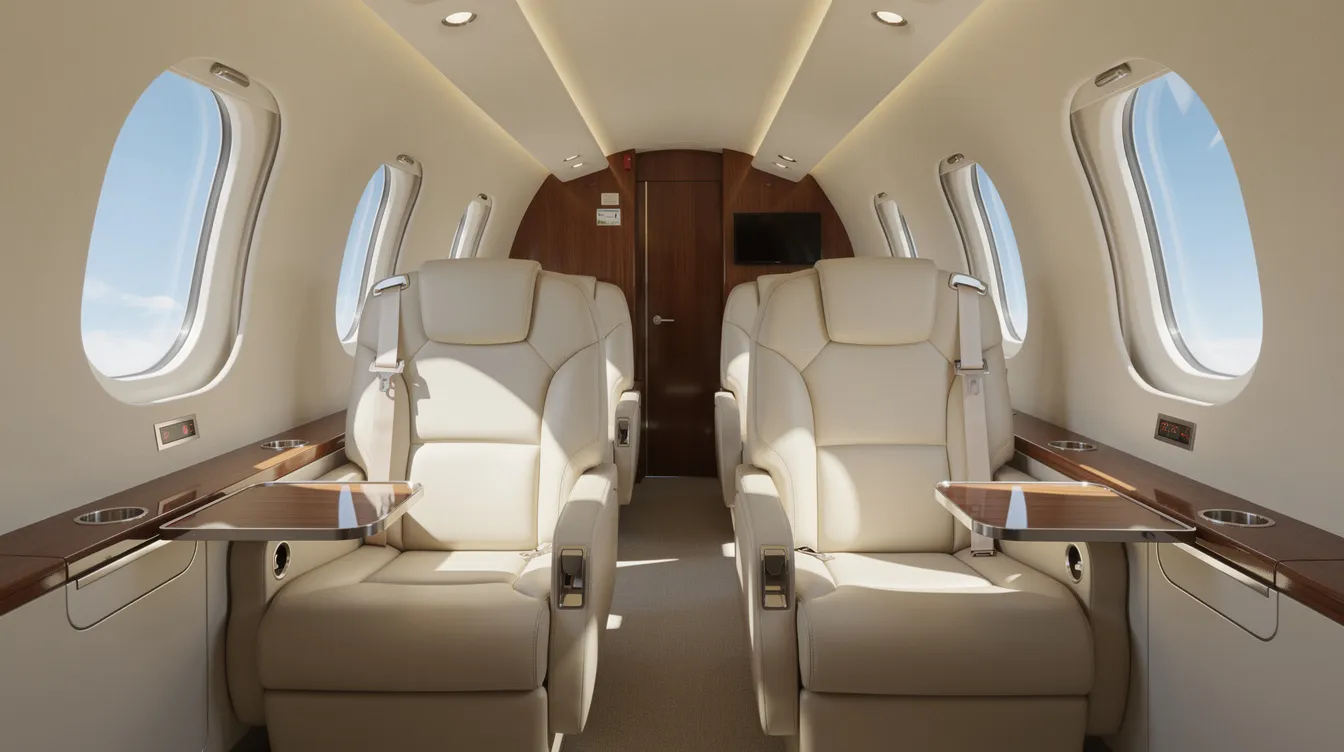
A realistic annual budget includes fixed costs and variable costs. Buyers often model 200–400 flight hours per year, while prospective charter customers can use a private jet charter cost estimator to benchmark trip-based pricing against ownership.
Annual fixed costs for operating a HondaJet can range from $550,000 to $900,000 before flying, which is manageable for owner-operators or small corporate flight departments. Other estimates put annual fixed costs closer to $200,000–$250,000 for lean owner-operated models, so assumptions matter.
Common fixed costs include:
Hangar or parking at the home base
Hull and liability insurance
Crew pay and training if not flown single-pilot
Navigation databases, charts, and service subscriptions
Scheduled maintenance program fees
Variable costs include:
Fuel based on Jet-A prices and mission length
Maintenance labor and parts per flight hour
Engine and airframe reserves
Landing, handling, and repositioning fees
Operating costs for the HondaJet range from $1,200 to $1,600 per flight hour, which includes fuel, crew, maintenance reserves, insurance, and hangar costs. At 150–200 hours per year, total cash cost may reach $500,000–$800,000. At 350–400 hours, total fixed costs spread across more hours, but total annual outlay may exceed $900,000.
Depreciation and financing can add hundreds of thousands per year. For a traveler flying 50–150 hours annually, charter through Jettly avoids a fixed annual budget and long-term maintenance exposure.
Direct operating cost per hour is useful when comparing a Honda Jet with another jet, turboprop, or light jet.
A simplified per-hour view:
|
Cost item |
Typical driver |
|---|---|
|
Fuel |
Jet-A price, climb time, cruise profile |
|
Maintenance |
Inspections, parts, labor |
|
Engine reserves |
GE Honda HF120 program coverage |
|
Fees |
Landing, handling, parking |
|
Crew |
Salary allocation or contract pilot cost |
Short flights under 300 NM often have a higher effective cost because takeoff and climb burn more fuel relative to cruise. Longer legs make better use of the aircraft’s cruise efficiency.
Charter customers using Jettly see many operating variables bundled into one quote, and Jettly also highlights affordable private jet charter strategies for travelers focused on managing total trip spend. That helps compare a 40-hour, 100-hour, or 250-hour annual travel pattern against ownership.
Many business travelers compare the price of a Honda jet aircraft with the simpler cost of chartering similar aircraft.
For flyers under 150–200 hours per year, charter is often more cost-effective because there is no purchase price, depreciation, hangar, crew hiring, or maintenance scheduling. For flyers above 250–300 hours per year, ownership, fractional access, or a managed aircraft arrangement may become more competitive, though some still prefer a NetJets alternative in Jettly to avoid long-term commitments.
Jettly gives access to Honda Jet aircraft where available, plus comparable very light jets and light jets across a global network of private charter aircraft. Travelers can choose a light jet for New York–Chicago, a midsize jet for Toronto–Vancouver, or a larger aircraft for regional routes like private jet charter to Chennai in Tamil Nadu and longer international transport.
A company flying two or three monthly trips between Los Angeles and San Francisco may want HondaJet-level convenience without tying up $3M–$6M in one airframe. Charter makes that possible, while preserving flexibility if the next trip needs more cabin space, more range, or more passengers.
Former operators, such as jet, helped show demand for accessible HondaJet travel, but a wide range of charter airlines and private operators on modern marketplaces now give many flyers a broader choice of operators and aircraft.

Jettly is a digital private jet charter marketplace, not an aircraft dealer. The platform provides on-demand flights, instant pricing, and access to a large global fleet of private charter aircraft.
Through Jettly, customers can request a HondaJet or comparable aircraft for suitable routes such as Toronto–New York, London–Geneva, and Los Angeles–Las Vegas. Quotes can show aircraft type, estimated flight time, and total cost before booking, and tools like an airport locator for private jets help match the right aircraft to the right airfields.
Customers can book online or with support, then adjust departure times, catering, and ground transportation. Some choose a pay-as-you-go charter. Others use private jet memberships for added convenience instead of traditional jet cards or fractional programs.
Jettly works with licensed operators that comply with regional aviation regulations, similar to Part 135 charter companies and other regulated operators. Safety history, pilot experience, aircraft maintenance status, and operator oversight are important selection factors.
Learn more about the best private jet charter companies and how Jettly compares, or explore Jettly’s charter options at https://www.jettly.com.
A new Honda Jet Elite II offers the latest avionics, warranty coverage, increased range, and updated safety features. A pre-owned HA-420 or HondaJet Elite can be less expensive upfront, but buyers must review maintenance history, engine program status, and upgrade records carefully.
Like many business jets, Honda aircraft often see the steepest depreciation in the first 5–7 years. Usage, market demand, maintenance programs, and newer models like Elite II all affect resale prices.
Yes. Aviation lenders may finance HondaJet purchases with multi-year terms, depending on borrower profile and aircraft age. Interest increases total ownership cost, which is why some travelers avoid aircraft debt and use Jettly charter instead, sometimes comparing against jet card flight cost estimates to see if prepaid hours make sense.
The Elite II is a very light business jet with competitive speed, efficient engines, and strong regional range. Buyers should compare purchase price, hourly operating cost, cabin space, baggage space, resale outlook, and mission length before choosing between aircraft, and some frequent flyers will weigh full ownership against jet card programs for private jets.
Usually, no. If annual flying is limited, the fixed costs and capital commitment are difficult to justify. Travelers who care more about the trip than the asset can explore HondaJet-class charter, including crowdsourced private jet flights and shared empty seats, and instant quotes through Jettly at https://www.jettly.com.
The price of the Honda jet aircraft is only the starting point. Purchase price, fuel, maintenance, crew, insurance, depreciation, and financing all shape the real cost of ownership.
For frequent operators, a HondaJet can be a capable and efficient business aircraft. For many travelers, Jettly offers a practical way to fly in HondaJet-level comfort without owning the jet.
Ready to experience private travel on your terms? Explore flight options or request a quote at https://www.jettly.com.
Share this post:
Jay Franco Serevilla
May 20, 2026
|
5
min read
Discover tips and trends in the industry.
5
min read
Priceline Plane Ticket: How It Works, What It Costs, and When Private Charter Makes More Sense
Priceline plane tickets offer affordable commercial flight options through an online travel agency, making them popular among budget-conscious travelers. However, they come with trade-offs such as rigid change policies and nonrefundable fares. For those prioritizing time and flexibility, private jet charters via Jettly present a compelling alternative, providing tailored travel experiences.
Read More
5
min read
Cheap Time to Fly to Europe: How to Find Cheap Flights, Routes, and Travel Windows
Finding the cheapest time to fly to Europe involves understanding seasonal patterns and booking strategies. January through early March offers the best deals, with midweek flights being more affordable. Utilizing flexible dates and comparing commercial flights with private jet options can significantly reduce travel costs.
Read MoreStay updated with our latest insights and tips to elevate your journey with us.
MEMBERSHIPS AND ASSOCIATIONS



Disclaimer: Jettly operates as a charter broker, offering access to a global digital jet charter marketplace. Jettly is not a direct air carrier and does not own or operate aircraft. All advertised flights are conducted by third-party air carriers that are fully licensed and hold the appropriate Part 135 or Part 121 certifications issued by the Federal Aviation Administration (FAA) or equivalent regulatory authorities under U.S. or foreign law. Jettly complies fully with the U.S. Department of Transportation's Part 295 and Part 298 Charter Broker regulations. Jettly does not carry additional liability insurance. Passengers are covered by aircraft operator insurance. TICO: 50023770


