



Login
Get Instant Pricing On 23,000+ Aircraft

>
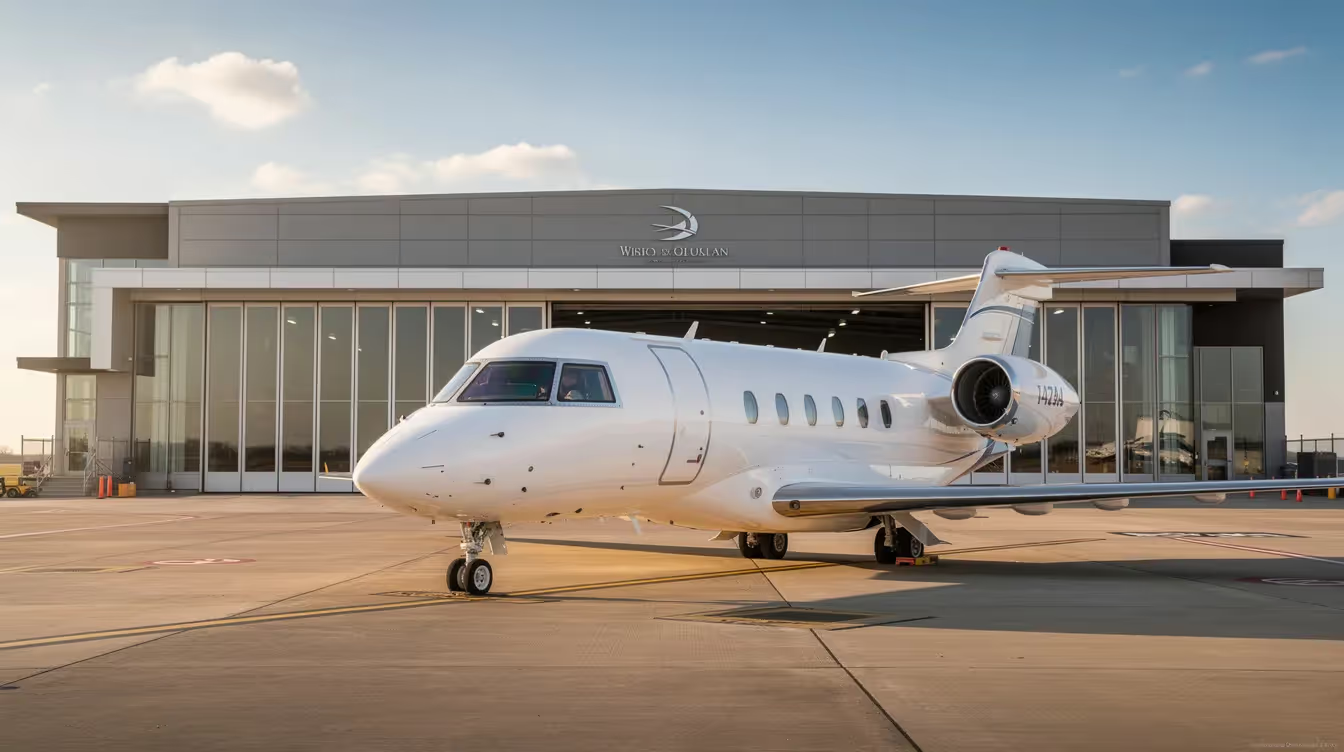
The operating cost of a private jet includes all ongoing expenses necessary to keep the aircraft ready and available, separate from the initial purchase price. These costs can vary dramatically based on jet size, usage, and ownership versus chartering approach.
– Operating costs are split into fixed (crew, hangar, insurance) and variable (fuel, maintenance, landing fees) categories.
– Annual operating costs range from $500,000–$1 million for light jets and $2–4 million+ for large or long-range jets.
– Fuel is the single largest variable cost, typically 25–35% of total operating expenses.
– Chartering with platforms like Jettly allows travelers to pay only for trips taken, avoiding year-round fixed ownership costs.
– For those flying under 200–300 hours per year, on-demand charter is generally more cost-effective than ownership.
The operating cost of a private jet encompasses every ongoing expense required to keep an aircraft flight-ready and available. This figure is entirely separate from the initial purchase price, which can range from $2 million for pre-owned aircraft in the very light jet category to over $90 million for new ultra-long range aircraft.
This guide is designed for prospective private jet owners, frequent charter travelers, and business executives seeking to understand the true costs of private aviation and make informed decisions. Understanding the operating costs of a private jet is crucial for anyone considering ownership or frequent charter use, as these expenses can significantly impact your overall travel budget, investment strategy, and long-term financial planning. By gaining a clear picture of both fixed and variable costs, you can determine the most cost-effective approach to private aviation—whether that means purchasing an aircraft, joining a membership program, or relying on on-demand charter services.
Annual operating expenses vary significantly by aircraft type. Very light jets typically have hourly operating costs ranging from $700 to $1,800, with the Cirrus Vision SF50 being one of the most economical at approximately $661.53 per hour. Light and midsize jets generally incur operating costs between $1,800 and $3,200 per hour, making them popular choices for business and personal travel. Light jets typically cost $500,000–$1 million per year, midsize jets run $800,000–$1.5 million, and heavy or ultra long-range aircraft reach $2–4 million+ annually—assuming 200–400 flight hours.
Fuel expenses are the largest variable cost in private aviation, typically making up 25–35% of total operating costs. Over a typical ownership period, these ongoing costs can rival or exceed the original aircraft price. A $10 million midsize jet costing $1.2 million annually to operate will consume more than its purchase price in operating expenses within a decade.
Jettly focuses on delivering the core benefits of private aviation—time savings, flexibility, and access to smaller airports—without requiring travelers to assume full ownership of operating costs. The platform connects flyers with over 20,000 aircraft worldwide, letting them pay only for trips they actually take.
The operating cost of a private jet refers to all recurring expenses required to maintain airworthiness and availability, separate from the initial purchase price. Jettly offers travelers access to private aviation without bearing these substantial ownership costs.
Owning a private jet typically costs $500,000–$1 million per year for light jets and $2–4 million+ for large cabin business aircraft, while chartering via Jettly avoids fixed ownership costs entirely.
Operating costs are divided into fixed expenses (crew salaries, hangar fees, insurance, management fees) and variable costs (fuel, maintenance, landing fees, catering).
Hourly operating costs range from approximately $700/hour for very light jets to $7,600+/hour for ultra-long-range aircraft, depending on utilization.
For travelers flying under 200–300 flight hours annually, on-demand charter through a platform like Jettly is usually more cost-effective than aircraft ownership.
Private jets depreciate over time, typically by 5%–10% annually, impacting total ownership costs.
Charter revenue from making the jet available for third-party charter can offset 60% to 80% of direct operating costs, but it introduces regulatory and insurance complexities.
Private jet operating costs fall into two categories: fixed costs (incurred whether the aircraft flies or not) and variable costs (scaling with each flight hour or trip).
Fixed operating costs include:
Crew salaries and recurrent training
Hangar and storage fees
Liability insurance and hull coverage
Management and administration, with fees typically ranging from $50,000 to $250,000 annually
Regulatory compliance and safety programs, including inspections costing $10,000 to $50,000 per year
Subscriptions (navigation databases, charts)
Fixed costs for midsize jets are estimated at $500,000 to $600,000 annually, while for larger aircraft, insurance, hangar fees, and crew salaries can collectively exceed $1 million per year.
Variable operating costs include:
Fuel expenses, the highest variable cost, account for 25–35% of total operating costs
Maintenance per flight hour
Engine reserves for overhauls
Landing and handling fees
De-icing and parking
Catering and ground transport
A simple example illustrates how an annual budget translates to hourly operating costs: $1.2 million yearly divided by 300 flight hours equals approximately $4,000 per hour.
Higher annual utilization spreads fixed costs across more flight hours, reducing cost per hour—but increases total cash outlay. For travelers using Jettly, the calculus is simpler: pay per-trip charter rates without year-round fixed commitments, while resources like Jettly’s complete private jet operating cost breakdown help clarify the true economics of ownership versus charter.
Fixed costs can exceed several hundred thousand dollars annually, even if an aircraft barely flies. These expenses persist regardless of utilization, making them the primary burden of private jet ownership.
Insurance typically runs 1–3% of aircraft value. Very light jets and light jets cost $15,000–$50,000 per year, while midsize and larger jets range from $50,000–$150,000+. Factors affecting premiums include pilot experience, hull value, and usage patterns.
Hangar fees vary dramatically by location. Secondary airports charge $2,000–$5,000 monthly, while major hubs like New York, Los Angeles, or London command $8,000–$15,000+ per month.
Crew costs represent the largest fixed expense for most owners:
|
Role |
Annual Salary Range |
|---|---|
|
Captain |
$150,000–$300,000+ |
|
First Officer |
$85,000–$175,000 |
|
Flight Attendants |
$50,000–$75,000 |
Add benefits, recurrent training, and travel expenses, and crew costs can exceed $500,000 annually for larger jets.
Management fees cover scheduling, accounting, regulatory filings, and safety management. Professional management companies typically charge $50,000–$250,000 per year or 10–15% of total operating costs. These companies can provide volume purchasing discounts for fuel, insurance, and maintenance services, which can offset management fees through negotiated rates and operational expertise.
Regulatory compliance requires ongoing investment in inspections, safety audits, documentation systems, and professional services to maintain alignment with FAA, EASA, and ICAO requirements.
Planning routine inspections and scheduling necessary repairs during designated aircraft downtime helps prevent avoidable operational interruptions and lowers overall maintenance costs.
These fixed costs disappear entirely for travelers who choose on-demand charter through Jettly instead of owning the aircraft.
Variable costs scale with usage and typically dominate the hourly operating cost of a private jet, comprising 50–70% of per-hour rates.
Fuel costs represent the largest variable expense. Burn rates and costs vary sharply by category:
|
Aircraft Category |
Fuel Burn (gal/hour) |
Hourly Fuel Cost |
|---|---|---|
|
Very Light/Light Jets |
120–200 |
$600–$1,600 |
|
Midsize Jets |
200–300 |
$1,000–$2,400 |
|
Heavy/Ultra-Long-Range Jets |
350–500+ |
$1,750–$4,000+ |
|
Assumes Jet A at $5–$8 per gallon |
Fuel prices fluctuate with market conditions, making fuel consumption a significant variable in cost management and budgeting. Annual fuel expenses for private jets can vary significantly, with light jets costing between $100,000–$200,000 and heavy jets exceeding $800,000 based on utilization patterns. Fuel management represents the most immediate opportunity for cost savings, as fuel accounts for 25–35% of total operating costs in private aviation. Strategies to reduce fuel consumption—such as using modern, fuel-efficient engines, advanced flight management systems, and optimized route planning—can further enhance cost efficiency.
Maintenance costs and engine reserves accrue at 5–10% of aircraft value annually. Major engine overhauls can exceed $1 million for large jets, requiring hourly reserve accruals to smooth cash flow. Maintenance costs for private jets can quickly increase to $500,000 to $1,000,000 or more annually, depending on the aircraft's age and condition. Routine maintenance, unscheduled maintenance, and unexpected repairs add to ongoing expenses.
Airport fees include landing fees, parking, de-icing, and handling charges. Each flight incurs various trip-related fees, including landing fees and handling charges, which can vary significantly by airport. These rise substantially at busy hubs and for international operations. A European winter trip might add significant overnight parking and de-icing charges.
Passenger-related costs—in-flight catering, Wi-Fi, and ground transport—are discretionary but can meaningfully increase total trip cost, along with aircraft cleaning between flights.
Crew expenses usually fall between $85,000 and $300,000 annually per individual, varying with aircraft type and crew experience.
When booking through Jettly, these variable elements are typically bundled into transparent per-trip pricing, simplifying budgeting for each journey and complementing tools like Jettly’s private jet charter cost estimator for upfront trip planning.
The operating cost of a private jet varies widely depending on aircraft type, range, and cabin configuration. Different categories serve different mission profiles, and understanding these distinctions helps match each trip to the most cost-efficient option.
Very light jets seat 4–6 passengers with ranges of 800–1,500 nautical miles, ideal for regional trips like Los Angeles–Las Vegas or London–Geneva.
Hourly operating costs for this category:
Cirrus Vision SF50: ~$661.53–$700/hour (variable)
Cessna Citation Mustang: ~$1,000–$1,800/hour
HondaJet: ~$1,134/hour (variable)
Eclipse 500: ~$888/hour (variable)
Many very light jets qualify for single-pilot operation, cutting crew costs compared with business jets requiring two pilots. This makes them attractive for entrepreneurs, small executive teams, and families needing quick hops between nearby cities.
Jettly’s platform frequently sources aircraft in this category for cost-conscious, short-haul private charters where efficiency and airport access matter more than cabin size, drawing from its extensive inventory of private charter aircraft.
Light and midsize jets balance cost, range, and comfort, typically seating 6–9 passengers with ranges of 2,000–3,500 nautical miles. They’re well-suited for routes like New York–Dallas, Toronto–Vancouver, or Paris–Dubai.
Hourly operating costs typically range from $1,800–$3,200:
Cessna Citation XLS+: ~$2,300–$2,500/hour
Embraer Phenom 300: ~$1,757/hour (variable)
Challenger 350: ~$3,152/hour (variable)
Hawker 900XP: ~$2,000–$2,500/hour
These aircraft require two pilots and may include an optional flight attendant on longer flights. Corporate roadshows, multi-city business itineraries, and longer leisure trips often call for midsize jet capabilities—stand-up cabins and meaningful baggage capacity, with many travelers consulting Jettly’s guide to affordable private jet charter costs to budget these missions.

Large cabin business aircraft seat 10–16+ passengers with 5,000–7,500+ nautical mile ranges, enabling nonstop flights like New York–London, Los Angeles–Tokyo, or Dubai–Sydney.
Operating costs range from $4,000–$7,600+ per hour:
Gulfstream G650: ~$4,843–$6,000+/hour
Bombardier Global 7500: ~$5,149–$5,827/hour
Falcon 8X: ~$3,803/hour (variable)
Boeing BBJ: ~$7,396–$7,674/hour
Fuel burn reaches 350–500+ gallons per hour, and annual fuel expenses alone can exceed $800,000 for aircraft logging 400+ more flight hours. These jets typically carry two pilots and one or more flight attendants, with total crew compensation frequently surpassing $500,000 yearly.
Jettly’s global inventory includes access to heavy and ultra-long-range aircraft for multinational corporations and high-net-worth individuals who need reliable intercontinental connectivity without jet ownership, and many long-haul flyers further reduce costs by leveraging empty leg flights when their schedules are flexible.
Beyond obvious expenses, private jet owners face smaller but significant costs that can add tens of thousands of dollars annually.
Navigation and subscriptions: Up-to-date IFR navigation data and approach plates cost $3,000–$5,000+ per year.
Avionics upgrades: Required equipment updates (ADS-B compliance, connectivity systems, cockpit avionics) can quickly reach six figures. These avionics upgrades often catch owners off guard.
Irregular operations: Weather diversions, overnight crew accommodations, and repositioning flights consume resources without producing useful flight hours. Aircraft downtime for unexpected maintenance compounds scheduling challenges.
International costs: Overflight permits, landing permits, customs and immigration handling, and foreign taxes can significantly inflate cross-border trip costs—often tens of thousands per irregular international trip.
One advantage of chartering through Jettly is that these complexities are handled by vetted operators and reflected in clear trip quotes, rather than becoming surprise owner bills and unexpected costs.
When evaluating the true cost of private jet ownership, regulatory compliance and insurance are two critical components that can significantly impact your annual operating budget—yet they’re often underestimated or overlooked entirely. These ongoing costs are essential for maintaining airworthiness, legal operation, and peace of mind, and they can add up to tens or even hundreds of thousands of dollars annually, depending on your aircraft type and usage.
Regulatory compliance involves adhering to strict aviation authority standards, such as those set by the FAA or EASA, to ensure your private jet remains safe and legal to operate. This includes regular pilot training, routine maintenance, mandatory inspections, and keeping up with evolving regulations. For business jets and large cabin business aircraft, compliance requirements are even more rigorous, often resulting in higher maintenance costs, more frequent aircraft downtime, and additional administrative oversight. Pre-owned aircraft may require extra attention to meet current standards, further increasing ongoing expenses.
Insurance is another substantial operating cost that varies widely based on aircraft value, usage, and category. Every private jet owner must carry liability insurance to protect against claims from accidents or incidents, with premiums ranging from $10,000 to $500,000 per year. Hull insurance, which covers physical damage to the aircraft, typically costs 1% to 3% of the aircraft’s value annually. For example, insuring a $5 million light jet could mean $50,000 to $150,000 per year in hull insurance alone, while larger jets or ultra-long-range aircraft command even higher premiums.
These costs are not static—they fluctuate with factors like flight hours, whether the aircraft is new or pre-owned, and how the jet is used (personal vs. commercial). A light jet used for occasional private jet travel will generally incur lower insurance and compliance costs than a large cabin business aircraft flying frequent international missions. Additionally, unexpected costs such as unscheduled maintenance, avionics upgrades, or regulatory changes can quickly add tens of thousands to your annual expenses.
To manage these substantial operating costs, many private jet owners turn to professional management companies. These experts handle everything from maintenance oversight and regulatory filings to negotiating insurance policies and managing crew salaries. By leveraging their industry knowledge and economies of scale, professional management companies can often secure cost savings of 10% to 20% on regulatory and insurance expenses, improving overall cost efficiency and reducing the administrative burden on owners.
Consider a midsize jet with an annual operating budget of $500,000: regulatory compliance and insurance alone might account for $100,000 or more of that total. With the support of a management company, owners can streamline cost management, minimize unexpected repairs, and ensure their aircraft remains compliant and protected—without sacrificing valuable flight hours or operational flexibility.
In summary, regulatory compliance and insurance are essential pillars of private jet operating costs. Factoring these ongoing costs into your ownership calculations is crucial for understanding the true cost of jet ownership and achieving smarter, more cost-efficient private aviation. Whether you’re considering a new aircraft, a pre-owned jet, or exploring fractional ownership or a NetJets alternative like Jettly, don’t overlook these critical expenses as you plan your private jet travel strategy.
Full ownership typically makes financial sense only when annual utilization crosses 200–400 hours, depending on aircraft type.
Industry rules of thumb suggest:
Under ~150–200 hours/year: On-demand charter delivers better economics
200–300 hours/year: Fractional ownership or jet card programs may be worth evaluating
Above ~300–400 hours/year: Full ownership or fractional can sometimes be justified, and a jet card flight cost estimator can help benchmark program pricing against full ownership.
A simple comparison illustrates the true cost: For 200 hours annually, a midsize jet might cost $500,000–$800,000 in operating expenses alone—excluding depreciation and the initial purchase price. Compare this with paying per-trip charter rates via Jettly, with no fixed costs or several million dollars tied up in an aircraft.
Non-financial factors also influence the decision: guaranteed availability, custom interiors, branding, or specialized configurations may justify ownership costs despite lower utilization. Others prefer the flexibility to choose different aircraft per mission rather than maintaining a single aircraft type.
Jettly serves as a digital marketplace offering global aircraft access, instant pricing, and private jet memberships alongside on-demand options—an alternative to tying capital into purchasing fuel, crew, and all the ongoing costs of new and used aircraft.
Jettly operates as a private jet charter platform providing access to 20,000+ aircraft worldwide without requiring travelers to assume ownership-level operating expenses.
By booking on-demand or via membership, customers pay only for the flight hours they use. There are no year-round commitments to pilot salaries, hangar fees, or engine reserves.
Jettly’s instant pricing engine packages aircraft costs, crew, fuel, airport fees, and standard handling into a single, predictable trip price. This transparency eliminates surprises and simplifies cost management.
The platform enables travelers to choose the right aircraft category for each mission—a very light jet for a short hop, a midsize jet for cross-country business trips, or a heavy jet for transatlantic flights. This flexibility optimizes cost efficiency per journey.
Jettly also surfaces empty leg opportunities where repositioning flights are offered at reduced rates, lowering effective hourly costs for flexible travelers.
All operators on the platform maintain proper certification and focus on compliance, ensuring customers benefit from professional safety standards without managing maintenance oversight, regulatory filings, or insurance policies directly.
Ready to explore flight options? Request a quote at Jettly.

Prospective owners should build realistic annual budgets, including contingencies of 10–15% above expected operating costs. Fuel prices, unscheduled maintenance, and unexpected repairs create volatility that demands a financial cushion.
Consider maintaining 6–12 months of estimated operating expenses in reserve to handle large events like engine overhauls, avionics upgrades, or economic downturns affecting utilization.
Seasonal patterns affect planning. Winter operations in Canada or Northern Europe bring de-icing costs. Summer brings peak demand for Mediterranean or Caribbean travel and higher pricing.
For those unsure whether to charter, join a membership, or consider ownership, model expected annual flight hours and compare the total costs of each path. How much does it cost under each scenario? The answer depends heavily on utilization.
Learn more about Jettly’s charter and membership options to build a practical benchmark for your travel needs.
Hourly ownership operating costs typically range from $700–$1,800 per hour for very light jets, $1,800–$3,200 per hour for light and midsize jets, and $4,000–$7,600+ per hour for heavy and ultra long range aircraft. These figures combine fuel, maintenance, crew allocation, insurance, and other operating expenses but exclude acquisition, depreciation, and financing costs. Charter prices per hour may appear higher, but they avoid long-term fixed ownership costs.
For travelers flying fewer than 200–300 hours annually, on-demand charter through Jettly is generally more cost-effective than owning a private aircraft outright. Charter customers pay only for flights taken, while owners must pay year-round for crew expenses, hangar fees, insurance, engine reserves, and regulatory compliance regardless of use. Jettly’s instant pricing and access to multiple aircraft types help customers avoid substantial operating costs for occasional travel.
Choose the smallest aircraft that safely meets mission requirements—a very light jet or turboprop for short regional flights instead of larger jets. Plan trips to minimize repositioning flights, select efficient airports, and avoid peak congestion periods. Monitor empty legs and one-way pricing on Jettly to secure lower effective hourly rates for flexible itineraries, and consider crowdsourcing private jet flights and sharing empty seats to further offset per-passenger costs. These approaches deliver meaningful cost savings without sacrificing convenience.
Traditional operating cost calculations focus on fuel, maintenance, crew, and airport fees—they typically exclude carbon offset purchasing. Some operators and charter platforms offer optional carbon offsetting or sustainable aviation fuel (SAF) programs at additional cost per flight. Environmentally conscious travelers should ask Jettly or specific operators about available offset options when requesting quotes.
Estimate annual flight hours and compare three scenarios: full ownership, fractional ownership or jet card, and on-demand charter via Jettly. Use realistic cost assumptions including all fixed and variable expenses for ownership, then compare with average charter rates on your most common routes. Contact Jettly for indicative pricing on typical trips to build a personalized benchmark before committing capital to an aircraft purchase.
Annual Fixed Costs: Full jet ownership requires $500,000–$4 million+ per year for expenses like crew, hangar, insurance, and management, while Jettly’s on-demand charter has no fixed annual costs at all.
Variable Costs per Flight Hour: Owners pay $700–$7,600+ per flight hour for fuel, maintenance, landing fees, and catering. With Jettly, these are included in each trip quote for easy budgeting.
Aircraft Access: Owners have access to one specific jet, but Jettly customers can choose from over 20,000 aircraft worldwide for every trip.
Cost Predictability: Ownership brings fluctuating costs and surprise repairs; Jettly offers a single, transparent price per trip.
Ownership Benefits: Ownership grants guaranteed availability, custom interiors, and branding, while Jettly provides flexibility to select a different jet type for each mission.
Depreciation Risk: Owners face 5–10% annual depreciation on aircraft value; Jettly charter users have no depreciation risk.
Best For: Ownership is smart for those flying 200–400+ hours per year or with special requirements. Jettly is best for occasional flyers using under 200–300 hours per year.
The operating cost of a private jet is substantial. Fixed and variable components combine to produce annual costs that can exceed hundreds of thousands to several million dollars, depending on aircraft type and utilization.
For executives and families flying under 300 hours annually, accessing aircraft through a digital charter platform like Jettly typically delivers better operating economics than bearing full ownership costs. The cost savings from avoiding year-round fixed expenses—crew costs, hangar fees, insurance, management—often outweigh any per-hour premium on charter rates.
Jettly’s global inventory, instant pricing, and transparent per-trip quotes help travelers control their effective cost per flight hour while retaining flexibility, convenience, and access to private jet travel.
Ready to experience private travel on your terms? Explore flight options or request a quote at Jettly.
Share this post:
Jay Franco Serevilla
Apr 13, 2026
|
5
min read
Discover tips and trends in the industry.

5
min read
Passenger Airline Crashes: History, Safety, and What Modern Travelers Should Know
Passenger airline crashes are rare, with commercial aviation being the safest mode of mass transportation today. In 2023, there were zero fatal accidents involving passenger jets, highlighting the effectiveness of safety regulations and advancements in technology. This article explores the history of airline crashes, safety measures, and what travelers should know about aviation safety.
Read More
5
min read
Worldwide Jet Charter: A Practical Guide to Global Private Flights with Jettly
Worldwide jet charter has transformed private air travel into a practical solution for executives, families, and urgent travelers. With access to over 20,000 aircraft globally, Jettly offers flexible, efficient, and direct flights that save time and enhance the travel experience. This guide outlines how jet charter works, its benefits, and how to navigate the booking process seamlessly.
Read MoreStay updated with our latest insights and tips to elevate your journey with us.
MEMBERSHIPS AND ASSOCIATIONS



Disclaimer: Jettly operates as a charter broker, offering access to a global digital jet charter marketplace. Jettly is not a direct air carrier and does not own or operate aircraft. All advertised flights are conducted by third-party air carriers that are fully licensed and hold the appropriate Part 135 or Part 121 certifications issued by the Federal Aviation Administration (FAA) or equivalent regulatory authorities under U.S. or foreign law. Jettly complies fully with the U.S. Department of Transportation's Part 295 and Part 298 Charter Broker regulations. Jettly does not carry additional liability insurance. Passengers are covered by aircraft operator insurance. TICO: 50023770


