


Login
Get Instant Pricing On 23,000+ Aircraft

>

The world of business aviation is soaring to new heights, with record-high flight activity and renewed interest in private air travel. As commercial travel becomes increasingly stressful, business executives, celebrities, and high-net-worth individuals are turning to private jets for their flexibility, comfort, and efficiency.
Private jets offer more than just a way to travel—they provide seamless access to your chosen destination, including remote destinations, exclusive events, and the luxury of a tailored in-flight experience. The market is growing rapidly, driven by the demand for cutting-edge aircraft with more cabin space, advanced safety features, and ultra-modern designs.
Whether you’re considering your first charter or exploring ownership, understanding the newest private jets available will help you make an informed decision.
Business aviation is the backbone of modern executive travel, offering a level of flexibility and efficiency that commercial airlines simply can’t match. This sector includes a wide array of aircraft, from nimble light jets and single-engine planes to the world’s most luxurious business jets. Companies and individuals rely on business aviation to access destinations that are often unreachable by scheduled airlines, ensuring seamless travel to remote locations, private events, or multiple cities in a single day.
The business aviation fleet is as diverse as its users, with aircraft designed to meet every need—whether it’s a quick regional hop or a long-range intercontinental journey. Leading manufacturers like Gulfstream, Bombardier, and Textron continue to push the boundaries of range, comfort, and performance, while operators such as NetJets and Flexjet provide tailored service and access to a global fleet. The Gulfstream G800, for instance, features a range of 8,000 nautical miles, making it ideal for ultra-long-haul travel.
For businesses, the advantages are clear: private jets save valuable time, boost productivity by turning travel hours into working hours, and offer secure, private environments for sensitive discussions. As demand for efficient, on-demand aviation solutions grows, business aviation remains at the forefront of connecting people, ideas, and opportunities around the world. Fractional ownership, which allows individuals to own as little as 1/16th of a jet, is also gaining popularity, reflecting the growing interest in private aviation. Fractional ownership companies are reporting record-high flight activity.
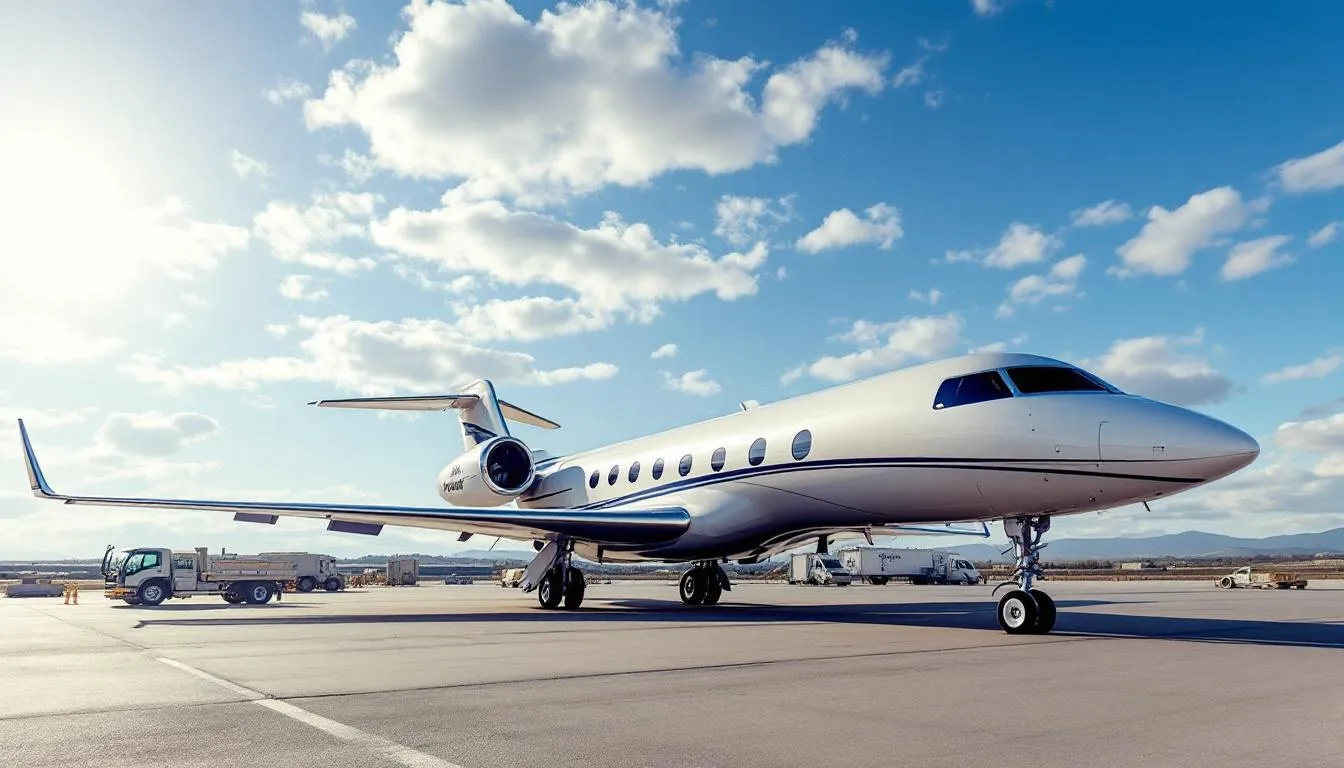
The Gulfstream G700 is a frontrunner in modern business aviation, featuring the largest cabin in its class, a range of up to 7,750 nautical miles, and room for up to 19 passengers. It is powered by Rolls-Royce Pearl 700 engines. The G700's cabin is equipped with a 100% fresh air system replenished every two to three minutes. Additionally, the G700 has a maximum range of 7,500 nautical miles. Key features include:
Dual head-up display (HUD)
Rolls-Royce Pearl engines
Symmetry Flight Deck™ with active control sidesticks
Up to five living zones, including a grand suite with a shower
Cruise speed of Mach 0.90
Claimed to be the world’s fastest and longest-range business jet, the Global 8000 offers a maximum range of 8,000 nautical miles. It also features four true living spaces, providing unparalleled comfort and functionality for passengers. The Global 8000 is anticipated to provide new routes between major cities like Dubai and Houston. It is the world's fastest civilian aircraft with a top speed of Mach 0.94.
Top speed of Mach 0.94
Cruise speed of Mach 0.85
Maximum range of 8,000 nautical miles
Smooth Flex Wing and advanced HEPA air filtration
Premier cabin ergonomics with Nuage seating
Four distinct living spaces for enhanced passenger comfort
Top speed of Mach 0.94
Cruise speed of Mach 0.85
Maximum range of 8,000 nautical miles
Smooth Flex Wing and advanced HEPA air filtration
Premier cabin ergonomics with Nuage seating
The Falcon 10X redefines cabin customization. It includes:
A cabin offering 2,780 square feet of floor space with multiple layout options
King-size bed and private bathroom with a full shower
A steam shower is available in the private bathroom for added luxury
Latest generation Digital Flight Control System
A range of approximately 7,500 nautical miles, making the Falcon 10X ideal for long-distance travel.
A cabin offering 2,780 square feet of floor space with multiple layout options
King-size bed and private bathroom with a full shower
A steam shower is available in the private bathroom for added luxury
Latest generation Digital Flight Control System
The ACJ220 is the private jet version of the Airbus A220. It stands out with six large VIP areas accommodating up to 19 passengers:
6 VIP living areas for up to 19 passengers
Intercontinental range of 5,650 nautical miles
Fuel-efficient engines with 25% lower consumption
A dedicated conference room for business meetings and executive functions
A spacious forward galley equipped with premium appliances and ample stowage for enhanced passenger comfort
6 VIP living areas for up to 19 passengers
Intercontinental range of 5,650 nautical miles
Fuel-efficient engines with 25% lower consumption
A dedicated conference room for business meetings and executive functions
A spacious forward galley equipped with premium appliances and ample stowage for enhanced passenger comfort
For short-range luxury, the HondaJet Elite II is a top pick in the very light jet category. Its highlights: The Beechcraft Denali, another notable aircraft, is powered by a 1,300-hp GE engine, offering exceptional performance for its class.
Range of 1,547 nautical miles
Garmin G3000 avionics suite
Noise-reducing Over-the-Wing Engine Mount
One of the quietest and most efficient light jets
Can be operated by a single pilot
The HondaJet 2600, a future model, aims to have a range of 2,625 nautical miles.
Range of 1,547 nautical miles
Garmin G3000 avionics suite
Noise-reducing Over-The-Wing Engine Mount
One of the quietest and most efficient light jets
Can be operated by a single pilot
Today’s private jets don’t just look sleek—they’re equipped with next-generation features and groundbreaking technology:
Active control sidesticks feature improved pilot response and coordination
Advanced weather radar systems feature enhanced situational awareness and safety
High-speed wing features and lightweight materials reduce fuel consumption
HUD and Enhanced Vision Systems (EVS) feature safer landings in poor visibility
Automated flight deck features reduce pilot workload and human error
The newest private jets prioritize space, comfort, and functionality. Key features include: Business jets are being developed with more spacious and flexible interiors to enhance passenger comfort, ensuring a more enjoyable and productive travel experience.
Low cabin altitude: Reduces fatigue and jet lag
Expansive, large windows: Bring in natural light for a relaxed, open atmosphere
Sound insulation: Quieter cabins for productive conversations
Modular layouts: Customize for leisure, meetings, or rest
Grand suites: Master bedrooms with en-suite bathrooms
These elements create an environment that feels less like transportation and more like a flying penthouse. Luxury private jets commonly include gold, crystal, and cashmere finishes to elevate the onboard experience.
From seating to storage, configuration options have come a long way:
Passenger capacity: Up to 19 passengers, depending on model
Power outlets and USB ports at every seat
Widest cabin in class: Offers unmatched elbow room, generous floor space, and walkability for passengers
Fully equipped kitchens and bars for in-flight dining
Optional office setups for business continuity
Customization includes materials, lighting schemes, color palettes, and furniture styles—offering complete personalization for discerning owners.
Light jets like the HondaJet Elite II—which is also considered a very light jet—or Embraer Phenom 300E offer:
Lower operating costs and fuel efficiency
Faster boarding and airport access
Ideal for short-to-mid-range flights (under 3 hours)
Easier to land at regional airports
They’re perfect for executives who travel frequently within a region or need a private, agile transport solution.
The latest generation of private jets is a showcase of cutting-edge technology and innovation, designed to elevate every aspect of the flying experience. Modern business jets are equipped with advanced flight decks featuring dual head-up displays and active control sidesticks, which enhance pilot situational awareness and reduce workload. High-speed wings and lightweight composite materials contribute to greater fuel efficiency and longer range, allowing aircraft to reach farther destinations with fewer stops.
Inside the cabin, passengers enjoy an environment that rivals the world’s finest hotels. Expansive windows flood the aircraft cabin with natural light, while smart cabin automation systems let travelers control lighting, temperature, and entertainment with a touch. The Gulfstream G700 has 20 panoramic oval windows that provide abundant natural light. Next-generation weather radar and real-time connectivity keep both pilots and passengers informed, ensuring a smooth and safe journey.
The world's most luxurious private jets offer surprising onboard amenities, including full-service bars.
The newest private jets blur the lines between air and home. Common luxury features include: Luxury private jet bathrooms often feature space comparable to boutique hotel bathrooms, adding to the overall comfort and opulence of the experience.
Lounge areas with plush seating
Dining rooms that convert into meeting spaces
Master suites with king-size beds and wardrobes
Walk-in showers with full water pressure
High-definition entertainment systems
Wi-Fi with satellite connectivity
Luxury finishes such as gold, crystal, and cashmere are often incorporated to elevate the onboard experience.
Lounge areas with plush seating
Dining rooms that convert into meeting spaces
Master suites with king-size beds and wardrobes
Walk-in showers with full water pressure
High-definition entertainment systems
Wi-Fi with satellite connectivity
Some advanced concepts even explore VR entertainment, outdoor viewing windows, and smart cabin automation.

Traveling aboard a private jet delivers:
No TSA lines or security delays
Private terminals and VIP lounges
Custom catering and concierge service
Onboard staff dedicated to your preferences
Smooth, direct flights to remote destinations
The pilot experience is just as premium, with modern cockpits offering real-time weather, terrain mapping, and AI-assisted systems.
Flying in a private jet truly feels like experiencing a palace in the sky, where luxury and freedom define every moment above the clouds.
Safety is paramount in business aviation, and the newest private jets are engineered with a suite of advanced features to protect both passengers and crew. Modern flight decks are equipped with dual head-up displays, enhanced vision systems, and state-of-the-art weather radar, giving pilots a clear view of their surroundings even in challenging conditions. Active control sidesticks and automated systems help reduce pilot workload, minimizing the risk of human error during critical phases of flight.
Redundant avionics, multiple communication channels, and robust navigation systems ensure that business jets can safely operate in a variety of environments, from busy international airports to remote airstrips. Advanced cabin pressurization systems maintain a comfortable cabin altitude, reducing fatigue and enhancing passenger well-being on long hauls.
Regular maintenance, rigorous pilot training, and strict regulatory oversight further reinforce the industry’s commitment to safety. With these comprehensive measures in place, travelers can enjoy the peace of mind that comes from flying aboard the world’s most advanced and secure private jets.
Buying the newest private jet is a major investment. Here's what to expect beyond the purchase price, which is only one part of the cost equation:
Purchase Price: $5 million to $90+ million
Annual Maintenance: $500,000 to $2 million
Fuel and Crew: $500,000 to $1.5 million
Hangar/Storage: $50,000 to $250,000 annually
Insurance: Varies by aircraft type and value
Private jet owners also incur ongoing operational costs similar to maintaining a fleet of luxury cars, with larger aircraft requiring more substantial resources. Operational costs for larger business jets may require a full-service team, including pilots and attendants.
Private jet owners also incur ongoing operational costs similar to maintaining a fleet of luxury cars, with larger aircraft requiring more substantial resources. The larger the aircraft, the more substantial the operational costs, which include staffing, maintenance, and insurance.
Purchase Price: $5 million to $90+ million
Annual Maintenance: $500,000 to $2 million
Fuel and Crew: $500,000 to $1.5 million
Hangar/Storage: $50,000 to $250,000 annually
Insurance: Varies by aircraft type and value
The annual costs of private jet ownership include operational costs, which can vary based on the type of aircraft and its amenities. In addition to the purchase price, private jet owners must anticipate high insurance premiums, especially for larger models.
To mitigate these costs, many opt for: The costs associated with private jet ownership are often not publicly disclosed among high-profile owners, adding an element of exclusivity to the industry.
Fractional ownership
Jet card memberships
Leasing programs
On-demand charter services
Companies like NetJets and Jettly make it easy to access luxury private flights without owning a jet.
Ongoing maintenance is essential to keep your jet airworthy:
Routine inspections (A, B, C, D checks)
Engine and avionics overhauls
Spare parts and upgrades
Compliance with regulatory inspections
Many OEMs (original equipment manufacturers) offer maintenance support programs that include parts, labor, and software upgrades.
The private jet industry is actively working on greener solutions: Aircraft manufacturers are introducing longer-range jets designed for ultra-long travel.
Sustainable Aviation Fuel (SAF): Reduces CO2 by up to 80%
Electric and hybrid jet development (in early stages)
Carbon offset programs for charter clients
Lighter composite materials that improve fuel efficiency
New technologies in business jets are focusing on sustainability, including the use of sustainable aviation fuel.
Sustainable Aviation Fuel (SAF): Reduces CO2 by up to 80%
Electric and hybrid jet development (in early stages)
Carbon offset programs for charter clients
Lighter composite materials that improve fuel efficiency
While concerns remain, technology is pushing toward a more sustainable future for business aviation.
Trends shaping the private jet industry include a highly competitive used aircraft market, often described as a 'feeding frenzy,' due to high demand and limited availability.
Rising interest in fractional ownership
Increase in first-time private jet users post-pandemic
AI-enabled predictive maintenance
Growing demand in the Asia-Pacific and Middle East markets
Used jet sales are thriving due to high demand and delayed deliveries
Major aircraft manufacturers are reporting strong sales in business aviation, driven by these trends.
The future points toward supersonic travel, autonomous piloting, and decarbonized aviation, as manufacturers compete to build the world's most advanced and luxurious private jets.
To find the right jet for your needs:
Assess your travel habits (range, frequency, destinations)
Set a realistic budget (including operating costs)
Decide between ownership and charter
Compare features, range, and cabin comfort
Schedule a demo flight or cabin walkthrough
Working with a platform like Jettly ensures you get expert support whether you’re flying occasionally or looking to purchase.
Events like EBACE, NBAA-BACE, and Dubai Airshow showcase the newest jets and tech. Boeing's luxury private jets, such as the Boeing 747-8, are often highlighted at these industry events, demonstrating the pinnacle of opulence and innovation. These expos are vital for learning about innovations like the Gulfstream G700's circadian lighting system, which helps reduce jet lag.
Learning about industry innovations
Comparing aircraft side-by-side
Meeting OEMs, charter companies, and maintenance providers
If you’re seriously considering buying a jet, attending one of these events can provide valuable insights.
The regulatory environment varies depending on where you operate:
FAA (U.S.) and EASA (EU) are key authorities
Requirements cover pilot licensing, aircraft certification, and safety compliance
International operations need permits, overflight approvals, and local compliance
Partnering with experienced operators helps you stay compliant with minimal hassle.
Most buyers opt for:
Loan financing with terms from 5–15 years
Operating leases with fixed monthly payments
Insurance coverage for liability, hull damage, and crew
Your choice of financing depends on cash flow, usage frequency, and long-term plans.
All pilots flying the newest jets must:
Be licensed under FAA, EASA, or ICAO standards
Complete aircraft-specific training
Undergo recurrent testing and simulator checks
Jet owners are responsible for ensuring their crew meets all regulatory and safety requirements.
The private aviation landscape is evolving faster than ever. Newer aircraft like the Gulfstream G700 and Global 8000 offer an unmatched combination of luxury, performance, and efficiency. Companies like Bombardier, Gulfstream, and Textron are seeing significant revenue growth in their business jet units, driven by these advancements.
From next-gen tech to eco-conscious innovation, the newest private jet models are setting new standards. Whether you're looking to buy, lease, or charter, understanding the features and costs helps you navigate the skies with confidence.
Whether you're flying for business or pleasure, Jettly provides flexible charter solutions and exclusive access to the most advanced private jets in the world. Explore options that match your lifestyle and enjoy the freedom, comfort, and convenience of private aviation.
Visit Jettly.com to learn more or book your next flight today.
Share this post:
Jay Franco Serevilla
Aug 21, 2025
|
5
min read
Discover tips and trends in the industry.
5
min read
How Much Weight Can a Plane Hold? (From Small Planes to Private Jets and Airliners)
Understanding how much weight a plane can hold is crucial for safe flight operations. Each aircraft has a certified maximum takeoff weight (MTOW) that dictates its capacity for passengers, baggage, and fuel. This knowledge helps travelers and pilots make informed decisions about flight planning and safety.
Read More
5
min read
What Are Empty Leg Flights? A Practical Guide to Discounted Private Jet Travel
Empty leg flights are discounted private jet journeys that occur when a jet is repositioning without passengers. These flights offer travelers the luxury of private aviation at a fraction of the cost, typically 50% to 80% cheaper than standard charters. This guide explains how to find and book these flights, making private travel more accessible for those with flexible schedules.
Read MoreStay updated with our latest insights and tips to elevate your journey with us.
MEMBERSHIPS AND ASSOCIATIONS



Disclaimer: Jettly operates as a charter broker, offering access to a global digital jet charter marketplace. Jettly is not a direct air carrier and does not own or operate aircraft. All advertised flights are conducted by third-party air carriers that are fully licensed and hold the appropriate Part 135 or Part 121 certifications issued by the Federal Aviation Administration (FAA) or equivalent regulatory authorities under U.S. or foreign law. Jettly complies fully with the U.S. Department of Transportation's Part 295 and Part 298 Charter Broker regulations. Jettly does not carry additional liability insurance. Passengers are covered by aircraft operator insurance. TICO: 50023770


