



Login
Get Instant Pricing On 23,000+ Aircraft

>
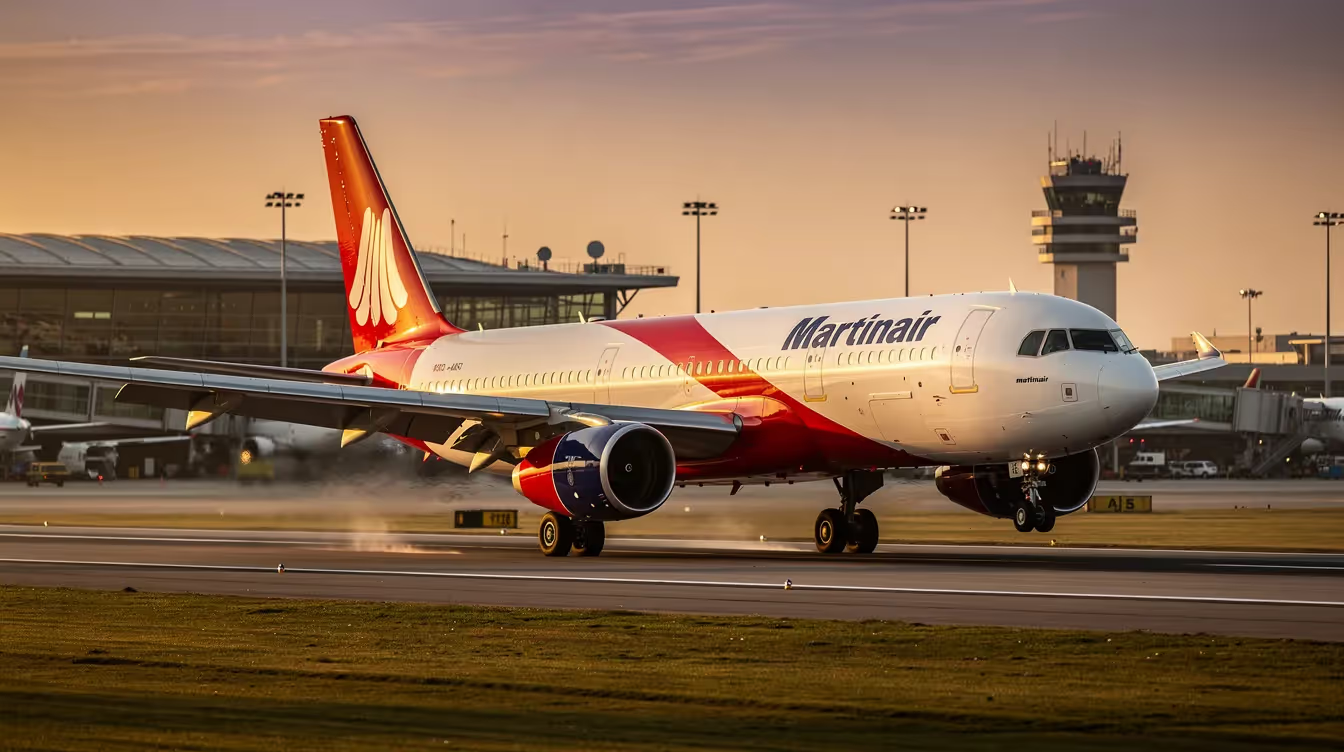
This page provides a comprehensive overview of Martinair, its cargo operations, aircraft charter services, and career opportunities. It is designed for shippers, travelers, aviation professionals, and anyone interested in the differences between Martinair and similarly named operators. Understanding these distinctions is crucial for making informed decisions about cargo shipping, private travel, and aviation careers.
Martinair is best known as a Dutch cargo airline within the Air France–KLM group, while similarly named U.S. operators such as MartinAir and Martinaire focus on regional aircraft charter and cargo flights.
Modern Martinair operates all-cargo Boeing 747 freighters from Amsterdam Airport Schiphol and serves heavy logistics, express cargo, perishables, pharmaceuticals, live animals, and oversized freight.
Martinair Holland ended passenger flights on 31 October 2011 after 53 years and now functions as a specialized cargo operator on behalf of the KLM Group.
U.S. MartinAir-branded operators often provide aircraft charter, management, maintenance, sales, acquisitions, and feeder freight services on the Eastern Seaboard and other regional markets.
Travelers and logistics teams that need on-demand flexibility can compare private charter options through Jettly’s digital marketplace at https://www.jettly.com.
Martinair commonly refers to Martinair Holland N.V., a Dutch airline founded in 1958 and now operating as a dedicated cargo carrier. Martinair was established on May 24, 1958, by Martin Schröder and John Block under the name Martin's Air Charter (MAC). Similar names, including MartinAir and Martinaire, are also used by U.S.-based operators involved in aircraft charter, management, maintenance, and regional cargo flights.
Martinair Holland began as a passenger and holiday airline, then evolved into a cargo-focused airline integrated into the Air France–KLM cargo division. Today, Martinair operates under the Air France-KLM Cargo network, specializing in heavy logistics and express cargo services.
In North America, a company branded MartinAir or Martinaire may refer to a separate regional operator. These businesses are not the same corporate entity as Martinair Holland. They may support aircraft charter, overnight freight, maintenance, and crew operations from strategic bases, including markets along the Eastern Seaboard and locations such as VA.
This distinction matters. A shipper looking for widebody cargo capacity, a traveler looking to fly privately, and a pilot seeking hiring opportunities are evaluating very different businesses. Jettly offers a carrier-agnostic private charter aircraft platform for travelers who want to compare aircraft and pricing across many certified operators instead of relying on a single fleet.

That final milestone is important. Martinair is proud of its 53-year legacy in passenger service, having ceased passenger operations on 31 October 2011 to transition fully to a dedicated freight carrier. In 2011, Martinair ended all passenger services, focusing exclusively on cargo operations after more than five decades of passenger flight history.
Since 2011, Martinair has operated as a dedicated cargo airline within the Air France–KLM network, based at Amsterdam Airport Schiphol. Martinair functions as the heavy-cargo operating arm for the KLM Group, based at Amsterdam Airport Schiphol.
Martinair operates as a specialized Dutch cargo airline focused exclusively on global cargo transportation and maintenance services. Its fleet is optimized for maximum payload capacity and loading efficiency rather than passenger comfort.
Key points include:
In 2006, Martinair acquired four Boeing 747-400 aircraft from Singapore Airlines, which were subsequently converted into freighters to replace older models.
Martinair operates scheduled and charter cargo flights, primarily using Boeing 747 freighters.
Martinair operates a Boeing 747-400BCF as part of its cargo fleet, which is a converted freighter version of the Boeing 747-400.
Martinair is fully owned by KLM and operates as an integral part of the KLM cargo fleet, utilizing its dedicated Boeing 747-400 freighter aircraft.
Martinair’s cargo operations are closely integrated with KLM Cargo and Air France Cargo, using shared scheduling, sales, ground handling, and network planning.
As of November 2022, Martinair operates scheduled freight services within the Air France-KLM cargo network, connecting Amsterdam-Schiphol with 12 destinations across Africa, North America, and South America.
Martinair’s infrastructure supports the transport of sensitive payloads, including live animals, pharmaceuticals, oversized freight, and perishable goods. This makes the airline relevant for shippers that need widebody freight capacity, temperature control, and specialist cargo handling.
The TransPort Building at Amsterdam Airport Schiphol is part of Martinair’s modern operational footprint. Completed around 2009–2010, the building supports office and cargo functions and reflects the broader Air France–KLM focus on more efficient infrastructure.
Martinair also operates a maintenance facility providing technical and line maintenance for KLM Cityhopper’s Embraer aircraft. In addition, Martinair operates dedicated maintenance facilities in Europe for aviation maintenance services, supported by a structured maintenance program that ensures high standards for aircraft reliability and safety.
Cargo demand is shaped by e-commerce, pharmaceuticals, perishables, express shipments, and supply chain events. That is where scheduled freighters and on-demand aircraft charter can complement each other. Large shipments may move through Martinair, while urgent, smaller loads may need a charter aircraft sourced through a platform such as Jettly’s airport locator tool.
In North America, similarly named operators such as MartinAir Inc. and Martinaire provide charter and feeder cargo services separate from the Dutch Martinair Holland brand. The names are similar, but the business models, certificates, aircraft types, and route networks are different.
U.S. MartinAir-type operators are often known for regional aircraft charter, management, maintenance, sales, and acquisitions. A company on the Eastern Seaboard may operate charter aircraft for business travelers, family trips, and time-sensitive missions, while feeder cargo operators may fly overnight freight for package networks.
Typical aircraft may include:
|
Operator type |
Common mission |
Typical aircraft category |
|---|---|---|
|
U.S. charter operator |
Private business or leisure flights |
Light jets, midsize jets, super-midsize jets |
|
U.S. feeder cargo operator |
Overnight package freight |
Turboprops and small freighters |
|
Dutch Martinair |
Intercontinental cargo |
Boeing 747 freighters |
|
Digital marketplace such as Jettly |
On-demand passenger charter and select urgent transport needs |
Turboprops, light jets, midsize jets, heavy jets, helicopters |
These U.S. entities may support bank bags, overnight freight, and ad hoc charter missions. They often use multiple crew bases so aircraft and people can be positioned for late-night departures, early-morning arrivals, and short-notice customer demand.
For travelers and businesses comparing options, regional providers can be useful when their aircraft, base, and schedule match the mission. Jettly takes a broader approach by aggregating thousands of aircraft from many operators on a single platform, giving customers more ways to stay in touch with available aircraft and pricing using its private jet charter cost estimator.
Martinair and MartinAir-branded operators regularly hire pilots, maintenance technicians, ground staff, dispatchers, and management professionals as fleets and routes evolve. Hiring needs are shaped by cargo demand, aircraft availability, training pipelines, and the number of flights operated each week.
Common roles include:
Cargo pilots
Charter captains and first officers
Aircraft mechanics and avionics technicians
Flight operations specialists
Dispatchers
Cargo handlers and ground operations staff
Terminal managers
Procurement managers
Maintenance planning and quality roles
As of early 2026, postings for cargo and regional charter roles remain strong across the sector. E-commerce, express logistics, pharmaceuticals, and time-critical transport continue to support demand for qualified crews and technicians, while Jettly’s high-ticket affiliate program creates additional earning opportunities for those referring new charter clients.
Dutch-based Martinair positions are generally integrated into the Air France–KLM system. U.S. MartinAir or Martinaire roles are usually advertised independently, through regional job boards, or through aviation hiring platforms.
Candidates should assess:
Fleet type
Base location
Overnight cargo versus daytime charter schedules
Training culture
Upgrade timelines
Benefits and retirement plans
Safety systems and maintenance standards
Long-term career path
Pilots and crews who want varied flying may also consider operators that partner with digital charter platforms such as Jettly. Ad hoc private charter can expose crews to different routes, passenger needs, airports, and aircraft categories, similar to the variety described in Jettly’s guide to affordable airplane rent costs and options.
Many MartinAir-branded operators periodically invite resumes for positions tied to aircraft charter, cargo handling, maintenance, and fleet growth. As of January 2026, Martinair is accepting resumes for various positions.
A typical hiring process may include:
Online application or resume email
Initial screening of qualifications
Technical interview
Simulator or flight assessment for pilots
Background check and employment verification
Medical, licensing, and regulatory review
Earlier public updates, such as hiring notices dated January 6, 2026, often include open pilot and management positions supporting expanding charter and cargo operations.
Resume submittal is usually the first formal step. Candidates should tailor CVs to highlight multi-engine time, IFR experience, cargo operations, customer-facing charter experience, and regulatory credentials such as FAA or EASA licensing.
Benefits information is typically shared as candidates move through the process. These details vary by company and jurisdiction, so applicants should verify whether they are applying to Martinair Holland in the Netherlands, a U.S. MartinAir charter operator, or a Martinaire regional cargo operator, and may also want to understand how these employers compare with providers featured in a broader list of charter airlines.
MartinAir-branded employers often offer standard aviation-industry benefits designed to retain qualified crews, technicians, and operational staff. Martinair offers a comprehensive benefits package that includes health, dental, and vision coverage, paid vacation and holidays, sick leave, short and long-term disability, and a 401K plan.
Working conditions in cargo and charter aviation can vary widely.
|
Work area |
Typical condition |
What to evaluate |
|---|---|---|
|
Long-haul cargo |
Night operations, international routes, heavy aircraft |
Duty rules, rest facilities, and training quality |
|
Regional feeder cargo |
Early-morning and late-night schedules |
Base location, seniority, and weather exposure |
|
Private charter |
Variable schedules and customer-specific trips |
Callout rules, days off, service expectations |
|
Maintenance |
Line checks, overnight work, time-sensitive repairs |
Tooling, staffing, safety culture |
Irregular hours, overnight flights, and variable schedules can suit some aviation professionals. They may also create fatigue risks if training, staffing, and planning are weak, and can influence the level of onboard services, including specialized options such as in-flight catering for private jets.
Safety culture, maintenance standards, and training programs should be weighed alongside pay. Candidates should ask about recurrent training, upgrade timelines, sick leave policies, and opportunities to move into larger aircraft or management tracks.
Martinair in the Netherlands and MartinAir or Martinaire operators in the U.S. maintain fleets sized to their mission profiles. Martinair focuses on long-haul cargo, while U.S. operators may focus on regional cargo and aircraft charter, similar in scale to some of the best private jet charter companies serving business and leisure travelers.
Martinair Holland’s operation is built around widebody freighters, including converted Boeing 747-400 aircraft. These aircraft serve intercontinental cargo routes from Amsterdam Schiphol to select destinations in Africa, North America, and South America.
Martinair has crew bases located at various strategic locations to support its operations. For Martinair Holland, Schiphol remains the central base, with activity embedded in the broader Air France–KLM cargo network for scheduling, cargo handling, and ground support.
For U.S. MartinAir or Martinaire-type operators, fleets may include turboprop freighters and charter aircraft positioned near logistics centers and metropolitan markets. Crew bases are designed to reduce repositioning flights, support tight overnight cargo schedules, and enable faster response for ad hoc aircraft charter missions.
This is where fleet scale matters. A single operator may be strong in one region. Jettly gives travelers access to over 20,000 aircraft globally, spanning light jets, midsize jets, heavy jets, turboprops, and helicopters, positioning it as a compelling NetJets alternative for flying private. That larger inventory can help customers compare route options, aircraft size, and schedule fit.

Aircraft charter means booking an entire aircraft for private use on a chosen schedule. It is often used for business trips, family travel, urgent site visits, or time-critical cargo transport.
A traditional MartinAir-style charter operator usually works like this:
The client contacts the company directly.
The client provides a route, passenger count, dates, and timing.
The in-house sales team checks fleet availability.
A quote is prepared based on aircraft type, flight time, airport fees, and positioning.
The client confirms the trip and receives operational details.
Jettly works differently. Jettly is a digital private jet charter platform that aggregates thousands of operators and more than 20,000 aircraft worldwide. It offers instant pricing and online booking without requiring jet cards, fractional ownership, or long-term aircraft commitments, and also supports crowdsourced private jet flights and shared empty seats to reduce costs.
|
Factor |
Traditional single operator |
Jettly marketplace |
|---|---|---|
|
Fleet access |
Limited to owned or managed aircraft |
Global access to more than 20,000 aircraft |
|
Coverage |
Often regional |
Global |
|
Pricing process |
Manual quote through the sales team |
Digital search and instant pricing with tools like Jettly’s jet card flight cost estimator |
|
Aircraft categories |
Depends on the operator fleet |
Turboprops, helicopters, light jets, midsize jets, heavy jets |
Logistics and cargo clients that use Martinair for palletized freight may use Jettly for time-sensitive, smaller loads or executive travel connected to those same supply chains.
Learn more about Jettly’s charter options at https://www.jettly.com.
This decision comes down to shipment size, urgency, routing, and schedule control.
Dedicated cargo airlines such as Martinair are often the right fit for bulk freight, containerized shipments, and long-term logistics contracts across fixed trade lanes. Martinair is especially relevant for heavy logistics, express cargo, perishables, pharmaceuticals, oversized freight, and other shipments that need specialist handling.
Private aircraft charter through Jettly is a better fit when the mission requires flexibility. Examples include urgent hand-carry shipments, just-in-time components, medical equipment, or executive teams that need to visit multiple facilities in one day, especially when travelers use Jettly’s tools to understand how private jet charter pricing works.
Cost structures also differ. Cargo airlines usually bill by weight, volume, commodity type, and route. Charter pricing depends on aircraft type, flight time, airport fees, crew costs, and positioning legs.
Price matters, but it is not the only factor. Schedule control, routing flexibility, airport access, and the cost of delay can change the total value of a trip.
Safety is central to cargo airlines and charter operators. Martinair, MartinAir-type operators, and Jettly’s operator partners all operate within aviation systems governed by strict national and international rules.
Public databases maintained by authorities and organizations such as EASA, the FAA, and ICAO help track aviation safety standards, regulatory frameworks, and operational oversight. Aviation safety databases and archives also provide transparency into historical incidents and accidents involving operators, including Martinair and similarly named carriers.
Media and archival content about Martinair incidents can be found through sources such as Wikimedia Commons and aviation safety databases. Current operations, however, are designed around modern maintenance requirements, crew training, cargo controls, and flight duty rules.
Typical safety measures include:
Working only with licensed operators, as highlighted in Jettly’s profiles of partners like Dexter Air Taxi
Regular line and heavy maintenance checks
Crew training and recurrent checks
Standard operating procedures
Dangerous goods controls and operator vetting are similar to those described for Zenflight private jet services
Cargo loading and weight-and-balance procedures
Flight time and duty limitations
Regulatory audits and certificate oversight
Jettly works only with licensed operators and aircraft that comply with relevant safety regulations. This makes regulatory oversight a baseline requirement for all flights booked through the marketplace.
Jettly does not replace Martinair’s scheduled cargo services. It complements them by serving use cases that fixed cargo networks and single-operator charter fleets may not handle efficiently.
A business may use Martinair for recurring freight contracts, then use Jettly for an urgent spare part, an executive site visit, or a last-minute itinerary change. This is useful when time matters more than standard routing.
Jettly’s on-demand private jet charter model supports one-off trips and frequent travel without requiring jet cards, fractional ownership, or long-term commitments, though frequent flyers may still evaluate what a jet card is, its costs, and benefits.
Key strengths include:
Transparent, upfront pricing
Digital search and booking
Membership or pay-as-you-go access
Global aircraft coverage
Aircraft categories include light jet, midsize jet, heavy jet, turboprop, and helicopter
Access to operators that meet licensing and safety requirements
In addition to on-demand charter, structured programs such as Jettly’s world-class corporate jet card programs can suit companies with recurring travel needs.
Example use cases include:
A management team flying from Amsterdam or New York to multiple warehouses in one day
A family traveling privately from Toronto to a vacation destination
A rapid-response flight carrying high-value components to keep a production line running
A project team attending multiple supplier events across different cities in the same week
Martinair is a strong example of how specialized aviation can serve global logistics. Jettly applies a similar focus on practical access, but for on-demand private flights and flexible aircraft charter.
Ready to compare aircraft, routes, and pricing? Explore flights or request a quote at https://www.jettly.com.
This FAQ addresses common questions about Martinair, similarly named operators, and how they relate to private aircraft charter options through Jettly. For live pricing or tailored route planning, visit https://www.jettly.com.
No. Martinair Holland N.V. is a Dutch cargo airline within Air France–KLM, while MartinAir and Martinaire in the U.S. are separate companies focused on regional charter and cargo operations.
They share similar names but operate under different corporate structures, regulatory authorities, and route networks. Always check the operator’s full legal name, base of operations, and regulatory certificate before booking flights or applying for jobs.
No. Martinair in the Netherlands no longer operates regular passenger services because it ended passenger flights in 2011 and now focuses on cargo.
Individual travelers looking for private passenger flights can use Jettly to book on-demand aircraft from certified operators. The platform lets users specify route, date, passenger count, and aircraft preferences before reviewing pricing.
Private aircraft charter is usually more expensive per seat than commercial business class. The tradeoff is schedule control, privacy, airport flexibility, and reduced total travel time.
Charter pricing depends on aircraft type, flight time, number of legs, airport fees, and repositioning costs. Travelers should compare the full trip value, not just the ticket price, and may want to review broader guidance on how much a private jet costs across ownership, leasing, and charter options.
Pilots should review fleet type, base locations, schedule patterns, training standards, and upgrade opportunities. Overnight cargo flying is different from daytime private charter, so lifestyle fit matters.
Cargo and regional charter roles can build valuable multi-engine and IFR experience. Candidates should confirm pay scales, benefits, rights, responsibilities, and long-term career paths before accepting an offer.
Many companies use scheduled cargo airlines such as Martinair for regular freight volumes and reserve private charter for urgent, high-value, or time-critical shipments.
A typical workflow is simple: bulk cargo moves on scheduled freighters, while last-minute or sensitive loads fly on chartered turboprops or jets sourced through platforms such as Jettly. This hybrid model can balance cost control with flexibility when supply chains are under pressure, much like how some shippers and travelers combine Martinair services with leading providers such as those profiled in an overview of NetJets and industry-leading private aviation.
Martinair stands out as a specialized cargo airline within the Air France–KLM group, focusing on global freight transportation with a modern fleet optimized for heavy logistics and sensitive cargo. Its transition from passenger services to dedicated cargo operations reflects a strategic focus on efficiency and reliability in global supply chains.
For travelers and businesses seeking flexible, on-demand private air travel or urgent cargo solutions, platforms like Jettly offer a complementary approach. Jettly’s digital marketplace provides instant access to thousands of aircraft worldwide, transparent pricing, and easy online booking without the commitments of ownership or jet cards.
Whether coordinating large-scale freight shipments with Martinair or arranging private charter flights through Jettly, customers benefit from tailored solutions that prioritize convenience, flexibility, and operational excellence.
Ready to experience private travel on your terms? Explore flight options or request a quote at https://www.jettly.com.
Share this post:
Jay Franco Serevilla
May 19, 2026
|
5
min read
Discover tips and trends in the industry.

5
min read
Boeing 737-300: Second-Generation Classic Airliner for Airlines and Private Charter
The Boeing 737-300 is a pivotal second-generation airliner that transformed commercial aviation since its introduction in the mid-1980s. Although many airlines have retired this model, it remains in service for cargo, VIP, and private charter operations worldwide, showcasing its adaptability and enduring value. This article delves into the aircraft's legacy, specifications, and its relevance in today's aviation landscape.
Read More
5
min read
Delta Airline Planes: Fleet History, Current Aircraft, And How They Compare To Private Jets
Delta Air Lines boasts one of the largest fleets in the world, featuring over 1,000 aircraft from Airbus and Boeing. This article explores Delta's fleet history, current aircraft, and the advantages of private jet charters for travelers seeking flexibility and privacy. Discover how Delta's evolution from historic jets to modern fuel-efficient models shapes the aviation landscape today.
Read MoreStay updated with our latest insights and tips to elevate your journey with us.
MEMBERSHIPS AND ASSOCIATIONS



Disclaimer: Jettly operates as a charter broker, offering access to a global digital jet charter marketplace. Jettly is not a direct air carrier and does not own or operate aircraft. All advertised flights are conducted by third-party air carriers that are fully licensed and hold the appropriate Part 135 or Part 121 certifications issued by the Federal Aviation Administration (FAA) or equivalent regulatory authorities under U.S. or foreign law. Jettly complies fully with the U.S. Department of Transportation's Part 295 and Part 298 Charter Broker regulations. Jettly does not carry additional liability insurance. Passengers are covered by aircraft operator insurance. TICO: 50023770


