


Login
Get Instant Pricing On 23,000+ Aircraft

>
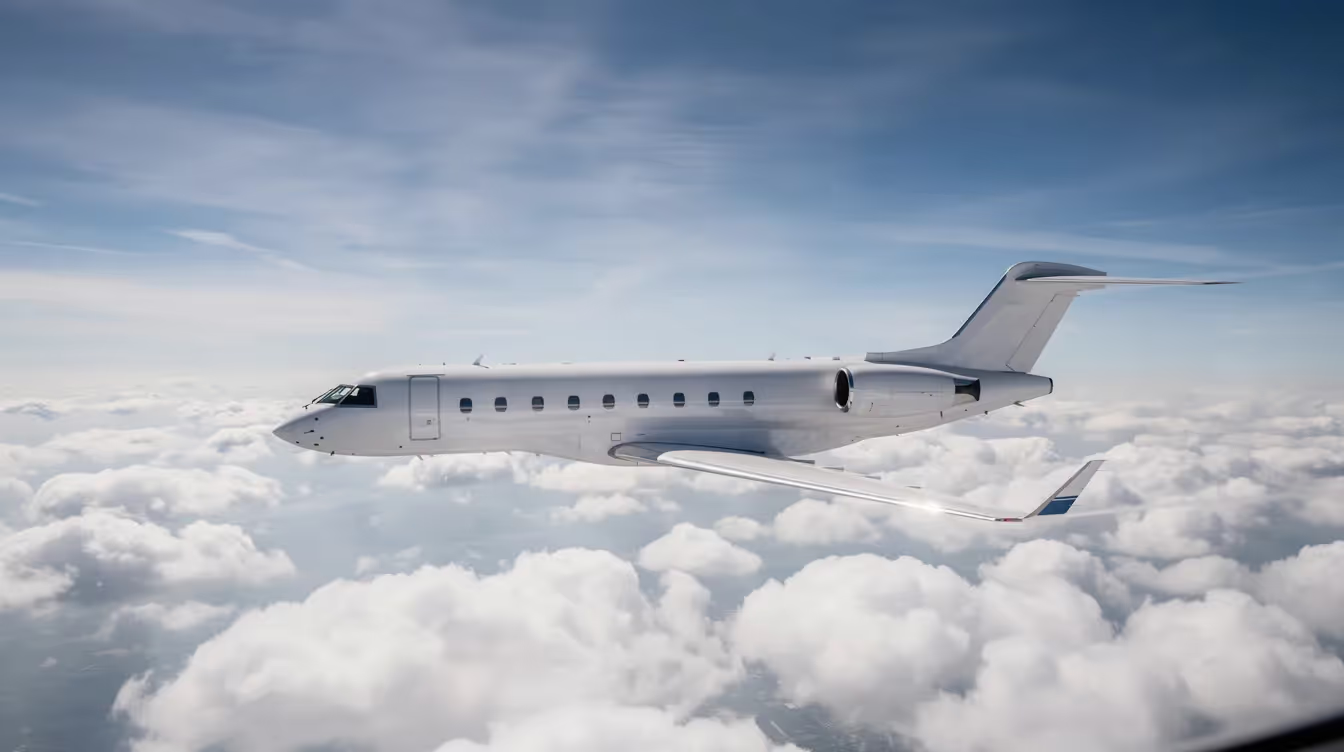
The Learjet 75 is a super-light business jet manufactured by Bombardier Aviation that entered service in late 2013. This article is tailored for business travelers, charter customers, and aviation enthusiasts seeking in-depth knowledge about the Learjet 75’s performance, cabin experience, operating economics, chartering process, and market insights. As the final evolution of the legendary Learjet 40/45 line, the Learjet 75 stands out in the business jet market for its exceptional speed, advanced cabin comfort, and unique flat-floor design—features that make it a compelling choice for those prioritizing efficiency and productivity in private air travel. Its relevance in the business jet market is underscored by its ability to combine high-speed cruise, fuel efficiency, and a premium passenger experience, setting a benchmark for super-light jets.
The aircraft first achieved its maiden flight in 2012 and received FAA certification in October 2013, entering service shortly thereafter. Manufactured by Bombardier Aviation, the Learjet 75 is certified to FAA Part 25 standards — the stringent requirements for large commercial airliners — ensuring higher safety standards.
The aircraft combines upgraded Honeywell TFE731-40BR engines producing 3,850 pounds of thrust each, new canted winglets derived from Bombardier’s Global series, and aerodynamic improvements that reduced drag by approximately 2% compared to earlier models. These refinements deliver better fuel efficiency while maintaining the performance characteristics that made the Learjet brand synonymous with business aviation speed. It is one of the fastest jets in its class, reaching a high-speed cruise of Mach 0.81 (approximately 535 mph).
For charter customers using Jettly, the Learjet 75 typically appears in the light jet segment, offering faster cruise speed than many comparable private jets on routes like New York–Miami or Los Angeles–Denver. It comfortably connects major city pairs such as New York to Los Angeles and Miami to San Francisco nonstop, ideal for tight business schedules. This article covers performance specifications, cabin layout, the Liberty variant, operating economics, and how to charter this business aircraft through Jettly’s global private charter network.
The Learjet 75 is a super-light to small midsize business jet produced from 2013 to 2022, with Bombardier manufacturing a total of 156 aircraft before ceasing production.
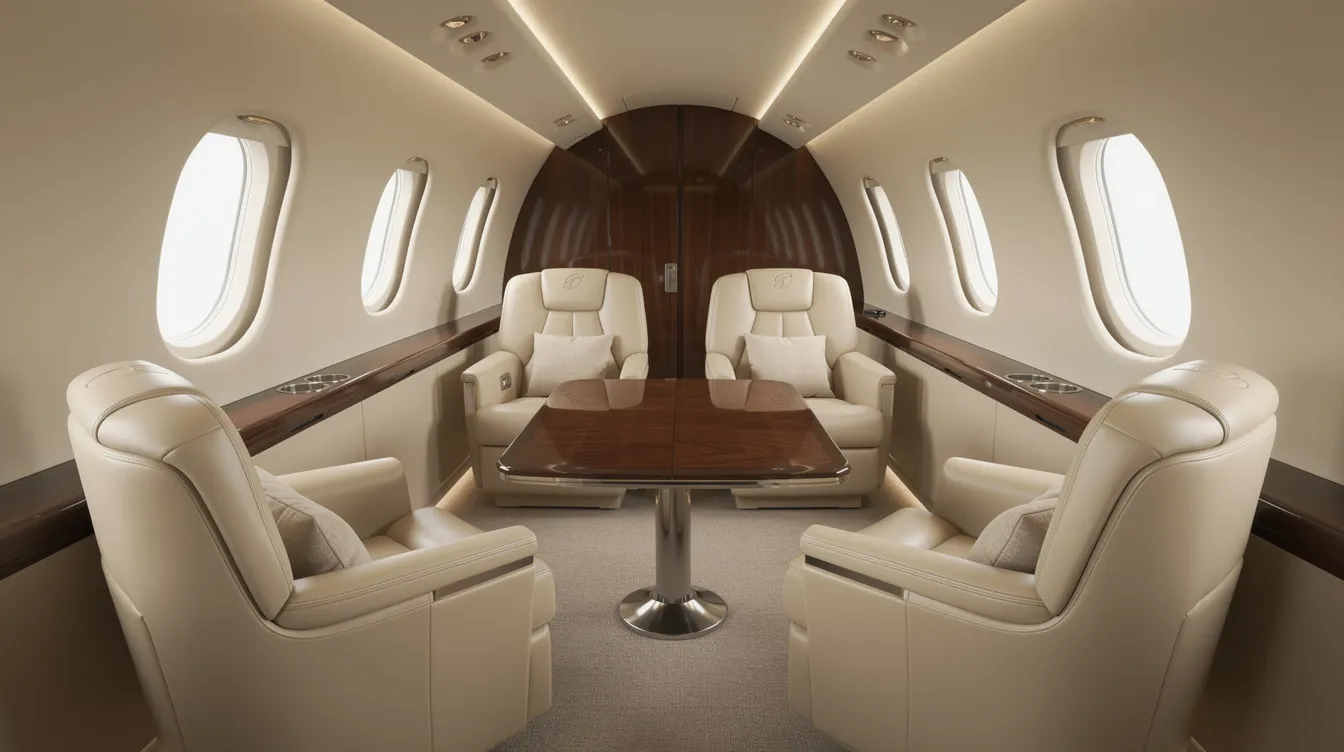
The aircraft features a unique flat-floor cabin — the only one in its category — enhancing mobility within the cabin and typically configured with an 8-seat double-club layout featuring 180-degree swivel chairs, ideal for mid-flight meetings.
It offers a maximum range of around 2,050 nm, high-speed cruise near Mach 0.79 to 0.81, and a 51,000 ft service ceiling.
The Learjet 75 was priced at approximately $13.8 million at launch, while the Learjet 75 Liberty variant was introduced in 2019 at a lower price point under $10 million to compete with other light jets.
Despite its advanced features and performance, the Learjet 75 struggled in the market due to its higher price compared to competitors, leading to low sales and production rates of just one aircraft per month by 2019.
Travelers can compare the Learjet 75 to similar aircraft and access instant charter pricing through Jettly’s digital marketplace at https://www.jettly.com.
The Learjet 75 is engineered for high-speed cruise, efficient climb rates, and operation at a service ceiling of 51,000 ft—well above most commercial traffic and bad weather systems.
Maximum Cruise Speed: ~465 knots (Mach 0.79–0.81)
Long-Range Cruise: ~437-451 knots (Mach 0.76)
Service Ceiling: 51,000 ft
Maximum Range: 2,040-2,080 nm
Max Takeoff Weight: 21,500 lb
Takeoff Distance: 4,440 ft
Landing Distance: 2,350 ft
The airframe features reshaped wings with canted winglets borrowed from the Global 7000/8000 series, a lighter composite nose section, and revised systems that together use less fuel than the Learjet 45XR. These aerodynamic improvements enable nonstop flights on routes such as Chicago–San Jose, Toronto–Fort Lauderdale, or Paris–Marrakesh with four passengers and NBAA reserves.
Balanced field performance allows access to many regional airports, though the Learjet 75 requires more runway length compared to some lighter competitors.
The Learjet 75 cabin features a flat-floor design, the only one in its category, providing enhanced mobility and comfort. The flat-floor design, unique in its category, enhances mobility within the cabin, allowing passengers to move freely and comfortably throughout the flight. Standard configurations often feature an 8-seat double-club layout with 180-degree swivel chairs, perfect for mid-flight meetings and work sessions. An optional ninth belted lavatory seat accommodates short flights.
Cabin length: 19 ft 10 in (6.05 m)
Width: 5 ft 1 in (1.55 m)
Height: 4 ft 11 in (1.50 m)
Total baggage: ~65 cu ft (external heated + internal access)
The forward cabin includes a galley with storage, ice drawers, and an optional microwave. An enclosed aft lavatory provides privacy on longer flights. Passenger technology includes a state-of-the-art Cabin Management System with personal touchscreens at every seat, HD monitors, in-flight entertainment linked to a Lufthansa Technik cabin management system, and optional high-speed Wi-Fi connectivity controllable via personal devices.
Charter customers on Jettly often select the Learjet 75 for small corporate teams of 4–6 travelers, weekend getaways for families, and same-day round trips where the quiet cabin and flat floor support productivity.
The Learjet 75 is powered by twin Honeywell TFE731-40BR turbofan engines paired with a Garmin G5000-based improved avionics suite in the Bombardier Vision cockpit.
Thrust: 3,850 lbf per engine
Time between overhauls: 5,000 hours
APU: Honeywell RE100XL for ground power
FADEC: Full-authority digital engine control with thrust reversers
The Garmin G5000 avionics feature three 14.1-inch LCD primary flight displays, an integrated flight management system, synthetic vision technology, and graphical weather. These systems reduce pilot workload significantly compared to legacy analog cockpits.
The aircraft holds FAA Part 25 transport-category certification and requires a two-pilot crew. Many operators value this for enhanced safety margins compared to single-pilot light jets that can be flown under Part 23, particularly when using tools like Jettly’s airport locator and charter platform to access a wide range of airports worldwide.
Bombardier launched the Learjet 75 Liberty around 2019, with deliveries beginning in 2020. This variant offers a more affordable entry point with a revised cabin and slightly extended range, making it attractive for travelers who track hourly budgets through tools like Jettly’s jet card flight cost estimator.
|
Feature |
Standard 75 |
Liberty |
|---|---|---|
|
Typical Seating |
8 passengers |
6 passengers |
|
Forward Cabin |
4 club seats |
2-seat executive suite with two fold-down ottomans |
|
Range |
2,040 nm |
2,080 nm |
|
List Price (Launch) |
$13.8 million |
Under $10 million |
The Liberty removes two forward seats to create extra legroom and sheds approximately 300-400 pounds through simplified interiors. Maximum cruise speed remains around 464 knots with unchanged 51,000 ft ceiling and max takeoff weight.
From a Jettly charter perspective, Liberty-configured aircraft are particularly attractive for longer North American routes—such as Dallas–Bogotá or Los Angeles–Chicago—where the extra range and lower operating weight provide advantages versus other light jets, and similar value applies on regional missions such as private jet charter in Kolkata, West Bengal or private jet flights to and from Lagos, Nigeria.
Understanding the operating costs of the Learjet 75 is essential for ownership or charter decisions, and tools such as Jettly’s private jet charter cost estimator can help benchmark hourly and trip pricing. Based on 300 flight hours per year, the annual fixed costs—including crew salaries, hangar fees, hull insurance, and liability insurance—are approximately $500,668. Variable hourly costs, which cover fuel, maintenance, and engine program expenses, total about $962,916 annually.
This brings the total estimated cost of operation for the Learjet 75 to around $1,463,584 per year at 300 flight hours. Fuel consumption averages 199 gallons per hour, reflecting the aircraft's high performance and speed, which owners may compare to the efficiency of larger wide-body options like a Boeing 767-300ER private charter when evaluating fleet mix or charter choices.
Pre-owned market data shows 2013–2019 models trading between $4–9 million, with low-time 2018 aircraft near the higher end. Only 5–10% of the approximately 120-unit fleet is actively listed for sale at any time.
Charter hourly rates through brokers generally range from $5,500 to $7,500, positioning the Learjet 75 competitively within the super-light segment; prospective frequent flyers can compare this to jet card pricing using Jettly’s jet card flight cost estimator. The end of production in 2022 created the final Learjet models, but continued support from Bombardier keeps them viable for charter and corporate operation.
Jettly’s platform aggregates Learjet 75 and 75 Liberty aircraft from certified operators worldwide, making selection straightforward when this model matches a trip profile and helping travelers understand private jet charter pricing factors relative to alternative aircraft types.
Same-day executive returns: New York–Chicago (712 nm, ~1.8 hours), a mission profile that can also suit mid-size alternatives, such as a Learjet 60 private jet charter
Cross-border meetings: Toronto–New York
European connections: London–Geneva
Family trips: Los Angeles–Cabo San Lucas
Weekend getaways: Miami–Nassau, occasionally available as lower-cost shared or empty-leg private jet flights
European escapes: Paris–Ibiza, with shorter regional hops sometimes better served by a Cessna 340 light cabin aircraft
The time-saving advantages versus commercial flight include shorter airport arrival times, access to secondary airports closer to final destinations, and direct routing that eliminates connections. Jettly offers digital quoting, transparent pricing, and access to crowdsourced and empty-leg private jet flights where available.

The Learjet 75 and 75 Liberty compete with aircraft such as the Embraer Phenom 300E, Cessna Citation CJ4, and Pilatus PC-24 in the high-performance light jet class, while larger groups may compare it to narrow-body airliners like the Boeing 737-800 charter option for higher-capacity missions.
|
Aircraft |
Max Speed |
Range |
Takeoff Distance |
Crew |
|---|---|---|---|---|
|
Learjet 75 |
465 ktas |
2,050 nm |
4,440 ft |
2 pilots |
|
Phenom 300E |
453 ktas |
2,010 nm |
3,400 ft |
Single-pilot capable |
|
Citation CJ4 |
451 ktas |
2,165 nm |
3,420 ft |
Single-pilot capable |
|
PC-24 |
440 ktas |
2,000 nm |
2,935 ft |
2 pilots |
The Learjet 75 delivers cruise speeds comparable to some large-cabin jets and operates at a higher service ceiling than competitors. However, it typically needs more runway length and requires two pilots, affecting operating cost compared to single-pilot-certified alternatives, which is important when evaluating Jettly as a flexible NetJets alternative for on-demand or program-based flying.
From a charter-selection standpoint on Jettly, customers who value top-end speed and a “big jet” feel in a smaller package often prefer the Learjet 75, while those prioritizing short-field access may compare other models.
Private aviation carries an environmental footprint, and the Learjet 75’s aerodynamic refinements aim to minimize fuel burn per mile compared to older-generation Learjet aircraft.
The canted winglets and optimized cruise profiles help the aircraft operate efficiently at high altitudes, potentially lowering emissions per passenger on typical 4–6 passenger missions. Operators on Jettly’s network may participate in carbon offset programs, allowing customers to compensate for CO₂ emissions, and can complement sustainability efforts with tailored onboard catering through Jettly Eats in-flight catering services.
Choosing a right-sized aircraft like the Learjet 75 rather than a larger jet can deliver efficiency gains when fuel burn matches passenger load, especially when paired with flexible private jet membership options that optimize aircraft choice per mission. Environmentally conscious travelers can ask Jettly for support about carbon offsetting options when booking.
Jettly operates as a digital charter marketplace connecting customers to vetted operators managing Learjet 75 and Liberty aircraft worldwide.
Visit https://www.jettly.com
Enter departure/arrival airports, date, and passenger count
Filter or select Learjet 75 from the available aircraft
Review instant pricing, aircraft details, and operator information
Confirm booking
The platform provides aircraft specifications, interior photos, seating layout, and safety information for comparison, and frequent travelers may also compare trip-by-trip pricing to jet card flight cost estimates for predictable hourly rates. Users can book single trips without long-term commitments or explore Jettly’s jet card programs for frequent private flyers for additional benefits.
Ready to fly on a Learjet 75? Explore flight options or request a quote at https://www.jettly.com, or partner with Jettly through its ULTRA high-ticket affiliate program to earn commissions when referring new charter clients.
Most Learjet 75 charter configurations accommodate 6–8 passengers comfortably, with an optional ninth belted lavatory seat for short flights. The Liberty variant prioritizes six seats for extra space, making it ideal for small groups valuing legroom and a quieter work environment.
With four passengers, standard baggage, and normal reserves, operators typically plan for 1,800–2,000 nm nonstop. Strong headwinds, high temperatures, or full loads can reduce usable range, so longer trips may include a brief fuel stop, or travelers may consider alternative types from Jettly’s global private charter fleet better suited to ultra-long missions or larger groups.
Hourly charter rates are usually higher than entry-level jets but competitive with other super-light aircraft offering similar speed and cabin size. When divided among 5–8 travelers, the per-person cost difference versus smaller jets or premium commercial cabins becomes relatively modest, particularly for those exploring how to buy a seat on a private jet through shared flights and empty legs.
Many Learjet 75 aircraft feature in-flight Wi-Fi and modern connectivity, particularly those on frequent business routes. Confirm availability during the quote stage on Jettly, as equipment varies by operator, while also considering broader strategies on how to get a seat on a private jet easily using memberships, empty legs, and shared flights.
The Learjet 75 can use many regional and secondary airports thanks to its balanced field performance, though it requires more runway than some turboprops or specialized light jets. Share both primary and secondary airport preferences with Jettly when requesting quotes for optimal routing recommendations, leveraging tools like its airport locator and booking platform to identify the most convenient options.
The Bombardier Learjet 75 remains a strong contender in the super-light to midsize private jet category, offering high-speed performance, a spacious flat-floor cabin, and advanced avionics. While production has ended, its presence in the pre-owned and charter markets continues to provide travelers with a reliable and efficient option for business and leisure travel. Jettly’s platform simplifies access to the Learjet 75 and its Liberty variant, providing instant pricing and transparent booking with vetted operators worldwide.
Ready to experience private travel on your terms? Explore Learjet 75 flight options or request a quote at https://jettly.com, Jettly’s private jet marketplace that connects travelers with operators such as Dexter Air Taxi for on-demand charter.
Share this post:
Jay Franco Serevilla
Apr 18, 2026
|
5
min read
Discover tips and trends in the industry.

5
min read
Busy airports for private jets during back-to-school season
Late August to early September triggers a surge in private aviation as summer travel ends, corporate travel resumes, and families transport students to major universities. Key hubs like Teterboro Airport (KTEB) and Dallas Love Field (KDAL) experience significant congestion, tight landing slots, and higher rates. To navigate these seasonal bottlenecks, charter operators must plan logistics and crew schedules in advance to accommodate flyer demand and ensure seamless travel.
Read More
5
min read
Destin Airport FL: Complete Guide to Destin–Fort Walton Beach (VPS) & Private Jet Charter
Destin–Fort Walton Beach Airport (VPS) is the main airport serving Florida's Emerald Coast, providing access to Destin and Fort Walton Beach. This guide covers essential information about VPS, including airlines, routes, and private jet charter options through Jettly for a more flexible travel experience.
Read MoreStay updated with our latest insights and tips to elevate your journey with us.
MEMBERSHIPS AND ASSOCIATIONS



Disclaimer: Jettly operates as a charter broker, offering access to a global digital jet charter marketplace. Jettly is not a direct air carrier and does not own or operate aircraft. All advertised flights are conducted by third-party air carriers that are fully licensed and hold the appropriate Part 135 or Part 121 certifications issued by the Federal Aviation Administration (FAA) or equivalent regulatory authorities under U.S. or foreign law. Jettly complies fully with the U.S. Department of Transportation's Part 295 and Part 298 Charter Broker regulations. Jettly does not carry additional liability insurance. Passengers are covered by aircraft operator insurance. TICO: 50023770


