


Login
Get Instant Pricing On 23,000+ Aircraft

>
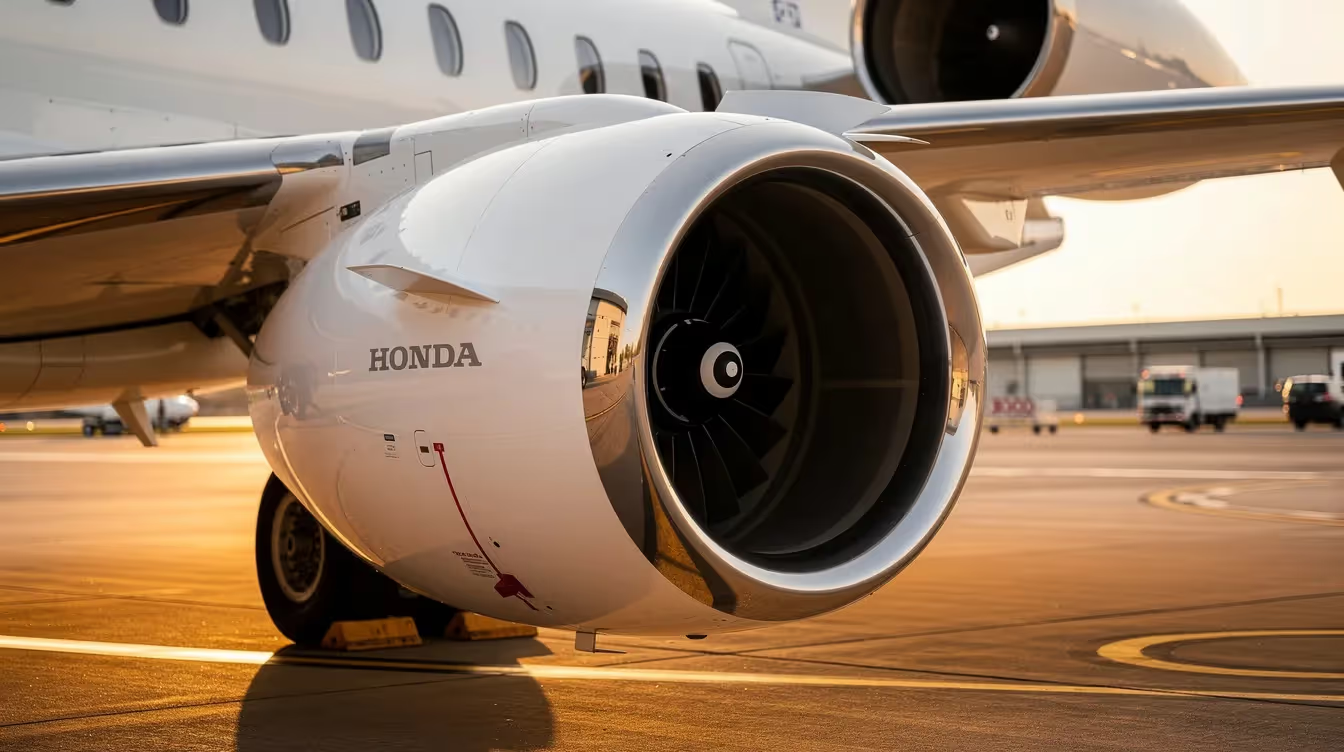
Are you interested in the technology behind the HondaJet, considering a private jet charter, or simply passionate about aviation innovation? This page provides a comprehensive overview of the Honda jet engine, focusing on the GE Honda HF120 powerplant, its unique over-the-wing engine mount (OTWEM) design, and the impact these features have on performance, efficiency, and the private charter market. Whether you are a charter customer seeking cost-effective and reliable light jet options, an aviation enthusiast curious about cutting-edge aircraft engineering, or an operator evaluating fleet choices, understanding the Honda jet engine is essential. The Honda jet engine is central to the HondaJet’s performance. The GE Honda HF120, its over-the-wing engine placement, and natural laminar flow aerodynamics define the HA-420, HondaJet Elite, and HondaJet Elite II family.
The HF120 is a GE Honda turbofan with FAA type certification, powering a light business jet with strong fuel efficiency and practical ranges around 1,000–1,200 nm.
The HondaJet features an over-the-wing engine mount (OTWEM) design, which is a departure from traditional business jets that typically mount engines at the rear of the fuselage.
The Over-The-Wing Engine Mount configuration allows for improved aerodynamic performance compared to conventional rear-mounted engines.
Jettly can arrange on-demand flights on HondaJet and comparable light jets through a digital marketplace with transparent pricing and global aircraft access.
This guide covers performance, operating cost, SAF testing, safety, and charter use cases.

Honda Aircraft Company is a subsidiary of American Honda Motor Co., based in Greensboro, North Carolina. Honda Aircraft Company was launched in 2006 to handle research, development, sales, and service for Honda Aircraft and the HondaJet family, which now appears alongside other leading private plane manufacturers across budgets and missions.
The history starts earlier. Honda began aircraft and airship design research in 1986, with HA-420 concept work in the late 1990s. The prototype flew its first successful test flight on 3 December 2003. The company founder for the aviation effort was not a single person; lead designer Michimasa Fujino shaped the concept, engine location, wing, fuselage, and cabin strategy.
The ha 420 received type certification from the Federal Aviation Administration in December 2015, and its introduction as the certified production version entering service came with the first delivery that same month. The certified production aircraft became known for two engines, over-wing mounts, and natural laminar flow aerodynamics.
By December 2021, 200 HondaJet aircraft had collectively logged 98,000 flight hours, achieving a dispatch reliability rate of 99.7%.By 2024–2025, the fleet exceeded 250 aircraft worldwide. Deliveries of the HondaJet slowed in 2018 due to a combination of the transition to the HondaJet Elite and customers’ schedules, and again in 2020 due to the COVID-19 pandemic, even as large fractional operators like NetJets expanded their private aviation services to meet growing demand.
The HondaHonda jet engine story began before the airframe. Honda’s research facility explored small turbofan technology from the mid-1980s, with the HF118 later used for flight testing on research aircraft.
In 2004, General Electric and Honda formed a joint venture, GE Honda Aero Engines. The goal was to create a certified GE Honda engine model for small jet engines in the very light class.
The HF120 launched as the joint venture’s first commercial engine. It received FAA certification and type certificate approval in 2013, and then wider aviation authority approvals. The Federal Aviation Administration (FAA) process included endurance, icing, and other testing for certification.
The GE Honda HF120 turbofan engine delivers high fuel efficiency and long maintenance intervals, characterized by an over-the-wing configuration. It was intended for high-utilization operating profiles, including owner use and charter service.
The HondaHonda jet engine produces about 2,095 lbf of thrust per engine. It uses a two-spool architecture with axial and centrifugal compression, a single-stage high-pressure turbine, and FADEC control.
|
HF120 item |
Approximate figure |
|---|---|
|
Takeoff thrust |
2,095 lbf |
|
Dry weight |
466 lb |
|
Bypass ratio |
2.9 |
|
Target TBO |
5,000 hour |
|
Cycle |
Standard Brayton cycle |
The HF120 employs a standard Brayton cycle, which is common for jet turbines, consisting of air intake, compression, combustion, and thrust generation phases. The HF120 features a wide-chord swept fan blisk and counter-rotating spool architecture, improving aerodynamic efficiency, which ultimately influences the overall cost of private jet ownership and operation as well as hourly pricing on private charter aircraft across different size categories.
The HF120 incorporates advanced materials, such as superalloys for turbine reductions, enabling higher performance and longer maintenance intervals. Its design maximizes airflow, minimizes pressure drops, and minimizes harmful emissions through its unique combustor design.
These improvements help reduce fuel burn, maintenance events, and lifecycle cost. For charter customers, this can support more competitive rates on short regional missions.
Honda’s OTWEM layout is the most visible part of the Honda jet engine story. Most business jet designs mount engines on the rear fuselage. Honda moved them above the wing.
Honda Aircraft and Mississippi State University’s Raspet Flight Research Laboratory studied nacelle positions to preserve laminar air flow and reduce wave drag. Honda’s Over-The-Wing Engine Mount configuration enhances aerodynamics by delaying shock wave formation at high speeds, thereby reducing wave drag.
The over-the-wing engine placement improves aerodynamics by allowing the airflow over the wing to interact with the engine’s airflow, reducing total air resistance during flight. This unique engine placement contributes to the HondaJet’s ability to fly faster than similarly sized aircraft, enhancing its performance in the light business jet market.
By placing engines over the wings, Honda eliminated the need for heavy internal structures, increasing cabin volume by 20% compared to similarly sized aircraft while fitting that space into an overall length of 42 ft 7 in (12.99 m). The engine’s placement above the wings leads to a quieter cabin environment by isolating vibrations from the fuselage. That means less noise for a passenger on short hops such as New York–Chicago or London–Nice, and these same design choices are part of what makes the HondaJet competitive among cross-country aircraft options for longer missions.
The original Honda Jet was a compact, twin-engine light business jet with 4–5 main seats and up to 6 occupants depending on configuration. It is powered by two HF120 engines and designed for regional flight.
The Hondajet elite arrived in 2018 with upgrades to range, avionics, takeoff performance, and cabin noise control. An auxiliary fuel tank helped increase the ideal-condition range to about 1,437 nm.
The Honda Jet Elite II keeps the same Honda Jet engine and over-wing layout, but adds avionics, stability features, and Emergency Autoland. Honda Jet Elite II. The FAA certified it as a light business jet, and it became notable as the first twin-turbine very light jet offered with that system, contributing to the broader global fleet of private jets and its evolving technology trends.
The Hondajet APMG package, also called the advanced performance modification group, lets earlier models gain performance improvements without changing the base engine, which can be factored into pricing with tools like a jet card flight cost estimator when comparing trip options.
The HondaJet has a maximum cruising speed of 422 knots (782 km/h). The maximum altitude for the HondaJet is 43,000 feet (13,106 meters). The HondaJet has a range of 1,223 nautical miles (2,265 kilometers) at long range.
Takeoff distance is under about 4,000 ft, and landing distance is near 3,000 ft. This helps the aircraft use smaller airports closer to city centers, and tools like Jettly’s airport locator for private jet charter can help identify suitable fields while you consider where private jets typically land and the benefits of different airport types.
Operating costs matter in charter pricing, and tools like a private jet charter cost estimator can help translate those numbers into trip-level pricing. For owners and operators, a full private jet operating cost breakdown clarifies how fuel, crew, maintenance, and other expenses compare across aircraft types. Fixed costs for operating a HondaJet, based on 300 hours of flight per year, total approximately $202,488. Variable hourly costs for operating a HondaJet are estimated at $1,561.60 per hour, which includes fuel, maintenance, and engine program costs. The annual operating cost for a HondaJet HA-420 is approximately $1,019,567.
For Jettly customers, the practical value is simple: a HondaJet can be cost-effective for 2–5 customers on routes such as Toronto–New York, Los Angeles–Las Vegas, or London–Geneva, especially when leveraging crowdsourced and shared-seat private jet flights to lower the per-passenger cost, and understanding the trade-offs between shared charter flights and full private charters can further refine the choice for each trip.
Safety is central to the Honda jet engine and airframe certification. The HF120 was certified by the FAA in 2013. The HA-420 followed with Federal Aviation Administration type certification in 2015, and most charter operations using the type fall under Part 135 charter company regulations and oversight.
The novel engine placement required validation for flutter, structural loads, emergency procedures, and high-speed aerodynamics. Emergency Autoland on the HondaJet Elite II also reflects a broader move toward automation that can assist if a pilot becomes incapacitated.
As of August 2025, the HA-420 had been involved in six hull-loss accidents with five fatalities. That context matters, but charter operators must follow maintenance, crew training, and regulatory oversight standards before an aircraft is offered for service, and travelers can evaluate operators within the broader landscape of private and charter airlines and their services.
Honda Aircraft Company and GE Honda have positioned the HF120-powered HondaJet as an efficient aircraft in the light category. The HondaJet achieves significant fuel economy, reportedly using up to 20% less fuel than comparable small aircraft due to aerodynamic drag reduction, which can translate into more affordable private jet charter pricing for travelers.
The HF120 demonstrates full compatibility with 100% Sustainable Aviation Fuel (SAF), contributing to the aviation industry’s transition towards net-zero carbon emissions. GE Honda completed ground tests on 100% SAF in 2022 and 2023, while approved aircraft can already use current 50% SAF blends under fuel standards.
Honda has also highlighted 100% SAF flight activity around Greensboro and Piedmont Triad International Airport. For sustainability-conscious travelers, Jettly can help compare efficient aircraft and request carbon offset options or SAF uplift where available.
The HondaJet fits routes under about 2–3 hours, especially where speed, runway access, and cost control matter. Jettly offers on-demand access to 20,000+ aircraft, instant pricing, and comparisons between HondaJet, light jet, midsize, and other aircraft classes without fractional ownership or jet cards, while still giving frequent flyers the option of structured jet card programs with fixed hourly rates and a deeper understanding of what jet cards are, how they work, and their costs.
Typical missions include, and can be arranged through Jettly’s global private charter aircraft network:
2–5 passengers flying under 1,000–1,200 nm.
Regional airports with shorter runways.
Business trips need flexible departure times.
Leisure travel for ski weekends, coastal resorts, or remote property visits.
Some operators or owners may sell aircraft, which can affect charter availability and secondary-market fleet supply, which is one reason many travelers prefer flexible private jet membership programs over ownership, even when they are evaluating affordable private aircraft options across different categories for purchase.
Learn more about Jettly’s charter options at https://www.jettly.com, or compare leading private jet charter companies and their services.
Choosing a HondaJet depends on range, cabin width, wing span, baggage, budget, and passenger count. Compared with aircraft such as the Phenom 100/300 or Citation CJ series, the Honda jet engine often supports lower fuel use and strong short-field performance.
|
Factor |
HondaJet strength |
When to choose a larger jet |
|---|---|---|
|
Passengers |
2–4 ideal |
5+ with more luggage |
|
Range |
Regional routes |
Longer nonstop routes |
|
Airport access |
Short runways |
Larger airports acceptable |
|
Cost |
Efficient light trips |
More cabin space is needed |
HondaJet-class aircraft are often among the most cost-effective jets for 2–4 passenger trips, though pricing varies by region, season, operator, and availability, especially when compared with fractional jet ownership programs and their costs or other affordable airplane rental options and pricing structures.
The HF120 was developed for very light business jets and can help the HondaJet use up to roughly 15–20% less fuel than many older aircraft of similar size. Real-world efficiency depends on payload, weather, routing, and altitude.
GE Honda Aero Engines supports the HF120, while Honda Aircraft Company maintains an Authorized Service Center network for the airframe. Many owners use engine programs to make maintenance costs more predictable.
The HondaJet is best for short- to medium-range missions. Routes around 1,000–1,200 nm are realistic depending on load and weather. Longer flights may require a fuel stop or a different aircraft.
Most charter customers use the cabin for 2–4 people with light to moderate luggage. Some layouts allow 5–6 occupants depending on seats, lavatory configuration, and operator policy.
Visit https://www.jettly.com, enter origin, destination, dates, and passenger count, then review instant pricing. Jettly can show HondaJet, HondaJet Elite, or comparable light business jet options, plus services such as ground transportation and catering.
The Honda jet engine is not just a powerplant. It shapes the aircraft’s aerodynamics, cabin space, noise profile, fuel economy, and charter economics. For travelers who want a modern light jet for regional missions, the HondaJet is a practical option, whether they fly ad hoc charters or use curated jet card programs compared across top providers.
Ready to compare HondaJet and similar light business jets? Explore flight options or request a quote at https://www.jettly.com.
Share this post:
Jay Franco Serevilla
May 20, 2026
|
5
min read
Discover tips and trends in the industry.

5
min read
Private Jet Charter Colorado Springs: Fly Smarter with Jettly
Private jet charter in Colorado Springs offers a convenient and flexible travel solution for business and leisure travelers. With access to over 20,000 aircraft through Jettly, booking a flight is quick and hassle-free, allowing you to bypass commercial airline delays and enjoy tailored services. Experience the benefits of private aviation, including direct airport access and personalized itineraries.
Read More
5
min read
Boise Charter Flights with Jettly: Private Jets, Pricing & Top Routes
Boise charter flights with Jettly offer travelers a flexible and efficient way to fly in and out of Idaho's capital. With access to over 20,000 aircraft, Jettly provides personalized scheduling, enhanced privacy, and direct routing to numerous destinations, making it ideal for both business and leisure travel.
Read MoreStay updated with our latest insights and tips to elevate your journey with us.
MEMBERSHIPS AND ASSOCIATIONS



Disclaimer: Jettly operates as a charter broker, offering access to a global digital jet charter marketplace. Jettly is not a direct air carrier and does not own or operate aircraft. All advertised flights are conducted by third-party air carriers that are fully licensed and hold the appropriate Part 135 or Part 121 certifications issued by the Federal Aviation Administration (FAA) or equivalent regulatory authorities under U.S. or foreign law. Jettly complies fully with the U.S. Department of Transportation's Part 295 and Part 298 Charter Broker regulations. Jettly does not carry additional liability insurance. Passengers are covered by aircraft operator insurance. TICO: 50023770


