


Login
Get Instant Pricing On 23,000+ Aircraft

>

If you have an upcoming flight on an Embraer ERJ 145 and find yourself concerned about Embraer ERJ 145 safety, you are not alone. Regional jets often raise questions for passengers unfamiliar with smaller aircraft. The good news: the ERJ 145 has maintained an excellent safety record over three decades of commercial service, with zero passenger fatalities in scheduled airline operations as of 2026.
Basically, the ERJ 145 is one of the safest regional jets in commercial service.
This article breaks down everything you need to know about the ERJ 145’s safety performance, design features, and operational standards—plus how private charter compares if you prefer more control over your travel experience.
The Embraer ERJ 145 has achieved a remarkable aviation safety record that nervous flyers should find reassuring. Here are the essential facts:
Zero passenger fatalities have been recorded in scheduled airline service for the ERJ 145 family as of 2026
More than 1,200 aircraft across the ERJ 135/140/145 family have been delivered since the mid-1990s, accumulating millions of flight hours
Major carriers, including American Eagle, Piedmont Airlines, United Express, and Envoy Air, operate this regional jet daily across North America, Europe, and other regions
Most negative online reviews focus on comfort issues like cramped seats and limited leg room—not safety or reliability concerns
The ERJ 145 meets the same FAA Part 25 certification standards as larger aircraft like the Boeing 737 and Airbus A320
Private charter through platforms like Jettly offers comparable safety with greater control over schedule, route, and cabin environment
The Embraer ERJ 145 is a regional jet with 50 seats, produced by the Brazilian aerospace manufacturer Embraer. The aircraft first flew in August 1995 and entered airline service in 1997. Originally designated EMB-145, it was later renamed ERJ-145 to reflect its regional-jet classification.
Embraer produced the ERJ 145 family as part of a successful regional jet line, which also includes the ERJ 135 and ERJ 140 models introduced in 1999 to expand the product line and meet market demands. Production continued until 2020, with 1,231 Embraer aircraft delivered across the ERJ 135/140/145 family variants. As of the end of production, operator accounts worldwide managed over 1,200 aircraft from this line. Many of these aircraft remain in active service today, operating daily routes in North and South America, Europe, and Africa.
The ERJ 145 typically seats 50 passengers in a 1x2 configuration, providing a more spacious feel compared to other regional jets with a 2x2 layout. For more technical performance data, many operators reference the Embraer ERJ 145 specs, range, and charter rates when evaluating regional fleet options.
The ERJ 145 features a distinctive 1-2 seating arrangement with a single aisle and typically one flight attendant. Stage lengths generally cover short flight sectors under two hours, connecting cities like:
Chicago to Cedar Rapids
Detroit (Flint) to Chicago
Albany to JFK in NY
Toronto to regional Canadian destinations
Philadelphia to smaller northeastern airports
The ERJ 145 is often used by major carriers for short-haul, regional flights, connecting regional cities and facilitating seamless travel for passengers who need to make connecting flights as part of their journey.
The aircraft was designed as a faster, smoother alternative to older turboprops like the De Havilland Dash 8. This jet-powered upgrade improved passenger perception of regional travel without compromising safety standards.
The ERJ platform shares core systems with several other Embraer products:
|
Variant |
Role |
Notes |
|---|---|---|
|
ERJ 135 |
Regional jet |
37 seats |
|
ERJ 140 |
Regional jet |
44 seats |
|
ERJ 145 |
Regional jet |
50 seats |
|
Legacy 600/650 |
Business jet |
Executive configuration |
|
R-99 |
Military aircraft |
Surveillance and reconnaissance |
|
This multi-platform use across commercial, business, and military roles demonstrates extensive validation of the underlying airframe and systems. |
||
Let’s begin with explicit reassurance: according to publicly available safety databases through 2026, the ERJ 135/140/145 family has experienced approximately 26 reportable accidents and incidents, with roughly 11 hull losses. Critically, none resulted in passenger fatalities during scheduled airline operations.
This distinction matters. The aircraft family has sustained significant damage in some events, yet maintained occupant survival—a testament to robust design and safety equipment.
Statistical analysis ranks Embraer among the safest manufacturers, with a fatal accident rate of just 0.01 per thousand years of service. The ERJ-145 family’s safety profile is considered superior to that of other regional aircraft, including the Bombardier CRJ200 and turboprops such as the ATR family.
When reading aviation safety statistics, it helps to understand the categories:
Incident: Any occurrence affecting safety that does not result in an accident
Accident: An occurrence involving injury, death, or significant property damage
Hull loss: An aircraft destroyed or rendered uneconomical to repair
The ERJ 145’s 26 incidents/accidents, including 11 hull losses, represent a very low rate when spread across more than 1,200 aircraft operating for approximately 30 years. This equates to roughly 0.9 hull losses per 100 aircraft over the fleet’s operational life—comparable to or better than many transport-category aircraft across similar timeframes.
Several documented cases demonstrate the aircraft’s survivability:
CommuteAir United Express, March 2019 (Presque Isle, Maine): An ERJ 145 experienced runway misidentification in snow conditions. Despite the pilot's error due to confirmation bias, all occupants escaped uninjured after the aircraft landed at the wrong airport.
Curitiba Hard Landing (Brazil): An ERJ 145 landed with a positive acceleration of 11 g—an extremely hard impact that caused the fuselage to break in two after the wings. Despite this catastrophic structural damage, all 40 occupants escaped uninjured while the crew completed braking procedures and evacuated.
Chicago O’Hare, November 2019: An Envoy Air ERJ 145 operating for American Eagle slid off the runway in icy conditions. No fatalities occurred.
The FAA, EASA (European Union Aviation Safety Agency), and ANAC (Brazil’s civil aviation authority) have not mandated major structural redesigns or groundings due to systemic safety problems with the ERJ 145. The absence of design-related accidents or widespread airworthiness directives targeting fundamental flaws suggests the aircraft meets or exceeds regulatory standards.
Safety results from design, engineering, maintenance, and operation—not just accident statistics. The ERJ 145 incorporates multiple redundant systems and proven technologies that protect passengers and crew.
The ERJ 145 is powered by twin rear-mounted Rolls-Royce AE 3007 turbofan engines, which help minimize cabin noise. This configuration provides critical redundancy: should one engine fail, the aircraft is certified and tested to safely continue flight to a suitable airfield. This is a fundamental design principle in transport-category aircraft, rigorously validated through certification testing.
The AE 3007 is a proven power plant used across multiple aircraft types, ensuring:
Deep supply chain for maintenance parts
Extensive pilot and mechanical technical expertise
Well-documented performance characteristics
The ERJ-145 has a cruise speed of approximately 450 knots and a range of up to 2,000 nautical miles in its extended range variant. These capabilities make it well-suited for short-haul regional flights while providing operational flexibility for various route lengths.
The supercritical wing design improves fuel efficiency and performance while maintaining structural integrity. Key specifications include:
|
Feature |
Specification |
|---|---|
|
Maximum operating speed |
Mach 0.78 |
|
Structural safety factor |
1.5x ultimate load |
|
Wing design |
Supercritical |
|
Pressurization |
Standard transport category |
|
Transport-category certification requires that aircraft structures withstand loads well beyond typical operating conditions, with built-in safety factors. |
|
The ERJ 145 typically features the Honeywell Primus 1000 flight deck, which includes:
GPS/INS navigation systems
Weather radar
Terrain Awareness and Warning System (TAWS)
Modern autopilot capabilities
These systems help crews avoid dangerous situations such as controlled flight into terrain, navigate safely through weather, and maintain precise navigation. The Primus 1000 is a mature, proven avionics suite with extensive operational validation.
The ERJ 145 was certified under FAR Part 25 and JAR Part 25—the stringent transport-category standards applicable to all commercial airlines regardless of size. Certification testing includes:
Stall characteristics
Icing conditions
High-altitude performance
Emergency evacuations
Water ditching procedures
Fire safety compliance
This regulatory parity means the ERJ 145 is held to the same engineering standards as a Boeing 737 or Airbus A320.

An aircraft’s safety record depends heavily on how airlines operate and maintain it. The Embraer ERJ 145 is a successful regional jet, widely adopted by airlines for its operational achievements and proven reliability. Major ERJ 145 operators demonstrate strong safety cultures backed by extensive resources. The ERJ 145 was particularly popular in the American market for regional routes, but faced challenges in the European market due to logistical difficulties.
As of August 2021, CommuteAir was the largest operator of the ERJ 145, operating a fleet of 165 aircraft under the United Express brand.
American Eagle: Operated by Envoy Air and other regional carriers on behalf of American Airlines, these flights follow strict safety management and FAA Part 121 standards.
Piedmont Airlines: A wholly owned subsidiary of American Airlines, Piedmont operates ERJ 145s under the American Eagle brand. The airline benefits from American’s extensive safety oversight, engineering resources, and training infrastructure.
United Express: Operated by CommuteAir and other regional partners, following the same rigorous Part 121 requirements.
ERJ 145 operators follow maintenance schedules based on flight hours and cycles (individual takeoffs and landings):
|
Check Type |
Frequency |
Scope |
|---|---|---|
|
A-check |
~Monthly |
Routine inspection |
|
B-check |
Quarterly |
Systems review |
|
C-check |
18-24 months |
Comprehensive inspection |
|
D-check |
6-10 years |
Complete overhaul |
|
Engines typically undergo overhaul or replacement after 20,000-30,000 hours, depending on the variant and maintenance program. |
||
Pilots flying the ERJ family hold a single type rating across ERJ 135/140/145 variants. Training requirements include:
Initial type rating with classroom instruction
Simulator proficiency checks
Emergency procedure drills
Recurrent training at least annually (often twice yearly)
The training pipeline is well-established, with numerous simulators and training centers globally certified to provide ERJ 145 type rating and recurrent training, supporting the broader network of charter and private airlines that rely on the type.
Modern operators implement Safety Management Systems (SMS) required by regulators. These systems:
Track incidents and maintenance findings
Identify operational trends
Implement corrective actions proactively
Prevent incidents from escalating to accidents
When operators of the size and resource level of American Airlines commit to an aircraft type, the safety and reliability benefits extend across the entire fleet.
Many online reviews describe ERJ 145 flights as cramped and uncomfortable. This is valid feedback about the cabin—but it is absolutely separate from safety performance.
Passengers should be aware of bag size restrictions, as the ERJ 145 has small overhead bins and many carry-on bags may need to be gate checked. Additionally, passengers can expect limited in-flight entertainment options, as the aircraft does not have video screens or Wi-Fi, so travelers should bring their own entertainment.
The ERJ 145’s narrow fuselage creates several comfort challenges:
|
Feature |
ERJ 145 |
Typical Narrowbody |
|---|---|---|
|
Seat pitch |
~31 inches |
32-33 inches |
|
Seating layout |
1-2 across |
3-3 across |
|
Overhead bins |
Small (often gate check) |
Standard carry-on |
|
Aisle width |
Narrow |
Standard |
|
Ceiling height |
Low |
Standard |
|
The main cabin can feel cramped, particularly for taller passengers. The 1-2 arrangement means every seat is either a window or aisle, but shoulder room remains limited. |
||
Older ERJ 145s in some regional fleets may lack modern amenities:
No wi fi connectivity
No power outlets
No built-in entertainment systems
Limited galley service
Basic seat materials
These limitations can make flights feel basic by contemporary economy class standards, even though the aircraft remains mechanically sound and safe.
Regional jets like the ERJ 145 can feel turbulence more acutely than larger aircraft due to:
Lower aircraft mass
Different wing loading characteristics
Typical operating altitudes and routes
The bumps are typically well within design limits and safety margins. Pilots are trained and certified for regional profiles, and the aircraft is tested for operation in icing, thunderstorms, and high-altitude environments.
Comfort limitations do not equal safety deficiencies. An ERJ 145 with narrow seats and no modern amenities is still:
Structurally sound
Properly maintained
Safely operated
Certified to transport-category standards
Nervous flyers should focus on objective safety metrics rather than comfort reviews when assessing whether to board an ERJ 145.
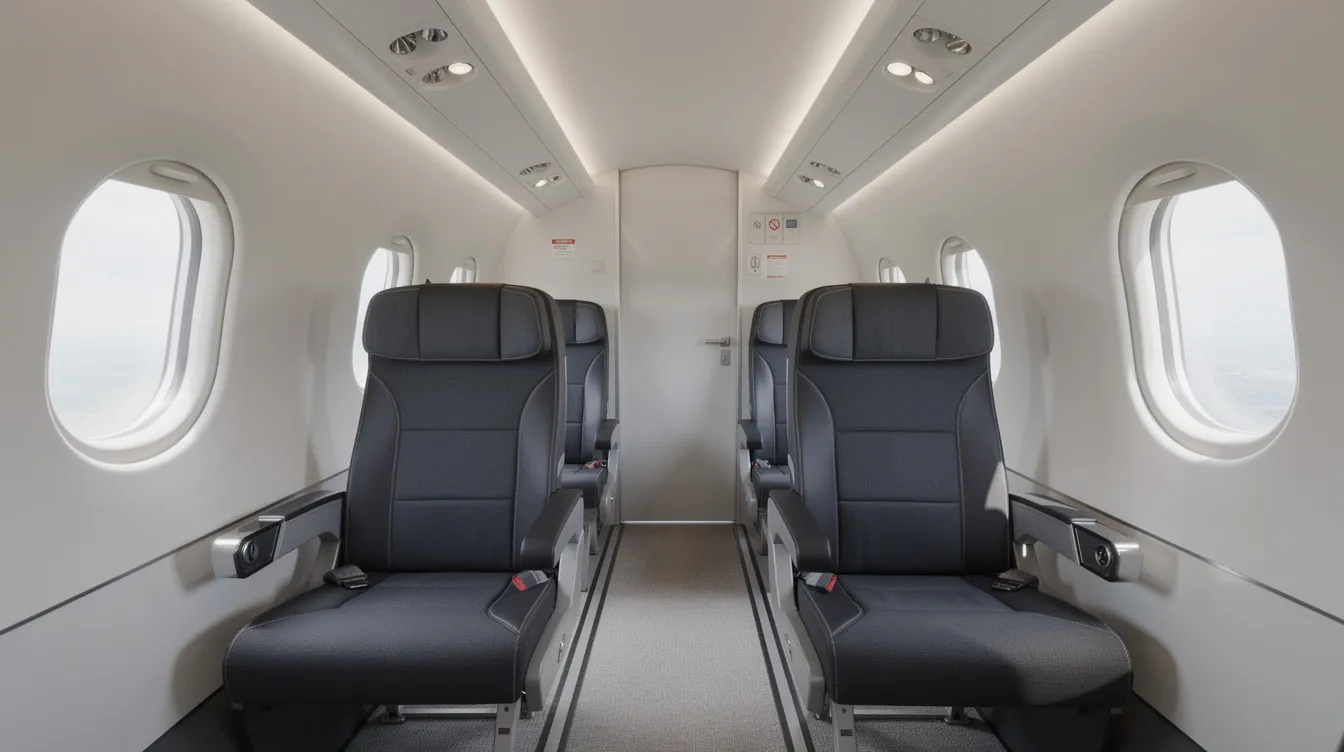
Some ERJ 135/145 airframes find second lives in corporate or private configurations. These conversions maintain the same robust airframe and core systems while transforming the cabin experience.
Embraer offers the Legacy 600 and Legacy 650 business jets based on the ERJ platform. These conversions feature:
Executive seating for 8-14 passengers
Enhanced interior materials
Full galley and lavatory facilities
Entertainment systems
Same twin-engine redundancy
Identical safety certification standards
The safety features—twin engines, advanced avionics, structural integrity—remain unchanged from the commercial variant.
Charter operators using ERJ-based aircraft or similar regional jets must comply with commercial regulations such as FAA Part 135 (On-Demand Air Taxi and Charter Service) or equivalent in other jurisdictions. For context, a guide to charter airlines and private flights outlines how these operators fit within the broader private aviation landscape, and detailed explainers on Part 135 charter companies and why they matter highlight the regulatory backbone. These regulations mandate:
Maintenance standards comparable to Part 121 carriers
Pilot qualification and duty-time limits
Operational procedures and safety oversight
Regular aircraft inspections and registration
Through a platform like Jettly, travelers can access aircraft similar in size and performance to the ERJ 145 but configured for private groups and even use a private jet charter cost estimator or jet card flight cost estimator to understand pricing before booking. Benefits include:
Departure from your home airport or preferred facility
Control over departure times and routing
Reduced stress from avoiding tight connection scenarios
No jet bridge crowds or gate wait times
Generous baggage allowance
Cabin configured for your group
Private charter offers enhanced control that can reduce the stress often associated with commercial travel—particularly valuable for nervous or time-sensitive passengers, whether they opt for shared charter flights or full private charters, and platforms like Jettly explain how private jet charter pricing works so travelers can budget accurately.
Regional jets and business jets can be optimized for operational efficiency. Some operators offer:
Carbon-offset programs
Sustainable aviation fuel (SAF) options
Empty-leg flights at discounted rates
While private charter may result in higher per-seat emissions than a full commercial flight, these options help environmentally conscious travelers manage their impact.
The choice between commercial regional jet service and private charter depends on your priorities. Nearly half of regional jet passengers in the U.S. have flown on an ERJ 145 at some point, reflecting its significant presence in the market. Here’s a practical comparison:
|
Factor |
Commercial ERJ 145 |
Private Charter |
|---|---|---|
|
Cost per seat |
$150-400 |
$3,000-8,000+ (total aircraft) |
|
Schedule flexibility |
Fixed airline times |
Depart when ready |
|
Privacy |
Shared main cabin |
Exclusive use |
|
Luggage |
Limited, often gate check |
Generous |
|
Airport access |
Major hubs only |
5,000+ airports |
|
Connection risk |
Subject to delays |
Point-to-point |
|
Travel time |
4-6 hours with connections |
2-3 hours direct |
Business day-trip between regional cities: A Chicago-to-Memphis commercial itinerary might require connecting through a busy hub, which could cause delays. A charter flight from a local airport eliminates connections and offers departure flexibility, allowing you to begin your day on your schedule, especially if you use a NetJets alternative like Jettly that focuses on flexible, on-demand service.
Family vacation with multiple bags: Commercial ERJ 145 overhead bins often cannot accommodate standard carry-ons, requiring gate check. Charter aircraft handle family luggage without hassle, and some travelers further reduce costs by using crowdsourced private jet flights and shared empty seats or following guides on how to buy a seat on a private jet and how to get a private jet seat easily.
Emergency or time-sensitive travel: Charter can depart within hours rather than waiting for the next scheduled airline flight—particularly valuable when commercial options to smaller cities are limited.
Jettly’s platform sources different aircraft categories to match group size and distance, helping travelers understand how many passengers different private jet types can carry and drawing from its wider private charter aircraft marketplace:
Light jets: 4-6 passengers, shorter range
Midsize jets: 6-8 passengers, medium range
Regional-jet-sized options: 8-10+ passengers, longer flights
Turboprops: Cost-effective for shorter distances
The ERJ 145 remains a benchmark for regional jet safety and performance. Understanding its characteristics helps travelers evaluate charter alternatives.
Evaluate not just the aircraft type, but how you want to fly:
Budget-conscious leisure travel may favor commercial service
Time-sensitive business trips often justify charter economics
Group travel can make charter cost-competitive per person
Anxious flyers may benefit from charter’s reduced stress factors

Based on publicly available records through 2026, the ERJ 145 family has an excellent safety history with no passenger fatalities in scheduled airline operations. The aircraft is certified to the same FAR Part 25 transport-category standards as larger jets like the Boeing 737 or Airbus A320.
Regional jets are not inherently less safe than larger aircraft. They are optimized for different mission profiles—shorter routes and smaller airports—while maintaining identical safety standards. If you are concerned about flying on an ERJ 145, the objective data should provide significant reassurance.
While the ERJ 135/140/145 family has experienced incidents and hull losses over its operational history, these events have not resulted in passenger fatalities in regular scheduled airline service as of 2026.
Some events have involved serious damage, including off-runway excursions and hard landings that damaged airframes beyond repair. However, occupants survived due to robust design, effective safety equipment, and trained crew procedures. When assessing aircraft safety, look at rates and context across the entire fleet rather than isolated headlines.
Smaller aircraft like the ERJ 145 can feel turbulence more intensely due to physics: lower mass and different wing loading mean the plane responds more noticeably to air movement. This sensation does not indicate danger—the bumps are typically well within design limits that the aircraft was tested to withstand.
Pilots often adjust altitude or speed to improve ride quality when possible, but cannot eliminate all turbulence, especially near weather systems or in wind conditions over mountainous terrain. Rest assured that turbulence is uncomfortable but not usually dangerous to the aircraft's structure.
From a regulatory and engineering standpoint, both large jets and regional jets must meet the same safety standards and are considered comparably safe. The accident rate per flight hour for large jets and regional jets is similar.
Route characteristics, weather conditions, and airport factors influence how a flight feels more than aircraft size. Anxious passengers might benefit from selecting seats over the wing or near the front, where motion can feel slightly reduced. The aircraft type matters far less than operator quality and maintenance standards.
Reputable charter operators follow strict commercial regulations (FAA Part 135 or equivalent) for maintenance, pilot qualifications, duty-time limits, and operational control. Safety levels are comparable to those of airlines operating under Part 121.
Jettly connects travelers with vetted operators and aircraft, helping them select options that balance safety, comfort, and budget for specific trips, often by comparing the best private jet charter companies and their services. For frequent flyers, structured solutions like private jet cards with fixed hourly rates or flexible private jet membership programs can simplify planning while preserving safety and cost transparency. For passengers who are highly anxious about crowds, tight connections, or busy airport environments, private charter offers a way to reduce stress while maintaining the same strong safety standards as commercial aviation.
The Embraer ERJ 145 has demonstrated a strong safety record over three decades of operation. With zero passenger fatalities in scheduled airline service as of 2026 and approximately 1,200 aircraft delivered worldwide, the plane has earned its place as a reliable regional workhorse for major carriers.
Negative commentary about the ERJ 145 overwhelmingly concerns cabin space, seat comfort, and lack of modern amenities—comfort issues—rather than structural problems or operational safety deficiencies. The aircraft is certified to the same transport-category standards as larger commercial jets, undergoes rigorous maintenance, and is operated by major carriers under strict FAA Part 121 oversight.
Whether flying commercially on an ERJ 145 or chartering a comparable aircraft through Jettly, travelers benefit from stringent maintenance protocols, professional pilot training with recurrent checks, and comprehensive regulatory oversight. Embraer ERJ 145 safety performance provides objective reassurance for any passenger, nervous or not.
Ready to experience private travel on your terms? Explore flight options or request a quote at https://www.jettly.com.
Share this post:
Jay Franco Serevilla
Apr 13, 2026
|
5
min read
Discover tips and trends in the industry.

5
min read
Luxury Personal Jet: Ultimate Guide to High-End Private Aviation
The luxury personal jet market is rapidly evolving, offering travelers access to high-end private aviation without the need for ownership. This comprehensive guide covers various categories of jets, from light jets to VIP airliners, and highlights key features, pricing, and the benefits of chartering through platforms like Jettly. Discover how to select the right aircraft for your mission and explore the future of luxury aviation.
Read More
5
min read
When Are Cheapest Flights? A Practical Guide for 2026 Travelers
Finding the cheapest flights relies on strategic timing rather than luck. This guide outlines optimal booking windows, the best days to fly, and how to leverage private jet options for savings. Understanding seasonal trends and setting price alerts can further enhance your chances of securing the best fares.
Read MoreStay updated with our latest insights and tips to elevate your journey with us.
MEMBERSHIPS AND ASSOCIATIONS



Disclaimer: Jettly operates as a charter broker, offering access to a global digital jet charter marketplace. Jettly is not a direct air carrier and does not own or operate aircraft. All advertised flights are conducted by third-party air carriers that are fully licensed and hold the appropriate Part 135 or Part 121 certifications issued by the Federal Aviation Administration (FAA) or equivalent regulatory authorities under U.S. or foreign law. Jettly complies fully with the U.S. Department of Transportation's Part 295 and Part 298 Charter Broker regulations. Jettly does not carry additional liability insurance. Passengers are covered by aircraft operator insurance. TICO: 50023770


