



Login
Get Instant Pricing On 23,000+ Aircraft

>
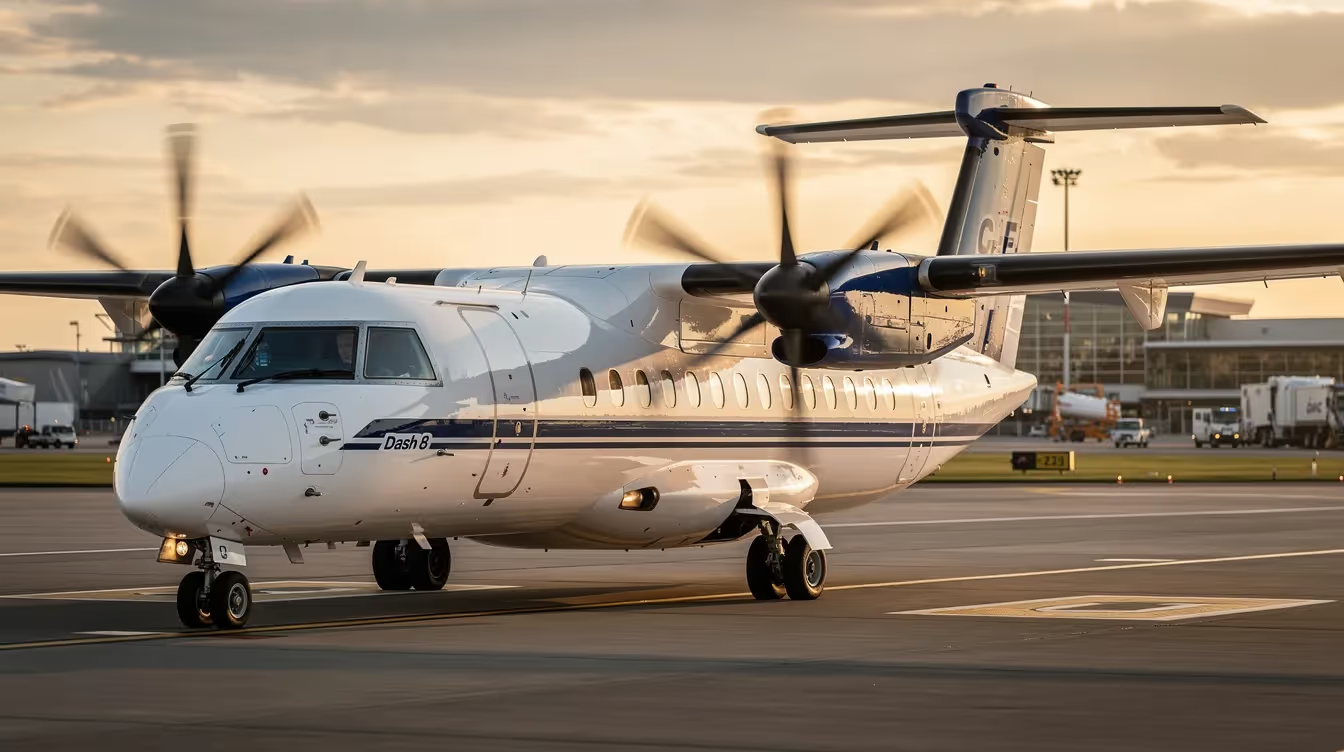
The Dash 8 engine plays a pivotal role in powering the de Havilland Canada DHC 8 and Bombardier Dash 8 series of turboprop aircraft. Known for its efficiency, reliability, and adaptability, the Dash 8 engine family has supported regional air travel since the early 1980s. These engines enable the aircraft to operate from shorter runways and smaller airports, making them ideal for diverse missions including regional airline service, charter flights, and operations in remote areas. Understanding the Dash 8 engine’s development, performance, and applications provides valuable insight for travelers and operators considering turboprop options alongside private jets and other aircraft types.
The Dash 8 engine is the Pratt & Whitney Canada PW100/PW150 family that powers the De Havilland Canada DHC-8, Bombardier Dash, and current De Havilland Dash 8 aircraft series.
Engine upgrades from the original engine PW120 to the PW150A enabled improved cruise performance, more seats, longer range, and Q Series comfort.
The Dash 8 offers lower operational costs than many regional jets on short sectors because turboprops use fuel efficiently at regional speeds.
Key milestones include first flight on June 20, 1983, service entry with NorOntair in 1984, Bombardier Aerospace development of the QQ series, and new hydrogen-electric concepts.
For Jettly customers, understanding Dash 8 engine performance helps compare turboprop aircraft with jets for group charters, remote areas, and small airports.
The DHC 8 is a twin-engine turboprop aircraft introduced in 1984 for regional airlines needing reliable service into shorter runways and small in city airports. The aircraft type later became the Bombardier Dash 8 and fits within Bombardier’s broader private and business aircraft lineup, which also includes popular narrowbody airliners like the Boeing 737‑800 for charter, and is again supported under De Havilland Canada.
In plain terms, “Dash 8 engine” means the Pratt & Whitney Canada PW100 family on Series 100/200/300 aircraft and the PW150A on the Dash 8-400. A Dash 8 engine uses a gas turbine core to spin a massive, multi-bladed propeller, generating roughly 90% of the aircraft’s forward propulsion. These engines burn standard Jet-A fuel and provide vastly more power and reliability compared to piston engines.
The Dash 8 engine utilizes a highly efficient three-shaft configuration. Some variants feature a two-stage centrifugal compressor along with a three-stage axial compressor, allowing efficient operation and shortened design. Capacity grew from the shortest fuselage Series 100 with about 37–39 seats to the longer airframe Series 300 and even longer airframe Series 400, which can reach 90 seats, positioning the Dash 8 alongside other multi-class private charter aircraft options in the market.

De Havilland had deep experience with the Dash 7, which used four medium power engines and offered excellent STOL characteristics. That was useful in the company’s traditional area of rugged Canadian and remote service, and de Havilland Canada invested heavily in the development of the Dash 7 and Dash 8 programs, focusing on STOL capabilities and technical innovation. However, four medium-power engines increased fuel burn and maintenance.
In 1980, de Havilland Canada adapted the Dash 7 layout to use two more powerful engines, leading to the development of the PW100 series engines, which significantly increased power. The market DHC felt was opening was for a simpler, faster, lower-cost commuter aircraft; de Havilland responded by making Pratt & Whitney Canada the favored engine supplier.
The Dash 8 aircraft series was developed from the Dash 7, with the first flight of the Dash 8 occurring on June 20, 1983, and it entered service in 1984 with NorOntair. The DHC 8-100 was introduced in 1984. The Dash 8 program was sold to Boeing in 1988, then to Bombardier in 1992, and finally to Longview Aviation Capital in 2019, which revived the de Havilland Canada name.
This redesign traded some extreme stall performance for better range, higher cruise speed, fewer engines, and lower operational costs. It also made the aircraft less expensive to maintain compared to its predecessor, the Dash 7, due to its design and the use of only two engines.
Each aircraft series uses engines matched to cabin length, takeoff weight, payload, and mission profile. The Series 100, Series 200, Series 300, and Series 400 each have different passenger capacities and engine specifications.
|
Model |
Engines |
Typical role |
|---|---|---|
|
Series 100 |
PW120/PW121, about 1,800 shp |
Short routes, 37–39 seats |
|
Series 200 |
PW123, about 2,150 shp |
Better climb and hot-and-high work |
|
Series 300 |
PW123 variants, up to about 2,500 shp |
50–56 seats, longer sectors |
|
Series 400 / Q400 |
PW150A, rated engine power about 4,850 shp and up to 5,071 shp |
68–90 seats, fastest dash |
The Series 100, introduced in 1984, has a maximum capacity of 39 passengers and was powered by the Pratt & Whitney Canada PW120 engine, rated at 1,800 shp.
Series 400, the latest in the Dash 8 series, can accommodate 68 to 90 passengers and is powered by Pratt & Whitney Canada PW150A engines, rated at 4,850 shp, with a cruise speed of 360 knots. The Dash 8-400 is powered by two Pratt & Whitney Canada PW150A engines, each providing up to 5,071 shaft horsepower, allowing for efficient thrust for quick takeoffs and landings, even on unpaved runways.
The q series name refers mainly to active noise and vibration suppression, not a separate engine family. Still, the powerful PrattPratt PW150A made the Q400 one of the most capable conventional turboprops in airline service.
Dash 8 engine performance shows up in speed, range, runway use, and unit cost. The Dash 8-400 has a maximum cruise speed of 360 knots, or 667 km/h, which is 60–90 knots higher than its predecessors, enhancing its operational efficiency.
The Dash 8-400 is often cited around 1,000–1,200 nm of range, depending on payload and conditions. Its maximum takeoff weight is about 65,200 lb, and its takeoff weight on a specific flight depends on passengers, fuel, weather, and runway length.
Modern turboprop aircraft burn less fuel than many regional jets on sectors up to about 400–500 nm. That lowers operational costs and unit cost per seat, especially when air carriers fly high-frequency regional routes. The Dash 8 turboprop engines operate with a high power-to-weight ratio, allowing for superior performance on short runway takeoffs and landings.
Indicative annual operational costs can exceed USD 1.5 million for smaller variants, depending on utilization, fuel, crew, maintenance, and insurance, which also highlights earning potential for those joining Jettly’s high-ticket travel affiliate program that promotes charter services like Dash 8 flights. For comparison, tools like Jettly’s jet card flight cost estimator help operators and frequent flyers understand typical jet program pricing. The Dash 8-400 also improves maintenance efficiency with A-checks extended to 800 hours from 600 hours and C-checks extended to 8,000 hours from 6,000 hours.
For Jettly users, that matters. A Dash 8 can be a cost-efficient alternative to a jet for 30–70+ passengers on routes under about 1,000 nm, and tools like Jettly’s private jet charter cost estimator help put those economics in context alongside jet options.
The Dash 8 airframe was engineered around two powerful engines, so the wing, tail, and landing gear design all support efficient operating from smaller fields, which aligns well with instant‑book platforms such as Zenflight’s private jet marketplace.
The high wing, efficient wing span, and wing area help produce lift at lower speeds while keeping drag controlled in cruise. The stouter t-tail sits above propeller wash, improving stability during landing and steep approaches.
The main landing gear retracts into elongated nacelles behind the engines. This landing gear design keeps the floor lower, supports faster boarding, and helps operations from shorter runways.
The Dash 8 design allows it to operate from small airports with runways as short as 3,000 ft, or 910 m, making it suitable for regional operations in areas with limited airport infrastructure. Using Jettly’s airport locator tool for private charters makes it easier to match Dash 8 capabilities with suitable departure and destination fields. The Dash 8 design also allows for operations from small airports and unpaved runways, which can reduce maintenance costs associated with infrastructure requirements at larger airports.
In the cabin, Q-series aircraft use Active Noise and Vibration Suppression systems. The Dash 8 engines feature an Active Noise and Vibration Suppression (ANVS) system to reduce cabin noise, giving comparatively lower noise levels and a more spacious cabin feel.

Early DHC 8-100/200/300 aircraft used traditional instruments and simpler engine indications. Later Q400 aircraft gained a modernized cockpit with electronic flight displays, enhanced engine monitoring, and better crew awareness.
The PW150A uses full-authority digital engine control, or FADEC, to manage fuel flow, torque, propeller speed, and safeguards. Propeller control improvements include beta lockout systems designed to prevent in-flight ground-beta selection.
The DashDash 8 engine setup also supports reliable work in difficult climates. The PW150A engines provide exceptional power for high-altitude operations, certified to 14,000 feet and temperatures from -54°C to 50°C. Dash 8 engines can operate safely in high-altitude airports or regions with extreme heat, where traditional aircraft struggle.
For charter passengers, these systems translate into smoother power changes, better schedule predictability, and improved comfort on regional flight sectors, especially when combined with premium services like in‑flight catering through Jettly Eats.
The Pratt & Whitney engine line contributes to a 99.5%+ dispatch reliability rate for the Dash 8, and the PW100/PW150 family has logged millions of hours across airlines, government fleets, and special mission roles. Still, any widely used aircraft can experience incidents that lead to better procedures.
By the late 2010s, the DHC-8 family had dozens of recorded accidents and incidents, with around 30+ hull losses and roughly 180 fatalities across all causes, not all engine-related.
The 2007 SAS Q400 events involved landing gear issues and maintenance, not core engine failure, but they led to inspections and operational reviews. In 2011, Airlines PNG Flight 1600 and a QantasLink case involved inadvertent in-flight beta selection and propeller overspeed. Regulators and manufacturers responded with beta lockout changes, cockpit placards, training revisions, and airworthiness directives.
Commercial operators, charter providers, and air carriers employed on passenger service must comply with Transport Canada, FAA, EASA, and local maintenance rules, and many travelers also look for aircraft with strong safety records similar to the safest private jets profiled by Jettly.
Although production has paused at times and only a handful of new-build questions remain open, the DashDash 8 engine story continues through support, overhaul, and retrofit programs.
After Bombardier Aerospace, Longview Aviation Capital began taking control of the program in 2019 and revived the de Havilland Canada name. De Havilland has since focused on support, parts, upgrades, and possible future production, while brokers such as Dexter Air Taxi via Jettly connect customers with operators flying Dash 8s and other types.
Hydrogen-electric projects are also being explored. De Havilland’s 2021 collaboration with ZeroAvia studied ZA-2000 hydrogen-electric powertrains for DHC 8 aircraft, targeting lower emissions and fuel costs, adding to a long history of innovation across leading private aircraft manufacturers.
More conventional upgrade paths include engine overhauls, digital control updates, propeller improvements, and life-extension programs. Since turboprops already offer efficiency benefits over many jets, further engine improvements could make future dash operations even more sustainable when compared with the wide range of private charter aircraft available on the market.
The Dash 8 was built as an airline workhorse, but it also fits charter, ACMI, corporate shuttle, NGO, government, sports team, and large family travel. Its strength is moving groups where a light jet is too small and a regional jet may be less efficient, placing it alongside many operators in the broader charter airline and private flight market.
Typical use cases include:
Corporate shuttles between regional offices, where structured solutions like corporate jet card programs can complement Dash 8 operations.
Event travel for 30–70+ passengers, sometimes combined with crowdsourced and shared private flights to keep per-seat costs down.
Government or NGO operations into remote areas, or city pairs such as private jet charters serving Houston, Texas, when missions center on major hubs.
Routes where short field performance requirements matter, especially for travelers comparing providers among the best private jet charter companies.
Compared with jets, the Dash 8 engine supports lower fuel burn on short legs, good short field performance, and access to shorter or rougher runways. Operators can also configure cabins with catering and service appropriate for business or leisure charters, and travelers can use guides to affordable private jet charter pricing to benchmark Dash 8 costs against jet options.
Jettly’s platform can surface Dash 8 options alongside light jets, midsize jets, helicopters, and other turboprops, helping travelers compare capacity, range, flight time, and pricing in real time or through flexible private jet memberships. Learn more about Jettly’s charter options at https://www.jettly.com.

All Dash 8 / DHC 8 aircraft use variants of the Pratt & Whitney Canada PW100 turboprop family. Earlier aircraft used PW120, PW121, and PW123 variants, while the larger Dash 8-400 / Q400 uses the PW150A. In some documents, the early PW100 line was originally designated from earlier Pratt & Whitney Canada development naming.
The Dash 8-400 typically cruises around 340–360 knots, or about 630–670 km/h. That is slower than most regional jets, but on routes under about 500 nm, total trip time can be competitive when the aircraft uses less congested airports and direct routings.
Yes. The Dash 8 engine family has a strong dispatch record, with the Pratt & Whitney line contributing to 99.5%+ dispatch reliability. Reliability still depends on approved maintenance, overhaul cycles, crew training, and operator procedures.
Yes, many variants can operate from relatively short runways, with some missions using runways around 3,000 ft, depending on weight, weather, and field conditions. Some variants are also suited to gravel or semi-prepared surfaces because of robust landing gear, propeller clearance, and responsive turboprop power.
A Dash 8 often makes sense for groups needing 30–70+ seats on regional routes under about 1,000–1,200 nm. It is especially useful when operating at smaller airports, prioritizing lower cost per seat, or choosing a capable turboprop aircraft over maximum jet cruise speed.
The Dash 8 engine is central to why the aircraft remains useful decades after its first flight: it combines strong unit power, efficient fuel burn, short-runway capability, and dependable regional performance.
For travelers comparing charter options, the Dash 8 engine helps explain when a turboprop may be the smarter choice than a jet, including for those evaluating alternatives to NetJets-style programs. Ready to experience private travel on your terms? Explore flight options or request a quote at https://www.jettly.com.
Share this post:
Jay Franco Serevilla
May 19, 2026
|
5
min read
Discover tips and trends in the industry.

5
min read
Boeing 737-300: Second-Generation Classic Airliner for Airlines and Private Charter
The Boeing 737-300 is a pivotal second-generation airliner that transformed commercial aviation since its introduction in the mid-1980s. Although many airlines have retired this model, it remains in service for cargo, VIP, and private charter operations worldwide, showcasing its adaptability and enduring value. This article delves into the aircraft's legacy, specifications, and its relevance in today's aviation landscape.
Read More
5
min read
Delta Airline Planes: Fleet History, Current Aircraft, And How They Compare To Private Jets
Delta Air Lines boasts one of the largest fleets in the world, featuring over 1,000 aircraft from Airbus and Boeing. This article explores Delta's fleet history, current aircraft, and the advantages of private jet charters for travelers seeking flexibility and privacy. Discover how Delta's evolution from historic jets to modern fuel-efficient models shapes the aviation landscape today.
Read MoreStay updated with our latest insights and tips to elevate your journey with us.
MEMBERSHIPS AND ASSOCIATIONS



Disclaimer: Jettly operates as a charter broker, offering access to a global digital jet charter marketplace. Jettly is not a direct air carrier and does not own or operate aircraft. All advertised flights are conducted by third-party air carriers that are fully licensed and hold the appropriate Part 135 or Part 121 certifications issued by the Federal Aviation Administration (FAA) or equivalent regulatory authorities under U.S. or foreign law. Jettly complies fully with the U.S. Department of Transportation's Part 295 and Part 298 Charter Broker regulations. Jettly does not carry additional liability insurance. Passengers are covered by aircraft operator insurance. TICO: 50023770


