



Login
Get Instant Pricing On 23,000+ Aircraft

>
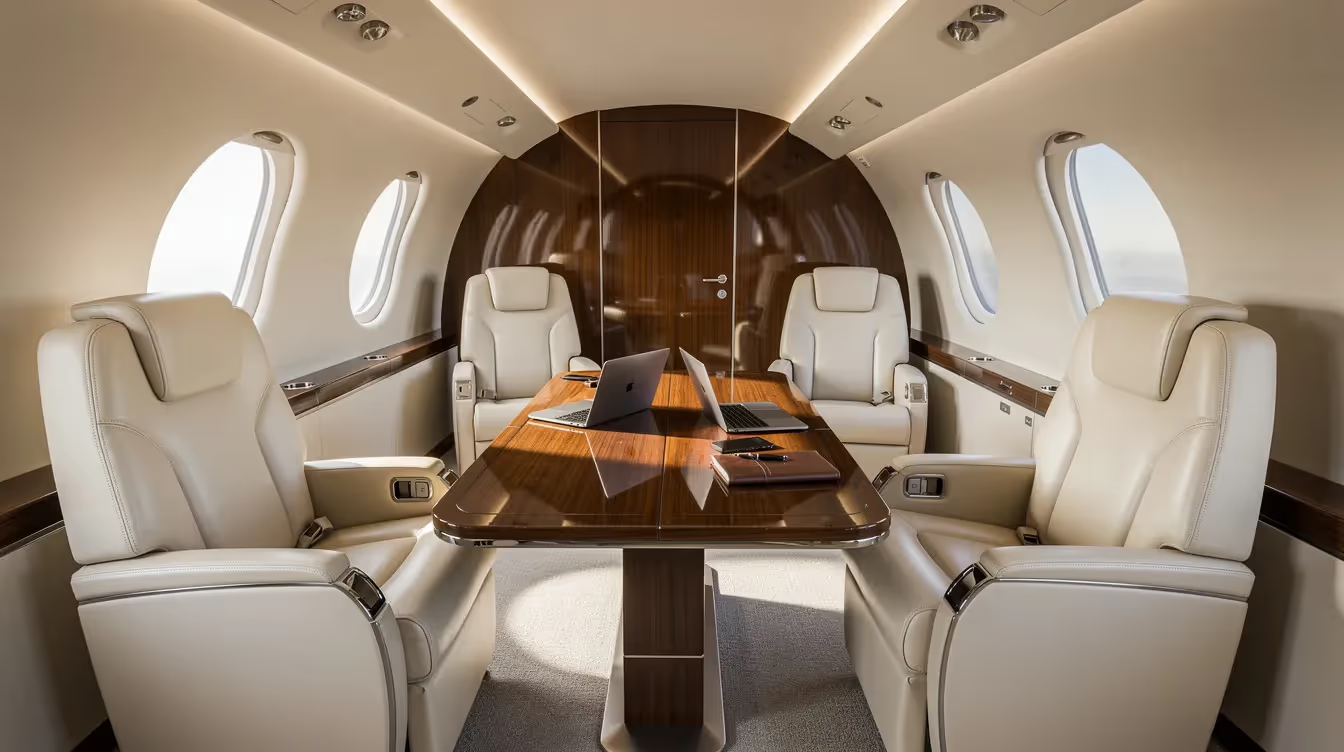
Corporate aircraft empower businesses with efficient, flexible travel solutions that bypass the constraints of commercial airlines. With options ranging from turboprops to ultra-long-range jets, companies can tailor their aviation experience to specific needs and budgets.
– Corporate jets drastically reduce travel time and increase productivity by providing direct access to more airports.
– On-demand charter platforms eliminate the commitment and costs of ownership while offering a wide selection of aircraft globally.
– Modern business jets feature advanced comfort, connectivity, and safety technologies suited for executive work on the go.
– Environmental and cost considerations are central to choosing the right access model and aircraft type.
– Digital charter services streamline booking and transparency, making private aviation accessible to more businesses.
Corporate aircraft have transformed how executives and companies approach business travel. From turboprops handling short regional hops to ultra-long-range jets connecting continents, these aircraft serve as productivity tools that eliminate the inefficiencies of commercial aviation. This guide breaks down what corporate aircraft are, who makes them, and how businesses access them—whether through ownership or on-demand charter platforms like Jettly.
Corporate aircraft include turboprops, very light jets (VLJs), light jets, super mid-size jets, heavy jets, and bizliners—each suited to different mission profiles, from 300-mile regional trips to 8,000+ nautical mile intercontinental flights.
Most corporate jets seat 6–14 passengers and fly 500–3,000 nautical miles per trip between business hubs, saving significant time by using secondary airports, flexible schedules, and direct routes.
On-demand charter platforms like Jettly provide access to 20,000+ aircraft globally without requiring ownership, jet cards, or fractional shares.
Time savings are substantial: a light jet covers the Toronto–New York route in about 1 hour, compared with 3–4 hours door-to-door on commercial flights, including security and delays.
This article compares ownership versus charter, outlines key manufacturers and models, addresses environmental considerations, and provides guidance on choosing the right aircraft for your mission.
Corporate aircraft are private planes owned or leased by businesses to transport personnel or equipment for work-related purposes. This category includes turboprop aircraft, business jets of all sizes, and corporate-configured airliners known as bizliners. The defining characteristic is their purpose: transporting executives, employees, clients, or cargo for business operations rather than scheduled commercial service.
The term covers both owned fleets—such as a Fortune 500 company’s in-house jet—and on-demand chartered aircraft accessed through digital platforms like Jettly. Business aviation operates under specific operating rules, including FAA Part 91 for private use and Part 135 for charter operations in the U.S., with equivalent EASA regulations in Europe.
Typical cabin sizes vary considerably:
Most corporate jets seat 6–10 passengers in a cabin comparable to a large SUV or small office.
Long-range jets and bizliners can accommodate 14–50 passengers with multiple living zones, including dedicated bedrooms and conference areas.
Common mission profiles range from 300–1,000 nautical miles (New York–Washington, London–Frankfurt) to intercontinental range flights of 3,000+ nautical miles.
Private terminals and separate security checkpoints offer discretion, protecting high-profile executives from public scrutiny and enhancing privacy. Corporate aircraft also provide flexible schedules and access to smaller, closer airports, boosting productivity through efficient travel and improved security.
Corporate aircraft are divided into distinct categories based on size, range, and mission profile. Jettly’s marketplace covers all these categories globally, allowing businesses to select the right aircraft for each specific trip.
Aircraft like the Beechcraft King Air 260 and Pilatus PC-12 seat 5–9 passengers with ranges around 1,500–1,800 nautical miles. They excel at short regional business hops and can access runways under 2,500 feet that jets cannot use. Hourly operating costs typically run $1,200–2,000.
VLJs typically have a maximum takeoff weight under 10,000 pounds and are designed for single-pilot operation. They accommodate 6–7 passengers over an average range of about 1,174 nautical miles. Examples include the HondaJet Elite II and similar aircraft, offering efficient access to small airports.
Light jets are a staple of the business jet industry, providing access to small airports and typically accommodating 6–8 passengers over an average range of 1,953 nautical miles. Models like the Embraer Phenom 300E and Cessna Citation CJ4 Gen3 efficiently handle short to medium city pairs.
Super mid-size jets combine transatlantic capability with the speed and comfort of a wide-body aircraft, typically accommodating 10–11 passengers over an average range of 3,420 nautical miles. Options such as the Cessna Citation Longitude, Gulfstream G280, and Embraer Praetor 600 handle transcontinental trips comfortably, climbing to 45,000 feet for smoother flights.
The Bombardier Global 8000, Gulfstream G700/G800, and Dassault Falcon 8X represent the large-business-jet category. Seating 12–19+ passengers and with a 6,000–8,200 nautical-mile range, they enable nonstop flights like New York–Tokyo or London–Singapore. The Global 8000 is recognized as the world's fastest business jet, capable of reaching a top speed of Mach 0.95 and delivering exceptional long-range performance. These luxury business jets often feature advanced technologies such as fly-by-wire systems, which enhance flight safety and operational efficiency, as well as innovative cabin designs that prioritize passenger comfort and wellness. The Global 8000 also features four spacious living areas, making it unique in the industry for its focus on passenger comfort and productivity on long flights.
Business airliners, or bizliners, are converted commercial airliners used for private travel, often accommodating large groups and providing the greatest space and capabilities among business aircraft. Airbus Corporate Jets (ACJ319neo, ACJ TwoTwenty) and Boeing Business Jets (BBJ 737 MAX, BBJ 787) convert commercial airframes into corporate configurations with 5,000–9,000+ nautical mile range and large cabin layouts. These aircraft serve heads of state, multinational corporations, and large delegations. The BBJ Select program from the Boeing Company offers standardized configurations for faster delivery.
Corporate aircraft function as strategic tools designed to maximize executive time, extend reach to remote locations, and support time-sensitive missions. They offer a drastic reduction in total travel time, transforming multi-day itineraries into same-day trips. Companies often use private aircraft to avoid commercial airline hubs, enabling visits to multiple cities in one day. This efficiency allows staff to make more in-person appearances, enhancing competitive advantage.
Multi-city roadshows covering New York, Chicago, and Dallas in 6 hours total versus 12+ hours commercially.
Plant and site visits in remote areas inaccessible by commercial airlines, often via turboprop.
Board meetings, investor presentations, and customer visits where confidentiality matters.
Executive shuttles on regular routes such as Houston–Midland or London–Toulouse.
Urgent and special missions encompass last-minute deal negotiations, critical engineering visits, and medical transport where every hour matters.
Access to private aviation is also viewed as a powerful tool for attracting and retaining top talent, as it improves work-life balance.
Consider this comparison: a light jet covers Toronto–New York in approximately 1 hour. The same trip on commercial carriers takes 3–4 hours door-to-door once security lines, boarding, and terminal transit are factored in. For executives, that difference translates directly into productivity.
Many companies now avoid ownership entirely, relying on on-demand charter through platforms like Jettly as a flexible NetJets alternative for flying private. This approach allows finance teams to treat corporate flying as a variable, project-based expense rather than a fixed asset cost, including hangars and crew salaries.
Several business aviation manufacturers dominate the market, and their aircraft commonly appear in Jettly’s inventory. As of April 1, 2017, there were 22,368 business jets in the worldwide fleet, with 11.2% available for sale.
Bombardier Inc produces the Global and Challenger families. The Global 8000 offers a top speed of Mach 0.95 and a range of 8,000 nautical miles, while the Challenger 3500 suits North American and transatlantic missions, with operating costs around $3,500/hour. In 2015, the total airplane billing for business jets amounted to US$21.9 billion, with 718 business jets delivered globally. The introduction of the Challenger series marked a significant milestone in Bombardier's business jet lineup.
Gulfstream builds the G500, G600, and long-range G700/G800, with a range of 8,200 nautical miles at a Mach 0.935 cruise. These aircraft connect financial centers worldwide through advanced aerodynamics and lower cabin altitudes, reducing fatigue.
Dassault Aviation manufactures the Falcon family (2000LXS, 900LX, 6X, 7X, 8X), known for efficiency and the trijet heritage that appeals to corporate and government operators alike. The next-generation Falcon 10X continues this lineage. Dassault’s deep military heritage and experience in military aircraft manufacturing contribute to the advanced technology found in its corporate aircraft.
Embraer Executive Jets offers the Phenom 100EX, Phenom 300E, and Praetor 500/600. The Phenom 300E has been the world’s best-selling light jet for over a decade, with the first flight of the prototype establishing its market position. Embraer has delivered over 700 Phenom 300 series jets to customers since its introduction.
Textron Aviation includes Cessna’s Citation line (M2 Gen3, CJ3 Gen3, CJ4 Gen3, Longitude) and Beechcraft turboprops such as the King Air 260. These aircraft serve everything from owner-flown missions to corporate fleet operations. By October 2018, the private jet fleet was dominated by Textron (Cessna and Beechcraft) at 43.9%, followed by Bombardier at 22.4%, Gulfstream at 13.0%, Dassault at 9.6%, and Embraer at 5.8%.
Airbus Corporate Jets and Boeing Business Jets provide wide-cabin aircraft based on A320neo-family and 737/787 platforms, chosen by corporations and state customers for long-haul missions carrying large delegations.
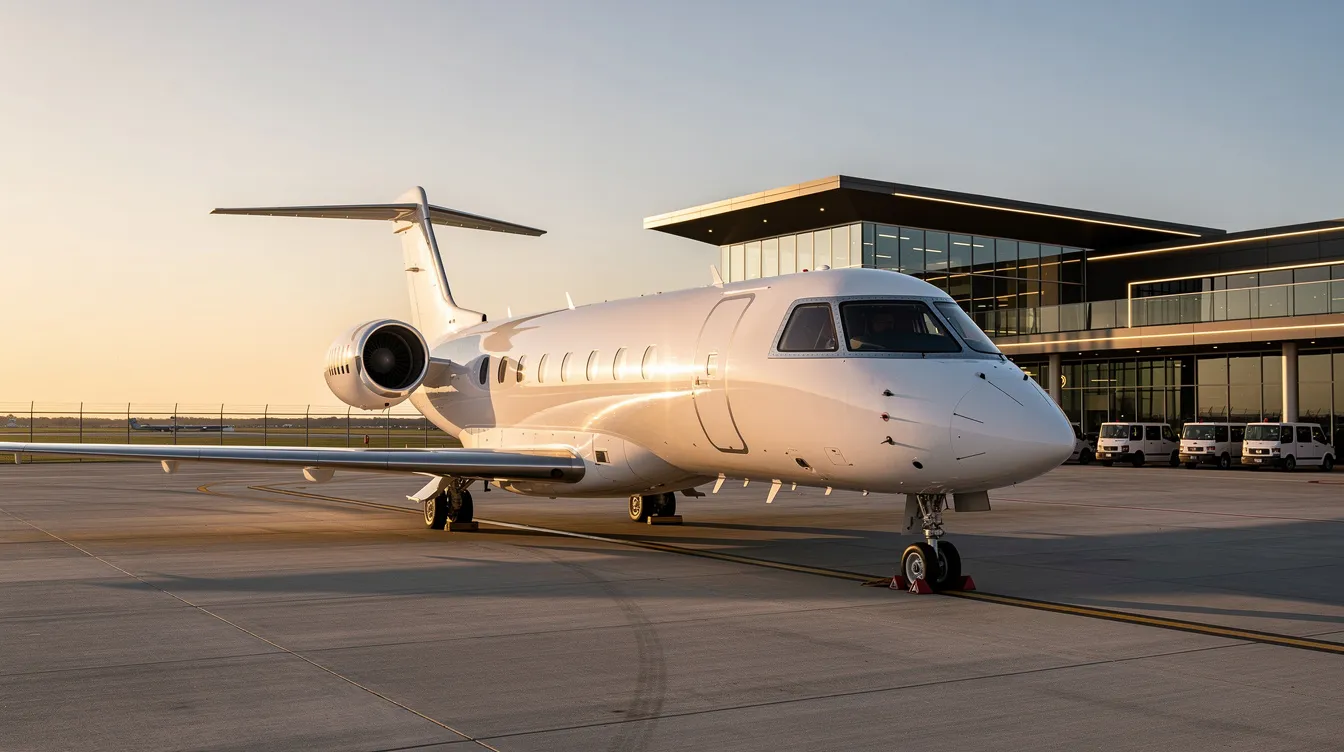
Businesses access corporate aircraft through four main models: full ownership, fractional ownership, jet cards/memberships, and on-demand charter.
|
Access Model |
Typical Cost |
Best For |
Commitment |
|---|---|---|---|
|
Full Ownership |
$5–75M purchase + $1–5M annual fixed |
300+ hours/year |
Long-term asset |
|
Fractional (e.g., 1/16 share) |
Monthly fees + hourly rates |
50–100 hours/year |
Multi-year contract |
|
Jet Cards |
$5,000–10,000/hour all-in |
25–100 hours/year |
Prepaid hours |
|
Private Jet Memberships |
Varies by plan; access to wholesale rates via private jet memberships |
10–200+ hours/year |
Month-to-month or annual |
|
On-Demand Charter (Jettly) |
$3,000–15,000/hour |
Variable patterns |
Per-trip |
|
Full ownership involves high initial capital ($5–75 million per jet aircraft), plus ongoing fixed expenses for hangar, crew, maintenance, and insurance. This suits frequent flyers clocking 300+ flight hours annually. |
|||
Fractional ownership allows individuals or corporations to pay an upfront equity share for the cost of an aircraft, sharing overhead costs such as flight crew and maintenance among users. It offers guaranteed access with 1/16- or 1/8-share options, typically requiring 50–100 hours per year. However, contracts, monthly management fees, and repositioning charges add complexity, which are explored further in this fractional jet ownership pros and cons guide.
Jet cards pre-sell hours at fixed rates, providing price predictability without ownership, and many travelers use them through world-class corporate jet card programs.
On-demand charter through platforms like Jettly provides access to more than 20,000 aircraft worldwide at dynamic market pricing, without long-term contracts. These services draw from a broad pool of private charter aircraft spanning turboprops to ultra-long-range jets. Charter operators manage private jets for multiple clients and handle all aspects of aircraft operation and maintenance, similar to corporate flight departments but not aligned with just one corporation. Aircraft charter brokers, by contrast, do not operate aircraft and are largely unregulated, requiring disclosure to consumers that they cannot use terms like 'our fleet of aircraft' or 'we operate'.
Charter is particularly well-suited to companies flying fewer than 150–200 hours annually or to those with irregular travel patterns, such as project-based consulting firms or companies with seasonal demand spikes.
A 2010 study revealed that small and midsize companies utilizing private jets experienced a 219% greater earnings growth rate compared to those relying solely on commercial airlines.
Finance and travel managers should compare lifetime cost per hour—including idle time and repositioning—across models to determine the most efficient access method for their organization’s needs, especially when evaluating fractional jet ownership costs in detail.
Digital marketplaces have fundamentally changed access to corporate aircraft by aggregating fleets from independent operators into a single searchable platform.
Jettly offers instant or near-instant pricing with transparent cost breakdowns covering aircraft type, hourly rate, taxes, and positioning fees, which can be approximated using a private jet charter cost estimator. This reduces the back-and-forth phone quotes that traditionally slowed charter bookings.
Global coverage across common business routes: New York–Miami, London–Zurich, Dubai–Riyadh, Sydney–Melbourne.
Multiple aircraft category options for the same route, letting travel planners choose between lower cost and extra speed or cabin space.
Vetted, regulated operators complying with civil aviation rules (FAA Part 135, Transport Canada, EASA) and standardized safety audits.
Integration with in-flight catering, ground transportation to private terminals (FBOs), and concierge support for complete itinerary coordination.
For customers seeking market transparency, digital platforms eliminate the opacity that historically characterized the charter industry.
Modern corporate aircraft function as flying offices, combining speed, quiet cabins, and always-on connectivity to enable executives to work productively in transit.
Jets cruise at Mach 0.75–0.90 (300–600 knots true airspeed).
Light jets cover approximately 1,000–2,000 nautical miles.
Ultra-long-range models like the Global 8000 fly faster and can achieve 8,000+ nautical miles nonstop—approaching what some describe as the world’s fastest civilian aircraft in their class.
Flat-floor designs with full-recline or lie-flat seats.
Meeting tables and galleys for meal service.
Large cabin aircraft may include dedicated principal suites, crew rest areas, and showers.
Luxury business jets often incorporate advanced technologies such as fly-by-wire systems to enhance flight safety and operational efficiency, alongside innovative cabin designs that prioritize passenger comfort and wellness.
Wellness and jet-lag reduction rely on lower cabin altitudes (4,500–6,000 feet equivalent pressure, versus 8,000 feet on airlines), fresh-air systems delivering 100% outside air, and advanced wing designs that reduce turbulence. Studies suggest these features can reduce the risk of deep vein thrombosis by up to 40%.
Connectivity options include Ka-band satellite internet through systems like JetWave or Gogo, enabling high-speed browsing and VPN access for confidential work. Emerging solutions like Starlink are appearing on some fleets, powered by next-generation satellite networks.
Jettly’s flight advisors can help clients choose aircraft with specific cabin layouts and connectivity packages suited for on-board meetings, presentations, or confidential calls by leveraging its global network of private charter aircraft options.

Corporate aircraft carry a higher per-passenger carbon footprint than most commercial airline class seats. This reality draws increasing regulatory and public attention, particularly in Europe, where climate neutrality by 2050 is a stated goal.
EU Emissions Trading System (ETS) increasingly covers business aviation.
2030 intermediate emissions-reduction targets affect operators.
The General Aviation Manufacturers Association tracks industry sustainability commitments.
New engine technologies (LEAP engines, advanced thrust designs) and lighter composite materials reduce fuel burn by 20–30% versus older models.
Optimized flight planning and direct routing minimize unnecessary fuel consumption.
Smaller, more efficient aircraft for short trips can cut fuel use by 50% compared to using a heavy jet for every mission.
Use turboprops or light jets for regional flights under 500 nautical miles.
Consolidate multiple meetings into single multi-stop itineraries.
Purchase carbon offsets or support sustainable aviation fuel (SAF) programs—currently 2–5% blended, scaling toward 10% by 2030.
Businesses can work with providers like Jettly and its partner operators to understand efficiency differences among aircraft and explore offsetting or SAF availability on specific routes, while also gaining a broader context from a comprehensive guide to private and charter airlines.
Charter has grown rapidly because it offers access to corporate aircraft benefits without tying up capital in aviation assets or long-term contracts.
Financial flexibility: Charter converts aviation costs from fixed expenses (depreciation, hangar, crew salaries) to trip-based operating costs that scale with business cycles. When travel needs drop, expenses drop proportionally.
Access to variety: Charter enables businesses to select from turboprops to ultra-long-range jets, right-sizing each mission rather than using a single owned aircraft regardless of efficiency. A King Air works for a 400-mile hop; a Global 8000 makes sense for intercontinental travel with a larger team.
Reduced friction: Digital platforms like Jettly address traditional charter pain points—price opacity, slow quoting, complex contracts—by providing fast pricing, online booking, and clear terms upfront.
Charter is particularly well-suited to companies flying fewer than 150–200 hours annually or to those with irregular travel patterns, such as project-based consulting firms or companies with seasonal demand spikes.
Businesses should compare historic or forecast travel hours against charter and ownership cost models. Jettly’s team can provide tailored analysis for specific situations.
Aircraft selection should be driven by mission profile: distance, passenger count, luggage requirements, runway length at destination, and desired onboard experience.
|
Distance |
Recommended Category |
Example Routes |
|---|---|---|
|
Under 500 nm |
Turboprop |
Dallas–Houston, Milan–Geneva |
|
500–1,500 nm |
Very Light/Light Jet |
New York–Miami, London–Paris |
|
3,000+ nm |
Heavy/Ultra-Long-Range |
LA–New York, Dubai–London |
4–6 passengers: Very light jet, light jet, or turboprop.
8–10 passengers with meeting space: midsize or super-midsize jet.
12+ passengers with sleeping arrangements: Large cabin or bizliner.
Some destinations have shorter runways or limited services. Turboprops and certain super midsize jets (like the Pilatus PC-24 with 2,935-foot takeoff capability) access airports that large cabin jets cannot.
A turboprop might cost $1,500/hour while a midsize jet runs $6,000/hour—but the jet flies 50% faster, potentially reducing total trip time and enabling same-day return.
Jettly’s platform and support team can propose 2–3 aircraft options per mission, explaining trade-offs in cost, flight time, cabin comfort, and baggage capacity for decision-makers.
Charter costs vary significantly by aircraft type. Turboprops generally run $1,200–3,000 per hour (excluding fuel repositioning on some quotes). Very light and light jets cost $3,000–6,000/hour, midsize jets $5,000–9,000/hour, and heavy jets $10,000–18,000/hour. These rates typically include crew and fuel but exclude catering, ground handling, and FBO fees (usually an additional $300–500). International flights may incur customs and handling surcharges.
For peak days—Monday mornings, Thursday evenings, and major events—booking 24–72 hours ahead improves aircraft selection. During off-peak periods, same-day flights are often possible through Jettly’s platform. Last-minute bookings may have limited aircraft choices or higher positioning costs if nearby aircraft aren’t available.
Passengers need a government-issued ID (passport for international flights). Security screening at private terminals (FBOs) is minimal compared to airlines, though international flights require customs processing. Operators may require passenger manifests 24 hours before departure for customs pre-clearance. Some countries require advance passenger information for border security.
Baggage capacity varies dramatically by aircraft type. Light jets typically accommodate 200–500 pounds of luggage, while heavy jets can carry 2,000+ pounds. Golf bags, ski equipment, and product samples generally fit in midsize and larger jets. Travel planners should confirm baggage compartment dimensions when booking—some light jets have limited door openings that restrict oversized items.
Jettly works exclusively with licensed operators meeting regulatory requirements, including FAA Part 135 certification in the U.S., Transport Canada approval, or EASA authorization in Europe. Many operators conduct additional third-party safety audits through organizations such as ARGUS or Wyvern. Pilots typically hold thousands of flight hours, and aircraft undergo manufacturer-specified maintenance programs with documented records.
Full Ownership — Requires $5–75 million for purchase plus $1–5 million in annual fixed costs. Best for companies flying 300+ hours per year who want long-term asset value and full control.
Fractional (e.g., 1/16 share) — Involves monthly fees and hourly rates with multi-year contracts. Ideal for 50–100 flight hours annually, offering shared access and reduced upfront investment.
Jet Cards — Provides prepaid hours at $5,000–10,000 per hour, suitable for those flying 25–100 hours per year seeking price predictability without ownership or long-term commitment.
Private Jet Memberships — Flexible month-to-month or annual plans with access to wholesale rates and variable hours (10–200+ per year), such as through private jet memberships.
On-Demand Charter (Jettly) — Pay-per-trip model at $3,000–15,000 per hour. Best for companies with variable or infrequent travel patterns, offering maximum flexibility and no ongoing commitment.
Corporate aircraft include turboprops, very light jets, light jets, midsize and super midsize jets, large and ultra-long-range jets, and bizliners, each catering to different range and passenger requirements.
On-demand charter platforms offer access to a wide variety of aircraft for individual trips without the costs or long-term commitments associated with owning or leasing a plane.
Chartered corporate aircraft must comply with strict regulatory standards such as FAA Part 135, EASA, or Transport Canada, and often undergo additional third-party safety audits.
Businesses can select more efficient aircraft, consolidate itineraries, use sustainable aviation fuels, or purchase carbon offsets to reduce the environmental footprint of their corporate aviation activities.
Key considerations include trip distance, passenger count, luggage requirements, runway length at destination airports, and desired onboard amenities.
Private jet memberships may offer more flexible terms, access to wholesale rates, and the ability to match travel volume with variable business needs compared to prepaid jet card programs.
While same-day bookings are possible during off-peak times, booking 24–72 hours in advance is recommended for better aircraft selection, especially during busy travel periods.
Modern corporate jets often feature lie-flat seats, meeting tables, advanced connectivity options, lower cabin altitudes, and wellness-focused designs for enhanced comfort and productivity.
Corporate aircraft enable faster, more flexible business travel than commercial alternatives. Digital charter platforms like Jettly are making this access more transparent and scalable for businesses of all sizes. The industry continues to grow, with platforms experiencing 15% annual growth as more companies recognize the productivity benefits of private aviation.
Looking ahead, corporate aircraft will continue to evolve. Better fuel efficiency from next-generation engines, enhanced connectivity options, and improved cabin wellness features will support global business even as environmental regulations tighten. Trends point toward hybrid-electric props by 2035, potential supersonic returns, and AI-optimized routing for additional efficiency gains in the next decade.
Companies do not need to own an aircraft to access these benefits. On-demand charter and membership options align travel capacity with real-time business needs, converting what was once a major capital commitment into a flexible operating expense.
Consider evaluating your current travel patterns: time lost in commercial hubs, productivity gaps during long security lines, and the potential gains from direct private flights for executives and teams. The math often favors charter access over commercial travel for frequent business trips.
Ready to explore your options? Compare aircraft, check routes, or request a tailored charter quote through Jettly at https://www.jettly.com.
Share this post:
Jay Franco Serevilla
Apr 14, 2026
|
5
min read
Discover tips and trends in the industry.
5
min read
Airport Charter Service: How Jettly Makes Private Charter Flights Simple
Jettly simplifies private charter flights, offering travelers on-demand access to over 20,000 aircraft worldwide. With flexible scheduling and transparent pricing, it caters to business, family, and group travel needs, ensuring a seamless experience from booking to arrival.
Read More
5
min read
How Many Passengers on a 737? Boeing 737 Seat Capacity Explained
The Boeing 737 is a versatile aircraft with a passenger capacity ranging from 85 to 230, depending on the variant and layout. Most commonly, the 737-800 and 737 MAX models accommodate between 162 and 200 passengers. This guide details the seating capacities across different generations and compares them to private jet options for tailored travel experiences.
Read MoreStay updated with our latest insights and tips to elevate your journey with us.
MEMBERSHIPS AND ASSOCIATIONS



Disclaimer: Jettly operates as a charter broker, offering access to a global digital jet charter marketplace. Jettly is not a direct air carrier and does not own or operate aircraft. All advertised flights are conducted by third-party air carriers that are fully licensed and hold the appropriate Part 135 or Part 121 certifications issued by the Federal Aviation Administration (FAA) or equivalent regulatory authorities under U.S. or foreign law. Jettly complies fully with the U.S. Department of Transportation's Part 295 and Part 298 Charter Broker regulations. Jettly does not carry additional liability insurance. Passengers are covered by aircraft operator insurance. TICO: 50023770


