


Login
Get Instant Pricing On 23,000+ Aircraft

>
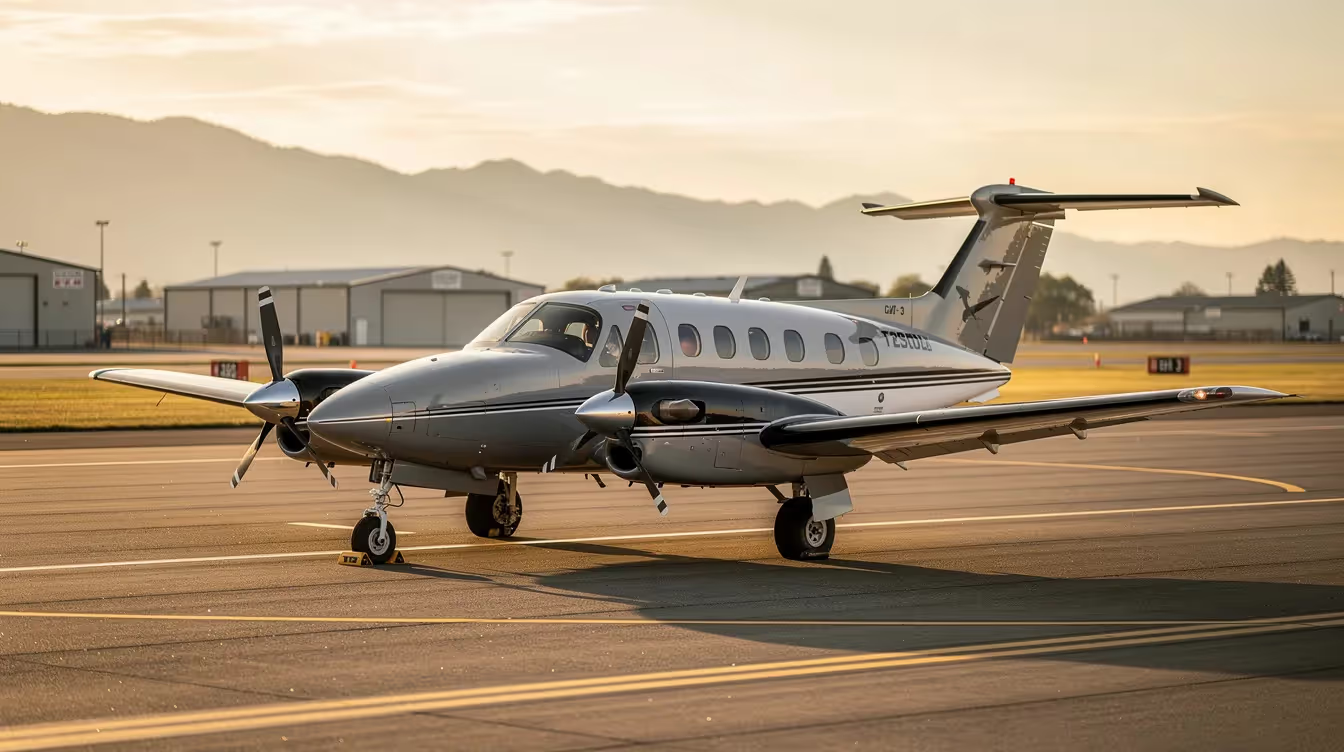
The Cessna 425 Corsair represents a pivotal moment in general aviation history—a pressurized twin-engine turboprop aircraft designed as an entry-level turbine for pilots transitioning from piston twins. Introduced by Cessna in 1980 as an evolution of the Cessna 421 Golden Eagle, this aircraft brought turbine reliability and higher cruise speeds to operators who wanted more than pistons could offer but weren’t ready for jet acquisition costs.
This article is intended for private aviation travelers, charter customers, and pilots interested in the Cessna 425 Corsair’s capabilities and charter suitability.
The Cessna 425 Corsair is a twin-engine, pressurized turboprop aircraft designed as an entry-level turbine for pilots transitioning from piston twins.
The naming history requires clarification. Early production aircraft from 1980 to 1982 were marketed as the “Corsair.” After upgrades in 1983 that included increased cabin space and higher maximum takeoff weight to meet customer demands, Cessna rebranded the entire line as the Cessna 425 Conquest I. Today, most pilots and operators use these names interchangeably. As an airplane, the Cessna 425 Corsair is often praised for its comfort, operational efficiency, and reliability compared to other aircraft in its class.
Jettly’s charter marketplace primarily matches clients with Conquest I-standard aircraft, though many operators still informally refer to them as Cessna 425 Corsairs. This article covers the history, performance, cabin experience, and charter suitability of this enduring turboprop in the context of Jettly’s broader private charter aircraft offerings. Approved modifications can further enhance the airplane’s performance, efficiency, and longevity, making it a valuable choice for private aviation.
The Cessna 425 Corsair is a pressurized twin-engine turboprop introduced in 1980, powered by two 450 shp Pratt & Whitney PT6A-112 engines, and was designed as a step up from the Cessna 421 Golden Eagle.
In 1983, after structural upgrades and an increased maximum takeoff weight, Cessna rebranded the model line as the Cessna 425 Conquest I.
Typical performance includes cruise speeds around 250–260 knots, a range of roughly 1,300–1,460 nautical miles with reserves, and the ability to operate from runways near 4,000 feet.
Jettly sources Cessna 425 and Conquest I aircraft through its charter marketplace for regional business trips, remote-access missions, and cost-efficient private travel.
Travelers can compare the 425 Corsair with light jets and other turboprops and request tailored pricing via Jettly’s digital platform.

Cessna’s turboprop expansion in the late 1970s and early 1980s positioned the company to bridge the gap between reliable piston twins and more expensive business jets. The 425 sat alongside larger models like the Cessna 441 Conquest II, which used Garrett TPE331 engines and entered service in 1977.
The first prototype of the Cessna 425 flew in 1978, designed to compete with the Beechcraft King Air, which dominated the popular turboprop market at the time. The Cessna 425 Corsair was introduced in 1980, during a challenging period for Cessna, as the company faced scrutiny over design errors in other aircraft models. Despite these challenges, the aircraft received FAA certification in mid-1980, near the peak of U.S. general aviation production before an industry downturn.
Introduced in 1980, the Cessna 425 was based on the Cessna 421 Golden Eagle airframe but featured significant structural reinforcements and a shift to turboprop power. The aircraft was designed around two Pratt & Whitney PT6A-112 turbine engines rated at 450 shaft horsepower each, delivering better climb and cruise performance than the piston-powered 421. Regular engine overhaul is essential for maintaining reliability and controlling long-term operating costs, especially as these engines age.
In 1983, the Cessna 425 was renamed the Conquest I after customer demands for increased cabin space and a higher maximum takeoff weight. This upgrade package increased the weight limit from about 8,200 lbs to 8,600 lbs, strengthened the structure, and refined the interior and systems. Production of the Cessna 425 ended in 1986 with roughly 236 units built. As the fleet ages, supplemental inspection documents (SIDs) become increasingly relevant for ongoing safety and maintenance, and the status of SIDs can influence the aircraft’s market value. The aircraft’s economics helped it remain attractive on the pre-owned and charter market decades later.
The Cessna 425’s design philosophy emphasized accessibility and smooth operations. A low-wing configuration with a distinctive T-tail provides stability, while the pressurized fuselage and trailing-link landing gear enable relatively smooth landings on shorter runways. The fuselage design carries over refined elements from the 421, making it familiar to pilots transitioning from that aircraft.
Key airframe specifications include:
Wingspan: approximately 44 feet
Length: approximately 36 feet
Maximum takeoff weight: 8,200 lbs (early Corsair) to 8,600 lbs (Conquest I)
The Cessna 425 Corsair is powered by two Pratt & Whitney PT6A-112 engines, each rated at 450 shaft horsepower, providing reliable performance and efficiency.
The Cessna 425 Corsair is powered by two Pratt & Whitney PT6A-112 engines, each rated at 450 shaft horsepower, providing reliable performance and efficiency. These engines feature reverse thrust, autofeather systems for engine-out scenarios, and simplified power management compared to piston twins—no mixture controls or magnetos to manage.
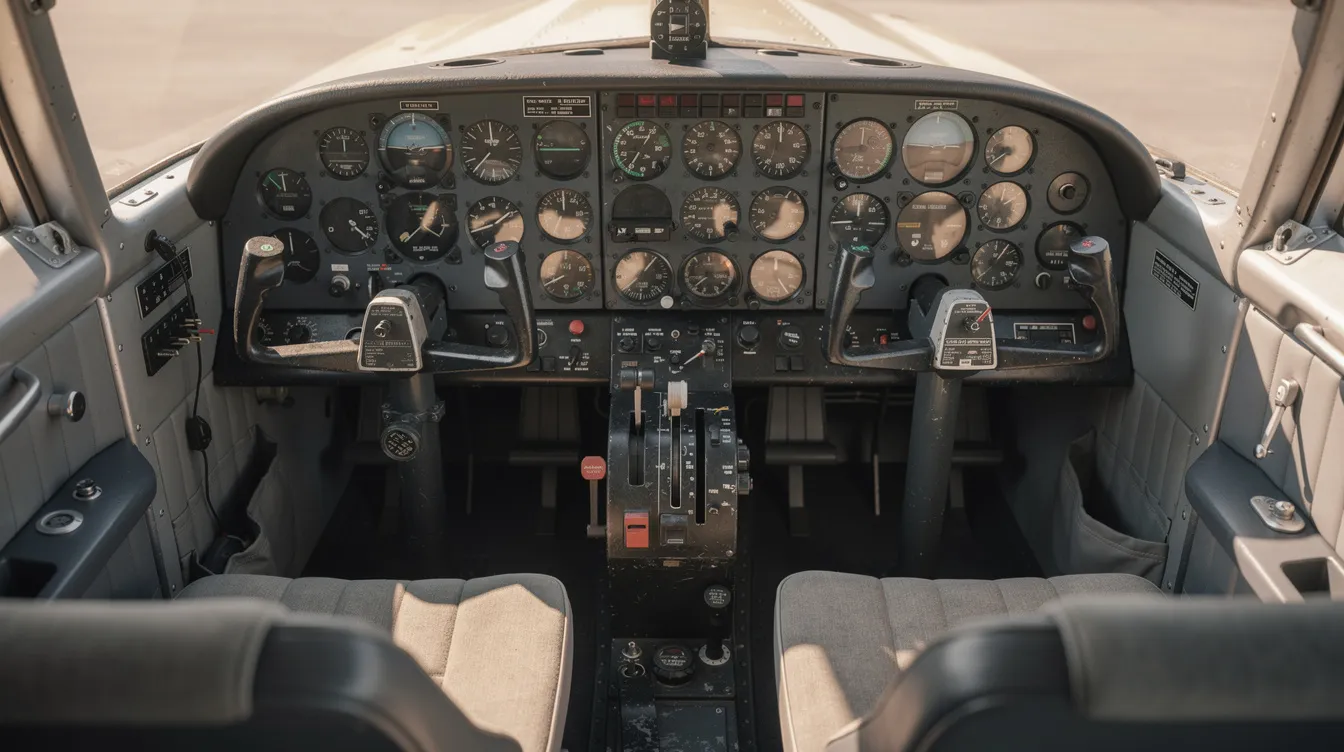
Original cockpit configurations featured Collins avionics suites, including dual VHF-20A communications radios, VIR-30A navigation units, ADF-60, DME-40, and WXR-300 weather radar. The optional Sperry SPZ-500 flight control system represented a significant upgrade over the standard ARC 1000 flight control system, improving handling and operational reliability. Modern examples often include Garmin G1000 or GTN series glass panels with ADS-B compliance.
The Cessna 425 has a spacious “wide-oval” cabin design that provides good elbow room for passengers. The aircraft features a massive nose baggage compartment that can accommodate long items, accessible via three doors—this heated compartment can hold 400–600 pounds, plus an aft cabin compartment for additional storage.
Real-world performance data demonstrates why so many pilots chose this aircraft for regional operations. The Cessna 425 can achieve a maximum speed of 264 knots at 17,700 feet, with typical cruise speeds of approximately 250 knots true airspeed at optimal altitudes.
Key performance figures:
|
Metric |
Value |
|---|---|
|
Maximum cruise speed |
264 knots at 17,700 ft |
|
Economy cruise |
210 knots at 30,000 ft |
|
Service ceiling |
34,700 feet |
|
Rate of climb |
2,027 feet per minute |
|
Takeoff distance (50 ft obstacle) |
2,431 feet |
The fuel capacity of the Cessna 425 is 366 gallons, which is approximately 2,452 lbs. This translates to a range of about 1,300–1,460 nautical miles with reserves under typical conditions. The maximum range of the Cessna 425 reaches 1,646 nautical miles with 45-minute reserves at 30,000 feet, though actual charter missions often fly somewhat shorter legs for passenger comfort and fuel margins.
Runway performance suits many regional and executive airports. Balanced field length runs approximately 3,500–4,000 feet at standard conditions, enabling access to facilities that might exclude larger aircraft, which travelers can identify using Jettly’s airport locator tool.
The aircraft typically seats six passengers in executive configuration, with layouts featuring four-place club seating plus additional forward or aft single seats, including one located on the left rear side of the cabin. The Cessna 425 has a max takeoff weight ranging from 8,200 lbs for early models to 8,600 lbs for later models, requiring careful weight and balance management when using aft cabin seats and aft baggage areas. Professional charter crew handles these calculations for passengers.
The 425 Corsair earned its reputation as a pilot-friendly aircraft partly due to its single-pilot certification. This appeals to owner-pilots while professional crews commonly fly the aircraft in charter and corporate roles.
Cockpit ergonomics prioritize clarity. Central power levers provide intuitive thrust management, clear overhead and pedestal layouts reduce confusion, and good visibility through large windows aids operations in busy terminal airspace. The Cessna 425 is known for its simple handling, making it a popular step-up aircraft for pilots transitioning from piston twins.
Turbine engines eliminate the complexity of piston prop management—no mixture adjustments, no magneto checks. Autofeather systems minimize asymmetric thrust issues if one engine fails, and most pilots find the handling characteristics forgiving during engine-out scenarios.
Training typically involves 25–40 hours plus simulator time for experienced twin or turboprop pilots. The emphasis falls on proper engine temperature management to avoid expensive hot-section wear on the PT6A powerplants.
In modern charter operations accessed through Jettly, Cessna 425 Corsair and Conquest I aircraft are flown by fully qualified, multi-engine instrument-rated crew members, with safety oversight from regulated Part 135 air carriers.
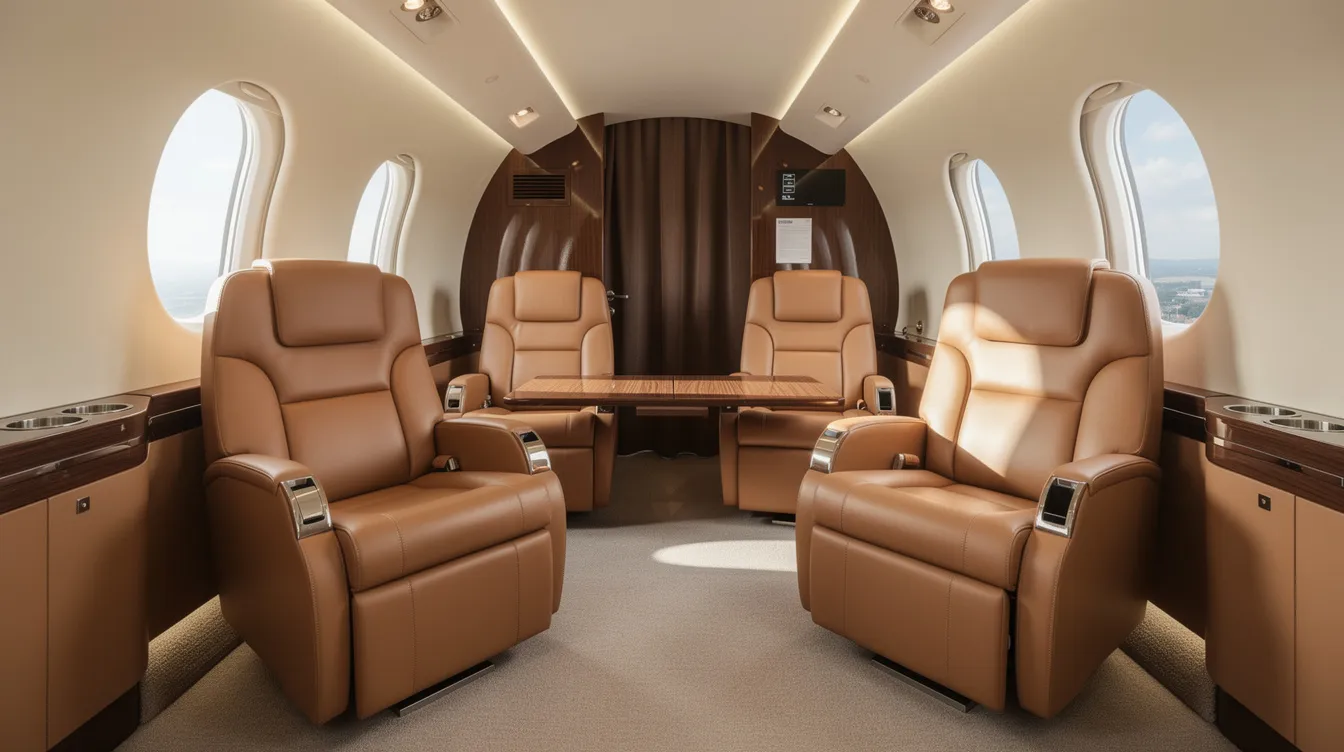
The 425’s cabin delivers a small business jet feel in a turboprop package. The pressurized environment (6.0 psi differential) with air conditioning creates an executive-style atmosphere. The aircraft features a pressurized cabin designed for comfort, typically configured to seat six passengers with a spacious interior.
Typical configurations include:
Four-place club seating arrangement
One or two additional forward or aft seats
Belted lavatory seat at the rear in many aircraft
Optional refreshment centers or small storage cabinets
Fold-out tables for work or dining
The wide oval cabin cross-section provides decent shoulder room, with large windows offering good visibility and natural light throughout the flight. In-flight vibration remains relatively low when propellers are properly balanced.
The Cessna 425’s cabin can be noisy, particularly depending on the function of the propeller synchrophaser. Cabin noise runs higher than most modern jets, though many operators install soundproofing upgrades and propeller synchronization systems to create an acceptable environment for 1–3 hour flights.
When arranging a Cessna 425-class charter through Jettly, the platform coordinates preferred seating layouts, in-flight catering, and ground transfers. This service integration ensures the experience feels comparable to larger private aircraft, albeit in a smaller cabin with comfortable seats.
The Cessna 425’s longevity on the charter and owner-flown market stems largely from its relatively efficient operating economics compared to light jets. The Cessna 425 is considered an economical entry into the turbine market and has been recognized for its performance and reliability. The Cessna 425 is often regarded as one of the most efficient entry-level twin turboprops in its class.
Direct operating costs per flight hour typically run lower than those of older light jets of similar vintage. The Cessna 425 typically cruises 15–20 knots faster than the King Air C90 while burning approximately 15% less fuel, making it attractive for cost-conscious operators.
Maintenance requires attention to several areas:
PT6A-112 hot-section inspections at scheduled intervals
Airframe inspections per Cessna’s requirements
The Supplemental Structural Inspection Program (SID) for the Cessna 425 was introduced to ensure the structural soundness of aging aircraft, with compliance required for turbine-powered models
Service bulletins and modifications affecting older airframes
Cessna support for the 425 is commendable, particularly when compared to most other manufacturers, providing valuable research materials for maintenance status. The Cessna 425 requires thorough pre-purchase and periodic inspections, with a focus on selecting a knowledgeable maintenance provider experienced with PT6A engines and Conquest-qualified shops.
Common upgrade paths include modern avionics retrofits, propeller changes (such as four-blade composite propellers on some aircraft), and engine modifications. The Blackhawk XP135A upgrade for the Cessna 425 Conquest I includes two factory-new Pratt & Whitney PT6A-135A engines rated at 750 shp, significantly enhancing performance. Additionally, aft fuselage strakes can be installed on the Cessna 425, which are claimed to boost cruise speeds by up to 12 knots.
For charter users, rates factor in these maintenance and compliance costs, but the 425 often remains cost-effective for small groups compared with chartering a light jet on the same route, a comparison that becomes clearer when using a private jet charter cost estimator.
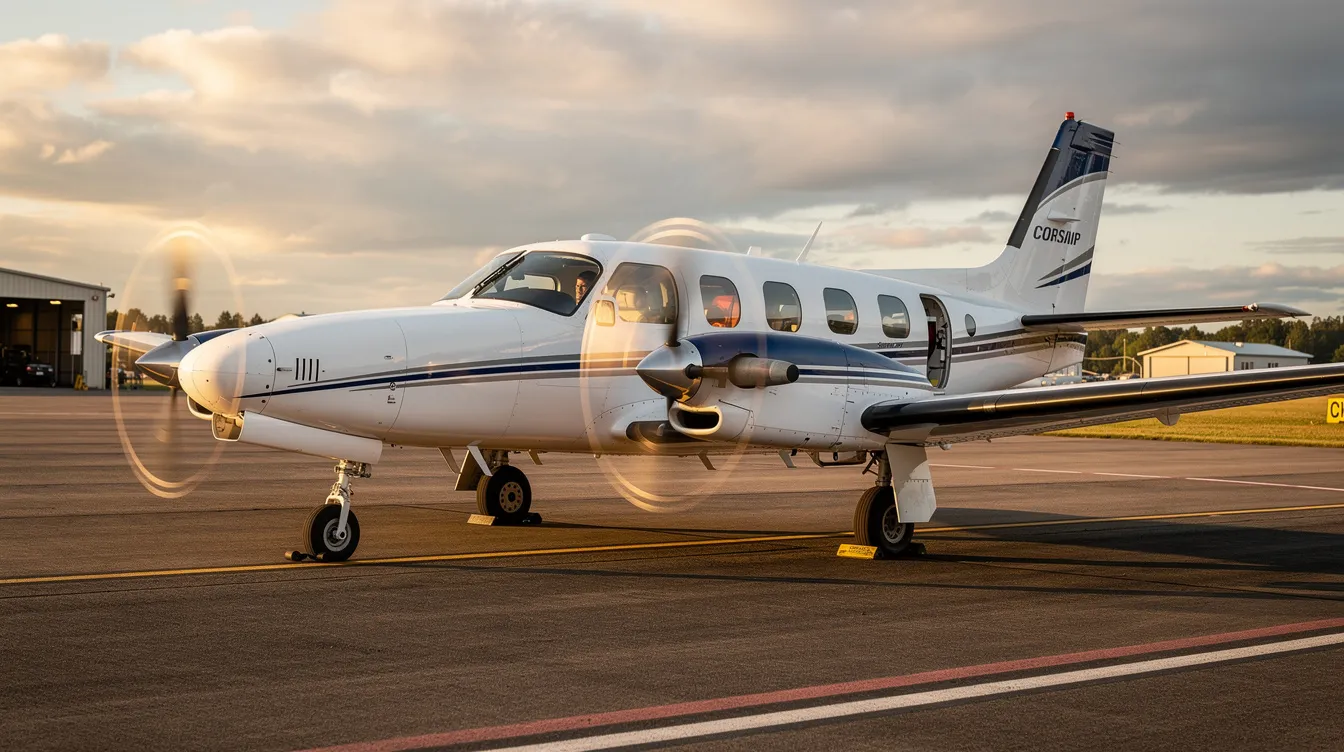
The aircraft’s capabilities align well with typical private charter mission profiles: 2–6 passengers on 300–800 nautical mile legs for regional business or leisure trips.
Example routes where a Cessna 425-class aircraft performs effectively, including popular city pairs served by Jettly’s private jet charter in Houston, Texas:
Dallas–Denver (~700 NM)
Toronto–Halifax (~800 NM)
Additional international routes, such as those served by Jettly’s private jet charter in Kolkata, West Bengal, also fit well within the performance envelope of turboprops and light jets for regional missions.
London–Geneva
Munich–Nice
These missions leverage the airplane’s cruise speed, fuel efficiency, and ability to use smaller airports closer to final destinations, while some travelers may occasionally require widebody options like the Boeing 767-300ER for large-group or long-range journeys beyond a turboprop’s capabilities.
Jettly uses its global aircraft inventory to source 425 Corsair and Conquest I aircraft where available. The platform’s instant-pricing tools allow customers to compare the 425 against other turboprops and jets on similar routes, with transparent cost breakdowns, whether booking directly through Jettly or via partner operators like Dexter Air Taxi.
Benefits for travelers include time savings over commercial travel on regional routes, flexible departure times, the ability to fly into smaller runway facilities, and tailored cabin services like catering on suitably equipped aircraft. Jettly also supports crowdsourced private jet flights and shared empty seats, which can further reduce costs for suitable trips. The Cessna 425 is generally recognized as faster than the Beechcraft King Air C90 and burns less fuel, leading to more economical operations on these mission profiles.
Turboprops like the 425 can be more fuel-efficient than comparable jets on shorter sectors. Jettly can help arrange carbon-offset options when requested by environmentally conscious travelers.
Charter customers and buyers often compare the 425 Corsair/Conquest I with several alternatives and evaluate how it stacks up among the best cross-country aircraft options for their mission profiles. Production ceased on the 425 in 1986, but the aircraft remains competitive in the pre-owned and charter market.
|
Aircraft |
Cruise Speed |
Fuel Efficiency |
Short-Field Capability |
|---|---|---|---|
|
Cessna 425 Conquest I |
~250 KTAS |
Excellent |
Good (4,000 ft runways) |
|
Cessna 421 Golden Eagle |
~180-200 KTAS |
Good |
Good |
|
Beechcraft King Air C90 |
~230 KTAS |
Good |
Very good |
|
Pilatus PC-12 |
~260 KTAS |
Good |
Excellent |
|
Citation I/CJ series |
~300+ KTAS |
Moderate |
Requires longer runways |
Piston twins like the Cessna 421 offer lower acquisition cost but lack turbine reliability and high-altitude performance, while cabin-class twins such as the Cessna 340 serve as another step on the spectrum between piston and turboprop performance. Single-engine turboprops like the PC-12 provide more cabin space but typically command higher charter rates and lack twin-engine redundancy, while smaller utility models such as the Cessna 207 prioritize short-field versatility and sightseeing-friendly cabins over high cruise speeds.
Light jets deliver faster cruise speeds and quieter cabins but require longer runways (typically 5,000+ feet), burn more fuel, and carry higher hourly costs; regional jets such as the Canadair CRJ-200 illustrate how higher-speed, higher-capacity aircraft trade efficiency for scale. For many 2–6 passenger missions under about 1,000 nautical miles, a Cessna Conquest-class aircraft offers a strong balance of speed and cost, while larger-cabin options like the Gulfstream G-IVSP cater to longer-range or higher-capacity missions.
Blackhawk Modifications and other upgrades can further enhance the 425’s competitive position, with improvements to powerplants and aerodynamics available through specialized shops.
Jettly’s platform allows users to model several aircraft types for their typical routes, comparing hourly rates, flight times, and airport options before deciding.
Jettly functions as a digital charter marketplace, providing on-demand access to more than 20,000 aircraft worldwide, including turboprops like the Cessna 425 Corsair and Conquest I, where available through vetted operators.
The booking process is straightforward:
Enter your route and travel dates
Select passenger count
Filter by turboprop or specific aircraft type where available
Review instant pricing or quote responses from vetted operators
Confirm your booking and arrange any extras
Frequent flyers can choose private jet memberships for additional cost predictability, while occasional travelers can book on a per-trip basis without long-term commitments.
Jettly emphasizes transparent pricing, safety screening of partner operators, and support for arranging extras such as catering, ground transportation, and special baggage requirements, all within an approach focused on offering affordable private jet charter.
Ready to explore turboprop charter options or earn by referring new flyers? Visit Jettly’s platform to compare aircraft, request a quote for your next regional trip, or learn about Jettly’s high-ticket affiliate program.
The term “Cessna 425 Corsair” originally referred to early production aircraft from 1980–1982. After structural and weight-increase upgrades in 1983, Cessna rebranded the line as the Cessna 425 Conquest I. Many aircraft flying today have been upgraded to Conquest I standards, so charter listings typically use “Conquest I” while pilots and owners may still casually say “Corsair.” For charter customers, performance and cabin experience are very similar across both variants when maintained to current standards.
The typical executive configuration seats six passengers comfortably, often with a four-seat club arrangement plus two additional seats. Some layouts include a belted lavatory seat at the rear. While eight seats may be installed in certain configurations, baggage capacity, range requirements, and comfort considerations usually make 4–6 passengers the practical sweet spot for charter flights. Jettly users should confirm the exact seating and baggage limits of the specific aircraft offered for their trip, particularly if they are combining 425 charters with jet card programs that involve varied aircraft types.
The aircraft offers a combination of heated nose baggage and aft cabin or tailcone storage areas. Total capacity accommodates business cases and several soft bags or small suitcases for a group of 4–6. Soft-sided luggage loads more easily through cabin doors and makes better use of available volume compared with large hard suitcases. When booking through Jettly, travelers can share baggage estimates so operators can confirm weight and balance limits for the planned route.
The 425’s turboprop power, 2,027 feet-per-minute climb rate, and trailing-link gear make it well-suited to many regional and moderately short runways, including some elevated or mountain-region airports within performance limits. Every flight is planned with specific field length, temperature, altitude, and obstacle data, so acceptance of any airport remains at the operator’s and captain’s discretion. Jettly users should ask about preferred departure and arrival airports on their routes to confirm where a 425 Corsair-class aircraft can safely operate.
Turboprops like the Cessna 425 Corsair cruise at slightly lower altitudes and speeds than light jets, which can mean more noticeable turbulence on some days. Most passengers find the ride comfortable for flights of 1–3 hours. Cabin noise runs higher than in modern jets, though well-maintained propeller synchronization and soundproofing create an acceptable environment for conversation and light work. Travelers who prioritize ultra-quiet cabins or higher cruise altitudes should compare the 425 Corsair with light jet options using Jettly’s aircraft selection and instant-pricing tools.
The Cessna 425 Corsair, and its later Conquest I evolution, combines turbine reliability with solid performance around 250–260 knots and a comfortable small-cabin layout for 4–6 passengers. The aircraft works best on regional routes up to around 1,000–1,200 nautical miles, departing from smaller airports that may be closer to a traveler’s final destination than major hubs.
Many charter listings reference the Conquest I name, which represents an upgraded version of the original Corsair design with structural improvements and higher weight limits. Both variants deliver the same core value proposition: turboprop efficiency, reasonable operating costs, and access to shorter runways that jets cannot use.
Jettly helps travelers compare the 425 Corsair with other turboprops and light jets, balancing cost, speed, and comfort for specific missions, and tools like its jet card flight cost estimator provide additional clarity on pricing. The platform’s inventory spans models for virtually every regional travel need.
Ready to experience private travel on your terms? Explore flight options or request a quote at https://www.jettly.com.
Share this post:
Jay Franco Serevilla
May 4, 2026
|
5
min read
Discover tips and trends in the industry.

5
min read
Pets on Private Jets in 2026: Size Limits, Crate vs. Cabin Rules, and International Paperwork
This comprehensive guide for pet owners covers everything you need to know about flying with pets on private jets in 2026. It details size limits, cabin versus crate rules, and essential international paperwork to ensure a smooth travel experience. Understanding these guidelines helps avoid surprises and keeps your pet comfortable during the journey.
Read More
5
min read
Jettly Private Jet Charters Miami, FL
Jettly offers private jet charters in Miami, providing fast and flexible flights tailored to your schedule. With over 221 jets available and multiple airports, travelers can enjoy a seamless experience, avoiding commercial terminal hassles. Whether for business or leisure, Jettly ensures privacy, comfort, and convenience for every journey.
Read MoreStay updated with our latest insights and tips to elevate your journey with us.
MEMBERSHIPS AND ASSOCIATIONS



Disclaimer: Jettly operates as a charter broker, offering access to a global digital jet charter marketplace. Jettly is not a direct air carrier and does not own or operate aircraft. All advertised flights are conducted by third-party air carriers that are fully licensed and hold the appropriate Part 135 or Part 121 certifications issued by the Federal Aviation Administration (FAA) or equivalent regulatory authorities under U.S. or foreign law. Jettly complies fully with the U.S. Department of Transportation's Part 295 and Part 298 Charter Broker regulations. Jettly does not carry additional liability insurance. Passengers are covered by aircraft operator insurance. TICO: 50023770


