



Login
Get Instant Pricing On 23,000+ Aircraft

>
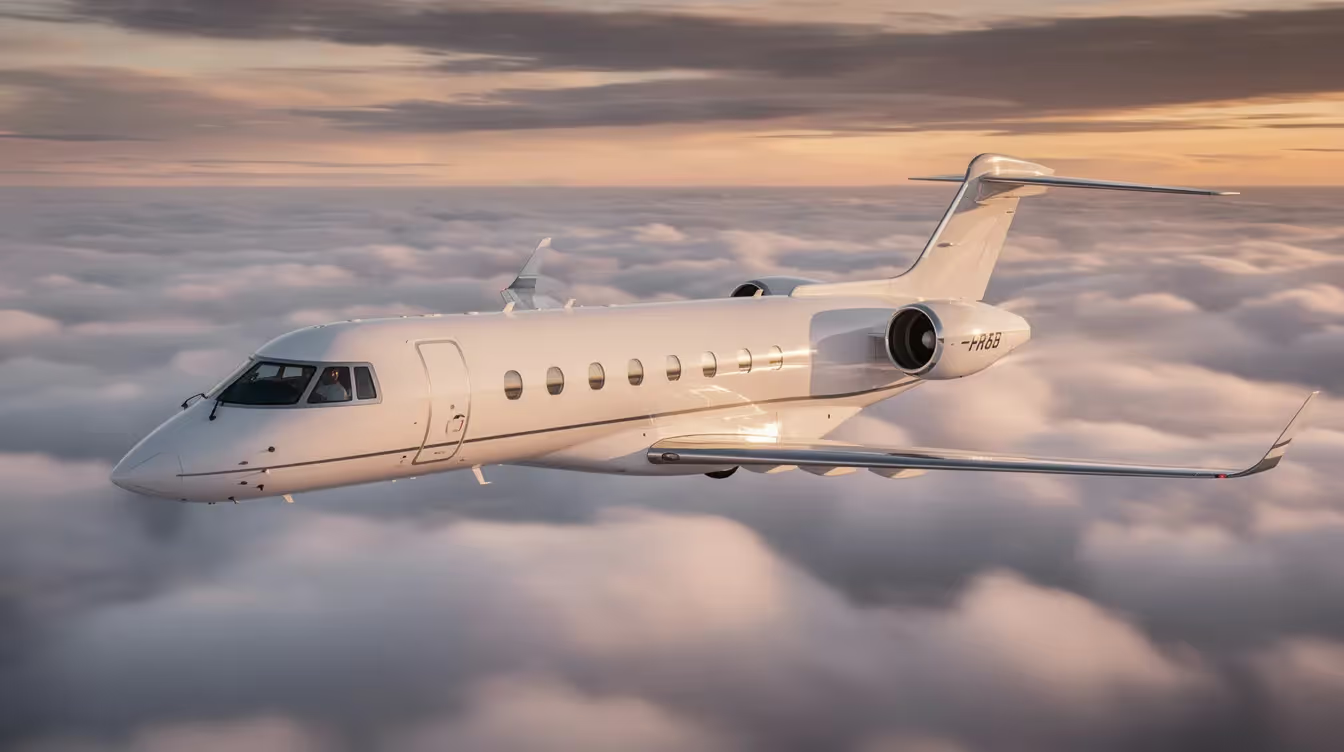
Navigating business class categories can feel overwhelming. Between cabin types, booking codes, and fare basis rules, even experienced travelers struggle to decode what their ticket actually includes. This guide breaks down the four main commercial cabin classes and the different flight classes travelers can choose from, explains how fare classes work across different airlines, and compares scheduled business class with on-demand private jet charter through platforms like Jettly.
Business class is both a cabin type and a service level featuring lie-flat seats, enhanced meals, lounge access, and priority boarding. It differs from economy class primarily in space, privacy, and flexibility.
There are four primary flight classes offered by airlines: Economy, Premium Economy, Business, and First Class. Each class comes with distinct pricing, with business class tickets averaging $1,784 for domestic flights and $4,227 for international journeys. Each carries distinct pricing, with business class tickets averaging $1,784 for domestic flights and $4,227 for international flights.
Airline fare classes and booking codes (like J, C, D, or Z) control pricing, refundability, and mileage earning within the same physical cabin. A “cabin” is where you sit; a “fare class” defines your ticket’s rules.
Business class categories vary significantly by region. European short-haul often means a blocked middle seat, while long-haul international routes typically feature fully lie-flat beds with direct aisle access.
Private jet charter through Jettly eliminates fare buckets entirely. Travelers choose aircraft type and route, then receive transparent pricing without deciphering alphabet codes or navigating upgrade waitlists.
Cabin classes exist because airlines segment passengers by willingness to pay. Economy class serves price-sensitive travelers, premium economy targets those wanting a modest upgrade, business class caters to corporate productivity needs, and first class delivers ultra-luxury for those who demand it. Frequent travelers often seek out the amenities and flexibility offered by higher cabin classes, making these premium options especially attractive to those who fly regularly.
Business class is both a physical location on the aircraft and a set of services. The cabin typically occupies the front section of the plane, but what defines the experience varies by airline and aircraft. On a Boeing 787 flying from New York to London, business class passengers might enjoy 78-inch fully flat beds, multi-course chef menus with wine pairings, and lounge access. On a regional Airbus A320 within Europe, business class often means an economy seat with the middle seat blocked and a hot meal instead of buy-on-board snacks.
Consider the differences in concrete terms. Standard economy seats offer 30-32 inches of pitch, 17-18 inches of width, and limited recline. Business class seats provide 60-80 inches of pitch, 20-22 inches of width, and often fully flat beds on long-haul flights. First class, where it exists, features first class seats that offer private suites with doors, lie-flat beds, exclusive amenities, onboard bars, and sometimes showers, setting them apart from business and economy cabins.
Here’s where it gets complicated: airline fare classes and booking codes sit inside each cabin. Two passengers in identical business class seats might have vastly different experiences with changes, refunds, and mileage earning. A full-fare J-class ticket typically earns 200% of flown miles with full refundability, while a discounted Z-class ticket in the same seat might earn only 100-150% and carry $300 change fees.
Since 2018, business class has increasingly replaced international first class on many airlines. United and Delta dropped first-class inventory on most international routes by 2023, upgrading business class to reverse-herringbone or suite designs that mimic former first-class perks. IATA 2024 data shows 70-80% load factors in business class versus under 20% in first class, driving this shift.

Most airlines offer business class on select routes, especially for long-haul and international flights, with different business class categories depending on geography. Domestic and regional routes prioritize frequency over luxury, often using recliner seats rather than lie-flat beds, as flight length is a key factor in determining the type of seating and amenities provided. Long-haul international routes demand fully lie-flat configurations for flights exceeding eight hours, where arriving refreshed matters more than saving on seat count.
Regional variations also affect boarding pass benefits. Business class passengers typically receive Group 1-2 boarding, priority security lanes (saving 15-20 minutes versus standard lines), and lounge access on approximately 80% of tickets. The specific business class product depends heavily on the aircraft type, route economics, flight length, and competitive pressure.
Qantas deploys lie flat seats on key routes like Sydney-Perth (Boeing 787 with 42 Stelia Aerospace Solstice suites) and Sydney-Auckland (Airbus A330 with angled lie-flat configurations). Virgin Australia mirrors this approach on larger aircraft, using 8-12 recliner business class seats on Boeing 737s with 38-inch pitch for shorter routes.
Air New Zealand reserves its true long-haul business class product for Boeing 777 and 787 international services, featuring 44 seats in a 1-2-1 configuration with direct aisle access. Domestic New Zealand flights often operate economy-only aircraft depending on demand and route economics.
Fare basis codes in this region distinguish flexible from sale business fares, impacting refunds and same-day changes more than the physical seat. A Qantas J/C full-fare ticket allows same-day changes free, while sale Z-class incurs AUD200 fees.
For busy executives seeking more space and privacy than regional business class offers, platforms like Jettly provide access to affordable private jet charter options such as Cessna Citations for routes like Sydney-Melbourne, often reducing door-to-door time from 3+ hours commercial to 90 minutes.
U.S. and Canadian carriers create a clear distinction between domestic first class (recliner seats on narrowbody aircraft like the Boeing 737 or Airbus A320) and true international business class (lie-flat with direct aisle access on widebodies like the Boeing 787-9 or Airbus A330neo). United Airlines’ Polaris product, for example, features 48 fully flat suites on international routes.
Premium transcontinental routes like New York-Los Angeles and Toronto-Vancouver feature lie-flat business class seats, sometimes marketed as “business” or “first” depending on airline branding. Delta Air Lines offers Mint suites on its A321T transcon service, featuring fully flat beds with doors.
Different airlines structure benefits similarly: priority check in, Group 1 boarding printed on the boarding pass, and lounge access on business and select domestic first class tickets. However, fare basis codes like J, C, D, I, and Z for business class influence upgrade priority, mileage accrual, and change fees even when the physical seat is identical.
Jettly customers on popular city pairs like New York-Miami or Los Angeles-Las Vegas often trade fixed commercial schedules for tailored departure times by choosing from a wide selection of private charter aircraft. A light jet charter takes 1.5 hours versus 2.5+ hours commercial with potential delays.
European short-haul business class operates differently than its long-haul counterpart. On intra-European short-haul flights, carriers like Lufthansa and Air France use standard economy class seats on Airbus A320 family aircraft, blocking the middle seat to create effective 2-1-2 spacing with 32-inch pitch. Service levels and cabin configurations on these short-haul flights are often simplified compared to long-haul routes, with some airlines removing or not offering premium cabins altogether due to shorter travel times and cost considerations. Enhanced catering and priority services complete the differentiation, but there are no unique business class seats.
On long-haul routes from hubs like London, Paris, Frankfurt, and Doha, business class transforms completely. British Airways’ Club World A350 features doors, 6’6” beds, and in flight entertainment systems rivaling first class. Qatar’s Qsuite on Boeing 777 offers closing doors and 79-inch beds, narrowing the gap to traditional first class products.
Singapore Airlines maintains a robust business class product across its fleet, while Japan Airlines invests heavily in seat privacy features. Low cost carriers across Europe and Asia, including Ryanair and EasyJet, skip business class entirely, offering only economy class with optional extra legroom or priority boarding add-ons.
Private jets accessible via platforms like Jettly parallel business class comfort but operate entirely outside the airline cabin class system, often leveraging the most affordable private aircraft categories such as very light jets and turboprops. Travelers select aircraft and route rather than decoding Club Europe versus Club World distinctions.
Long-haul airlines typically offer four main cabin classes: economy, premium economy, business class, and first class. Not every carrier offers all four; many airlines have eliminated first class or never introduced premium economy. Each cabin class defines the physical experience—the class seats, legroom, meals, and amenities—while fare classes fine-tune pricing and flexibility within each cabin.
Understanding these tiers helps travelers make informed decisions. A light jet charter cabin often matches or exceeds business class space while adding full privacy and schedule control, particularly when drawing on Jettly’s inventory of private charter aircraft.
Economy class serves as the baseline cabin with the highest seat density on any aircraft. Typical seat pitch ranges from 30-32 inches on long haul flights, with 17-18 inch width and limited recline. Economy class continues to be the most affordable travel option, with average costs of $316 for domestic flights and $868 for international journeys.
Economy class is the most basic and affordable option for travelers, often with limited flexibility and amenities compared to higher classes. Some airlines sell basic economy as the most restrictive fare, often with no changes, no refunds, and limited seat selection, even though the physical standard economy seats are identical.
Checked baggage allowance, seat selection, and in flight food might be included on international economy class seats (e.g., New York-London) but sold separately on many short domestic flights. Economy class booking codes often start with Y for full-fare tickets, with lower-yield letters like K, L, or V for discounted fares carrying stricter conditions.
Economy passengers sometimes upgrade to business class using airline miles or cash offers. Private jet travelers on Jettly typically book the cabin size they need from the outset, avoiding upgrade uncertainty entirely.
Premium economy class offers more space and amenities than economy class, typically including wider seats and better food options, making it a popular choice for long-haul flights. Seat pitch expands to 36-38 inches with 18-19 inch width, providing meaningful relief on flights exceeding six hours.
Premium economy class tickets average $732 for domestic flights and $2,124 for international flights, making it a more affordable option compared to business class. Airlines deploy this cabin primarily on Boeing 787, Airbus A350, and some Boeing 777 routes, though smaller regional jets rarely include it.
Airlines offer distinct premium economy booking codes (W, E, or P), affecting mileage earning and upgrade eligibility to business class. Common perks include priority boarding, extra checked baggage, and sometimes amenity kits, but rarely include flat beds or guaranteed lounge access.
Premium economy strikes a cost-effective balance on routes like London-New York, but still lacks the privacy and schedule control available through private jet charter, especially when you apply tips for booking the cheapest private jet flights such as choosing smaller jets or secondary airports.
Business class provides a significant upgrade from economy class, featuring more comfortable seating, enhanced meal service, and often includes lounge access and priority boarding. Business class tickets for domestic flights average around $1,784, while international tickets can cost approximately $4,227.
Business class seating includes key categories such as recliner seats, angle-lie-flat seats, fully lie-flat pods, staggered or herringbone layouts, and private suites with doors. Business class typically offers wider seats that can recline or lie flat, providing a significant upgrade in comfort compared to economy class. On aircraft like Qatar’s Qsuite-equipped Boeing 777 and select Airbus A350s, suites feature closing doors that create private workspaces.
Passengers in business class usually enjoy enhanced meal service, including multi-course meals and a selection of premium beverages, which are of higher quality than those offered in economy class. Restaurant quality meals and curated wine lists distinguish the in flight food experience from economy’s standard fare.
Standard business class booking codes include J, C, D, I, and Z, each carrying different fare rules, refund options, and mileage accrual levels even when the cabin experience appears identical. Business class travelers often have access to exclusive airport lounges, priority check-in, and expedited security screening, enhancing the overall travel experience.
Jettly’s private jet model offers an alternative where passengers charter the whole aircraft, customize departure times, choose airport pairs, and avoid queues entirely rather than just moving to the front of a commercial cabin, and tools like Jettly’s private jet charter cost estimator make it easier to understand pricing before booking.

First Class is the most luxurious cabin class, offering extensive amenities such as fully flat beds, gourmet meals, and exclusive lounge access, but is less commonly offered than Business Class. First class tickets can reach average prices of $846 for domestic flights and $4,361 for international flights, reflecting the high-end experience offered.
First class passengers typically fly on flagship routes like New York-London, Dubai-Sydney, or Los Angeles-Singapore. Amenities include fully enclosed private suites, onboard showers on selected Emirates A380 aircraft, chauffeur services at certain hubs, and dedicated first class lounges with à la carte dining, paralleling the emphasis on premium onboard dining found in services like Jettly Eats in-flight catering for private jets.
First class booking codes typically include F and A, sometimes P or R for special premium first cabins. These fares are usually the most flexible and highest earning for frequent flyer points.
The industry trend shows airlines removing international first class in favor of “super business” categories, blurring the line between top-tier business and first class. The privacy of first class suites compares favorably to light or midsize private jets, though private charter through Jettly provides full-cabin privacy for a group rather than shared premium space.
Airline fare classes, booking codes, and fare basis codes are inventory management tools that control how many tickets airlines sell at each price point. These systems operate separately from the physical cabin. Understanding them helps travelers compare the value of basic economy versus flexible economy versus full-fare business class, especially when chasing airline miles or upgrades.
Common booking codes include Y for full-fare economy, J for full-fare business, and F for first class. Partner airlines often honor these codes for mileage earning and upgrades. However, each carrier assigns different rules—refundability, change penalties, mileage earning rates—to the same letter, so fare rules must always be verified before booking.
In the private jet world facilitated by Jettly, pricing depends on aircraft type, distance, and availability rather than opaque fare buckets or alphabet codes. Travelers see transparent quotes without decoding specific fare classes.
A fare basis code is a 5-8 character string (letters and numbers) printed on tickets and in booking tools. It summarizes rules including seasonality, minimum stay requirements, advance purchase deadlines, and refund conditions.
The first letter typically indicates the fare class. For example, J0N2S might indicate J-class (full-fare business) with specific booking restrictions encoded in the following characters. This code determines whether a business class ticket allows changes or cancellations without large penalties and whether it earns full frequent flyer mileage.
Consider two business class passengers on the same New York-London flight: one holds a flexible J-class ticket with no change fees and first upgrade priority, while another holds a discounted I-class with $500 change fees and lower upgrade standing. Same seat, vastly different ticket value.
Private jet charters via Jettly provide clear, itinerary-based pricing and terms in plain language instead of coded fare basis strings.
While many airlines commonly use Y for economy, J for business, and F for first class, there is no global legal standard enforcing identical use across all carriers. Premium economy booking codes vary widely—W, E, or P depending on the airline—making direct comparison between different airlines difficult.
Focus on the specific fare rules attached to each code on the airline’s website or booking tool rather than assuming all J or C tickets work identically. Some platforms display booking codes in search results; others reveal them only in detailed fare rules or on the boarding pass after purchase.
Private charter bookings with Jettly bypass this complexity. Travelers choose aircraft and route first, then review transparent terms without deciphering letter codes.
Airlines grant mileage and elite status credits based on both ticket price and fare class. Full-fare business class (J) often earns 150-200% of flown miles, while discounted economy classes sometimes earn as low as 25%. Delta Air Lines, for example, awards Medallion Qualification Dollars at 40% of ticket price for J business versus 30% for C/D/I.
Certain discounted business class fare classes may be ineligible for complimentary upgrades to first class or sit lower in upgrade priority lists. Basic economy fares in many North American programs don’t qualify for free same-day changes or upgrades at all, even when higher cabin seats remain unsold.
A traveler pursuing elite status might choose a higher fare basis code on a New York-London flight to maximize mileage earning despite higher upfront cost. Frequent users of private jets through Jettly focus less on mileage programs and more on time saved, airport choice, and consistent cabin comfort.
For many executives and high-net-worth travelers, the real decision isn’t between economy and business class—it’s between commercial business class and private jet charter. Commercial business offers lie flat seats and premium services within fixed schedules and hub airports. Private jet charter through Jettly offers on-demand departures, access to smaller airports, and tailored personalized service.
Consider popular routes like New York-London, Toronto-Vancouver, or Los Angeles-Las Vegas. Commercial business class means arriving 2-3 hours early, navigating security and boarding gates, then waiting for scheduled departure. Private charter means arriving at an FBO 15-30 minutes before departure, skipping queues entirely, and departing when ready.
Jettly provides access to over 20,000 aircraft globally with instant pricing and digital booking, similar to the broader ecosystem of operators highlighted in a comprehensive guide to charter airlines and private flights. Travelers bypass the complexity of airline fare classes and boarding pass constraints entirely.

Commercial business class often makes the most practical choice for single-city trips on high-frequency routes, travelers prioritizing loyalty miles, or those with flexible travel times. Business and first class passengers benefit from competitive dynamics between airlines, especially on routes like London-New York or Singapore-Sydney.
Business class delivers excellent value when booked far in advance on competitive routes or redeemed via frequent flyer points. For solo travelers or couples, per-person business class costs may undercut private jet charter on many long haul routes, especially outside peak vacation destinations.
Despite comfort, business class passengers still pass through standard terminals, security lines, and boarding gates. Flight duration represents only part of total travel time. Weigh schedule constraints, privacy needs, and traveler count when deciding between flying domestically in business class versus chartering through Jettly.
Private jet charter excels when flying to secondary airports closer to meeting locations, visiting multiple cities in a single day, or transporting teams that would otherwise require several business class tickets. A group of four on New York-Miami might find charter pricing competitive with four last-minute business class seats.
Jettly’s platform lets travelers compare light jets (4-7 passengers), midsize jets for longer routes, and heavy jets for intercontinental trips with larger groups. Typical charter rates range from $4,000-7,000 per hour for light jets, $7,000-12,000 for midsize, and $12,000+ for heavy jets suitable for transatlantic crossings, aligning with broader considerations around how much a private jet costs to own or charter.
Benefits over business class include departing from private terminals (FBOs), minimal check in times, and fully private cabins for confidential discussions. Compare door-to-door time on a private flight from Fort Lauderdale Executive to Nassau versus connecting via Miami in business class—the difference often exceeds three hours, particularly when using efficient aircraft like the Piper Matrix with its notable range and speed.
Jettly offers private jet memberships and on-demand options, allowing frequent flyers to choose between scheduled business class and private charter on a trip-by-trip basis.
Cabin class choice affects per-passenger emissions because premium class seats occupy more space, reducing passenger density. Widely cited estimates suggest long-haul business class emits roughly two to three times more CO₂ per passenger-kilometer than economy class due to lower seating density.
Private jets, though efficient per aircraft, tend to have higher emissions per passenger because of limited seating and frequent repositioning flights. An eight-passenger midsize jet produces more emissions per traveler than a commercial business class seat on the same route.
Airlines and private aviation operators invest in efficiency improvements including newer aircraft (Airbus A321neo, Gulfstream G500), sustainable aviation fuel (SAF), and carbon offset programs. By 2026, approximately 20% SAF blends are expected on many operations.
Jettly can highlight operators using fuel-efficient aircraft types from leading private plane manufacturers and supports travelers interested in offsetting or optimizing routes to reduce environmental impact.
Modern air travel presents a complex mix of cabin classes, airline fare classes, and private charter options. The right choice depends on individual circumstances rather than universal rules.
Key decision factors include:
Trip length and flight duration
Departure and arrival airports (hub versus secondary)
Schedule flexibility
Number of travelers
Need for privacy and productivity
Loyalty program and mileage goals
Recommended approach:
Set a realistic budget for the trip
Check economy, premium economy business, and business class fares including fare basis code restrictions
Compare change/refund rules before booking
Request private jet charter pricing through Jettly for relevant routes
Calculate total door-to-door time, not just flight duration
For some trips, mixing modes makes sense—business class one way, private jet charter on a critical time-sensitive leg. Platforms like Jettly make charter comparison as straightforward as airline fare comparison, especially when using structured solutions like jet card programs for private flying.
|
Feature |
Commercial Business Class |
Private Jet Charter (via Jettly) |
|---|---|---|
|
Seating |
Lie-flat or recliner seats, sometimes suites |
Fully private cabin with club seating or suites |
|
Schedule |
Fixed airline schedules, advance booking needed |
On-demand departures, flexible timing |
|
Airport Access |
Major airports, standard terminals |
Private terminals (FBOs), secondary airports |
|
Boarding & Security |
Priority lanes, but still standard security lines |
Minimal check-in, expedited security |
|
Privacy |
Shared cabin with other passengers |
Entire aircraft reserved for group |
|
Amenities |
Lounge access, premium meals, in-flight service |
Customized catering, personalized service |
|
Pricing Model |
Per seat, fare classes with variable rules |
Hourly charter rates based on aircraft and route |
|
Upgrade & Mileage Programs |
Frequent flyer miles, upgrade eligibility |
No mileage programs, transparent pricing |
|
Environmental Impact |
Higher per-passenger emissions than the economy |
Higher emissions per passenger due to fewer seats |
|
Typical Use Cases |
Solo business travelers, long-haul flights |
Groups, multi-city trips, urgent or flexible travel |
This FAQ addresses common questions about business class categories and booking codes not fully covered above, focusing on practical decisions travelers face when comparing commercial and private aviation options.
Most airlines allow mixed-cabin itineraries—for example, economy class outbound and business class on the return. Pricing calculates segment by segment, and fare rules may differ for each leg. Mixing basic economy with business class can introduce restrictive conditions on changes and refunds, so check each segment’s fare basis code carefully.
Some travelers combine commercial business class for long-haul legs with private jet charter on Jettly for short regional hops or airport-to-resort transfers, sometimes choosing to buy a single seat on a private jet via shared or semi-private options. When mixing classes or modes, plan buffer time between arrivals and departures, especially when changing airports.
Most boarding passes display the cabin (e.g., “BUSINESS,” “ECONOMY”) and the booking code letter next to seat details, along with boarding group and sometimes status level. However, full fare rules—change penalties, refundability—appear in the detailed e-ticket receipt or booking confirmation, not the card itself.
Check mileage accrual and upgrade eligibility in your frequent flyer account after purchase, since these depend on the fare class coded in the reservation. Jettly bookings show clear information on aircraft type, departure terminal or FBO, and included services rather than cryptic letters, and tools like Jettly’s jet card flight cost estimator further simplify understanding pricing for frequent flyers.
Premium economy offers more space and better in flight food than economy class but typically lacks lie flat beds, which prove critical on overnight international flights longer than six to seven hours. Travelers who value sleep and need to arrive meeting-ready often find the cost jump to business class justified on red-eye routes like Los Angeles-London.
On shorter overnight flights or for price-sensitive travelers, premium economy strikes a better balance. Some travelers opt for daytime commercial flights and book time-sensitive legs by private jet with Jettly, using strategies for getting a seat on a private jet easily to optimize both cost and rest.
Private jet categories range from very light and light jets (4-7 passengers) for regional trips, to midsize and super-midsize jets for longer routes, to heavy jets for intercontinental travel with larger groups. Cabins feature club seating around tables with ability to move freely—quite different from even the best commercial class experience.
While per-person costs often exceed business class ticket prices, private jets save significant time through closer airports and minimal queues. Jettly’s platform helps match aircraft categories to route distance, passenger count, and budget rather than choosing between fixed airline cabin classes, similar to the provider comparisons found in guides to the best private jet charter companies.
Even for price-focused travelers, fare classes matter because the cheapest basic economy or discounted business class fares come with stricter change, refund, and mileage rules. Ignoring fare basis codes can lead to expensive change fees, forfeited tickets, or reduced miles on complex international itineraries.
Travelers who value flexibility, particularly business travelers with shifting schedules, should consider slightly higher fare classes within economy or business to avoid future costs. With Jettly, pricing appears as an all-in quote with clear terms, and tools like the jet card flight cost estimator make it easier to weigh charter against the lowest-fare commercial ticket.
Business class now sits at the center of premium commercial travel, bridging the gap between economy class and the shrinking world of international first class. Airlines continue refining business class products with more space, better food, and enhanced privacy features that approach what first class passengers enjoyed a decade ago.
Airline fare classes, booking codes, and fare basis codes control much of the price and flexibility within each cabin. Understanding these systems helps travelers avoid overly restrictive basic economy fares or non-upgradeable business class tickets that undermine trip value.
Private jet charter, accessible through Jettly, operates outside this traditional matrix entirely. Travelers choose aircraft categories based on passenger count and route distance rather than navigating fare buckets, often viewing Jettly as a flexible NetJets alternative for flying private at lower cost. The result is maximum control over schedule, routing, and cabin experience.
Align cabin class choice with total trip time, number of passengers, and the strategic value of time saved—not just the sticker price of a single seat. For your next business or leisure trip, compare options across the full spectrum.
Ready to experience private travel on your terms? Explore flight options or request an instant quote at https://www.jettly.com.
Share this post:
Jay Franco Serevilla
May 13, 2026
|
5
min read
Discover tips and trends in the industry.
5
min read
How Much Does It Cost to Fuel a Small Plane in 2026?
In 2026, fuel costs for small planes vary significantly based on aircraft type and fuel consumption rates. Single-engine pistons typically incur costs of $60–$80 per hour, while turboprops can reach $500–$600 per hour. Understanding these expenses is crucial for budgeting and flight planning for private pilots and aircraft owners.
Read More
5
min read
Private Jet Italy Guide: Routes, Costs, Airports and How Jettly Helps
Flying by private jet to Italy offers unmatched flexibility and speed, making it ideal for both business and leisure travelers. This comprehensive guide covers routes, costs, and how Jettly simplifies the booking process, ensuring a seamless travel experience. Discover the advantages of private aviation and how it can enhance your Italian journey.
Read MoreStay updated with our latest insights and tips to elevate your journey with us.
MEMBERSHIPS AND ASSOCIATIONS



Disclaimer: Jettly operates as a charter broker, offering access to a global digital jet charter marketplace. Jettly is not a direct air carrier and does not own or operate aircraft. All advertised flights are conducted by third-party air carriers that are fully licensed and hold the appropriate Part 135 or Part 121 certifications issued by the Federal Aviation Administration (FAA) or equivalent regulatory authorities under U.S. or foreign law. Jettly complies fully with the U.S. Department of Transportation's Part 295 and Part 298 Charter Broker regulations. Jettly does not carry additional liability insurance. Passengers are covered by aircraft operator insurance. TICO: 50023770


