


Login
Get Instant Pricing On 23,000+ Aircraft

>
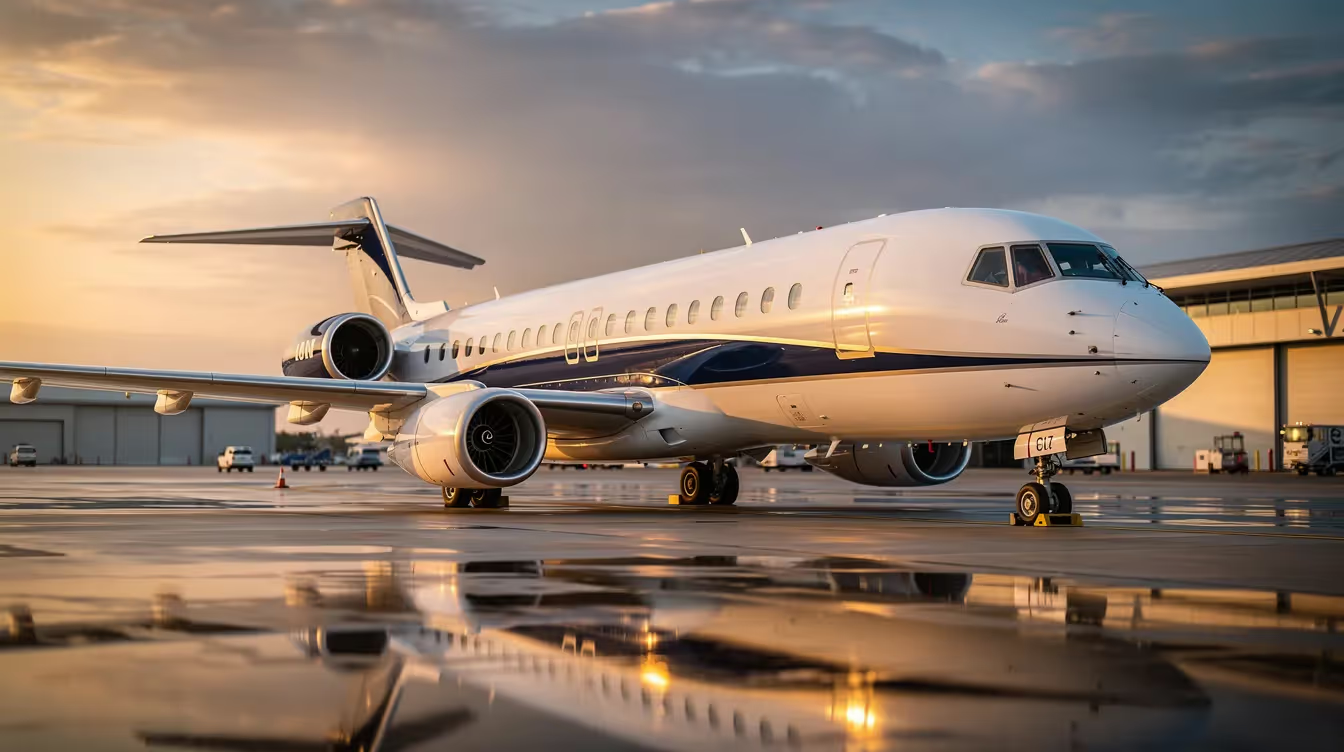
The Boeing Business Jet BBJ1 was the first BBJ, marking Boeing’s entry into the ultra-long-range business jet market. Under the leadership of key executives and the chairman, the BBJ program was launched in the late 1990s, establishing Boeing’s presence in the business aviation sector. The first BBJ, the BBJ1, brought commercial aircraft durability to the business aviation world and set the standard for subsequent models. It is primarily designed for corporate leaders, government officials, and high-net-worth individuals who travel with large entourages.
Unlike traditional large-cabin business jets from Gulfstream, Bombardier, or Dassault, the BBJ1 offers substantially more cabin space while maintaining intercontinental range. Jettly provides on-demand charter access to this aircraft category, making the Boeing Business Jet experience available without ownership.
The Boeing Business Jet BBJ1 was the first BBJ, launched in 1998 as the inaugural model in the BBJ program, based on the Boeing 737-700. A total of 113 BBJ1s were produced and sold to a range of clients, including governments and corporations, establishing Boeing's presence in the ultra-long-range business jet market.
Key benefits of the BBJ1 include exceptional passenger comfort, impressive fuel efficiency, and operational flexibility, all contributing to superior aircraft performance, enhanced passenger experience, and cost savings for operators.
The BBJ1 is built to commercial standards and designed for high-utilization cycles, making it significantly more durable than typical business jets designed for only 400 hours annually.
While BBJ1 production has ended, it remains highly active on the charter market. Jettly connects travelers to BBJ1 and other Boeing Business Jets through its digital private jet charter platform.
Chartering through Jettly offers access to this aircraft type without long-term commitments, ownership costs, or fractional ownership obligations.
This guide covers BBJ1 history, design, cabin layout, performance, ownership economics, and how to charter a BBJ 737 with instant pricing at Jettly.
The first BBJ, known as the BBJ1, was introduced in response to a request from Boeing’s President Phil Condit and General Electric’s CEO Jack Welch for a larger, long-range business jet derived from the Boeing 737. This collaboration in the mid-1990s created a new market segment.
The first BBJ1 rolled out of the production facility on August 11, 1998, and flew for the first time on September 4, 1998. The BBJ program was officially launched in April 1996, marking a significant milestone for Boeing. The first delivery to customers followed in October 1998, with General Electric receiving the inaugural aircraft.
A total of 113 BBJ1 aircraft have been produced and sold to customers since their introduction in 1998, showcasing their popularity in the business jet market. Production continued until approximately 2021, influenced by economic cycles including the 2008 financial crisis and growing demand from markets like China and Europe.

The BBJ1 was developed from the Boeing 737-700, featuring upgrades such as stronger wings and landing gear from the Boeing 737-800, and the addition of up to nine auxiliary fuel tanks located in the belly of the aircraft to extend its range. This high-performance derivative enables the aircraft to carry significantly more fuel than standard airliners.
The BBJ1, which is based on the Boeing 737-700, features upgraded landing gear and a stronger wing derived from the 737-800, along with nine auxiliary fuel tanks in the belly to extend its range to over 6,000 nautical miles. Maximum takeoff weight reaches approximately 171,000 pounds.
Aviation Partners blended winglets reduce drag by roughly 5% while improving fuel efficiency. The BBJ1 also includes integrated airstairs stored in the belly, allowing the aircraft to operate at airports without ground stair cars, adding operational flexibility at smaller facilities.
The BBJ1 delivers approximately 6,225 nautical miles of range with 8 passengers, scaling to roughly 5,300 nautical miles when configured for 50 passengers. Maximum cruise speed reaches Mach 0.82, with a service ceiling near 41,000 feet.
Real-world routing examples include:
New York to Tokyo (non-stop)
London to Johannesburg
Los Angeles to Dubai (with reduced payload)
Dubai to London
Takeoff distance runs approximately 5,785 feet at maximum takeoff weight, requiring runways over 6,000 feet for long-range operations. While BBJ MAX models offer slightly reduced range trade-offs with 15% better fuel efficiency, BBJ1 remains competitive for most intercontinental missions.
|
Specification |
Details |
|---|---|
|
Base Model |
Boeing 737-700 |
|
Maximum Takeoff Weight |
~171,000 pounds (77,564 kg) |
|
Range |
6,225 nautical miles (8 pax) |
|
Maximum Cruise Speed |
Mach 0.82 |
|
Service Ceiling |
~41,000 feet |
|
Auxiliary Fuel Tanks |
9 (belly-mounted) |
|
Winglets |
Aviation Partners blended winglets (5% drag reduction) |
|
Passenger Capacity |
16-20 typical VIP layout; up to 50-60 high-density |
|
Integrated Airstairs |
Yes (belly-stowed) |
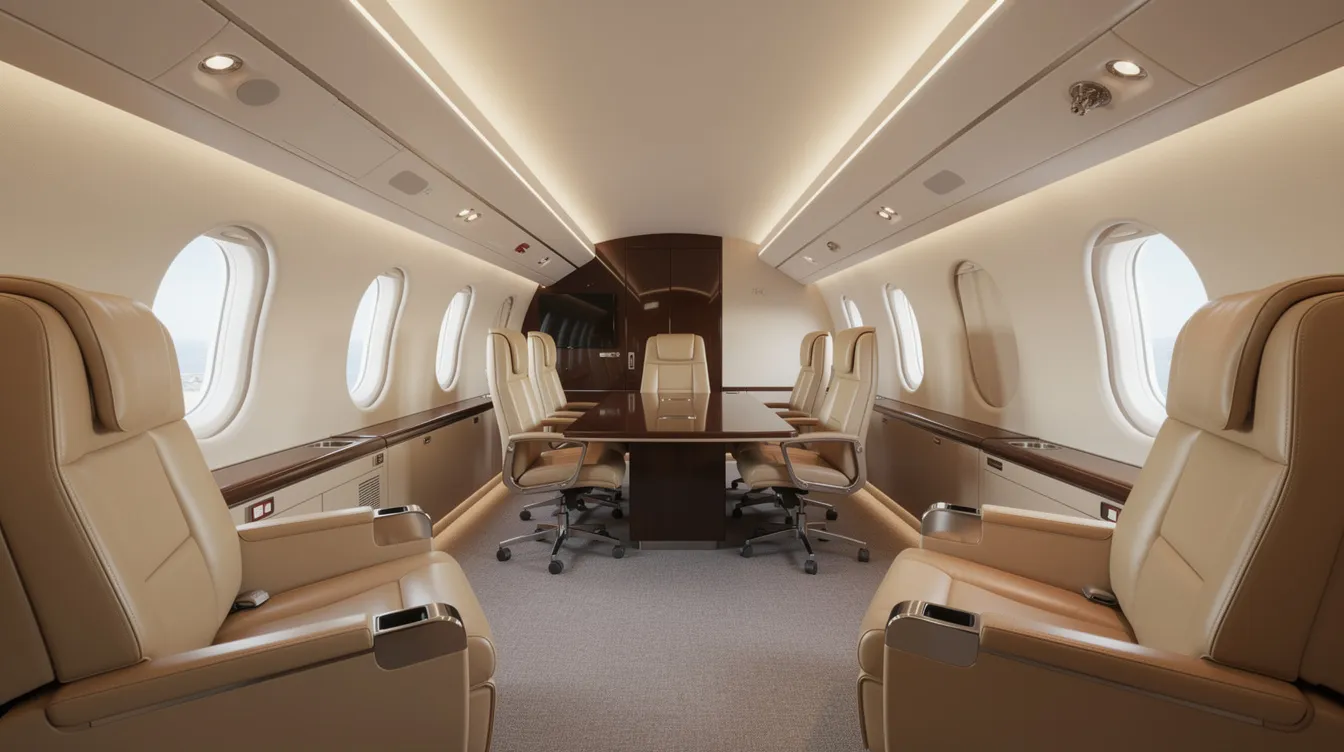
BBJ1 cabin dimensions far exceed typical business jets: approximately 79 feet of usable length, nearly 12 feet of width, and 7 feet of height. This narrow-body aircraft offers cabin space comparable to a compact airliner interior.
Its spacious cabin allows for modular living spaces, typically divided into areas such as a boardroom, lounge, master bedroom, and private office. The BBJ’s cabin can be configured to include completely private rooms while maintaining accessibility to the rest of the aircraft.
The typical passenger configuration of the BBJ1 accommodates 18 to 20 passengers to maximize space and comfort, though high-density layouts support 50-60 passengers. The BBJ Select offers various interior color palettes, including Serene, Midnight, and Earthbound, which can be further customized to fit individual styles.
The BBJ2 (Boeing 737-800 based) stretches approximately 19 feet longer than BBJ1, offering 25% more cabin volume with slightly reduced range. BBJ3 adds another 16 feet over BBJ2, trading additional cabin space for slightly shorter range capability.
The BBJ MAX family, which includes the BBJ MAX 7, MAX 8, and MAX 9, was launched in 2014 and features improvements such as a lower cabin altitude of 6,500 feet and a 15% reduction in fuel burn compared to earlier models. The BBJ MAX features a 15% reduction in fuel burn compared to its predecessor, with a range of over 6,000 nautical miles due to improved aerodynamics and new engines.
For widebody options, the BBJ 787-8 and BBJ 787-9 have ranges of 9,960 nautical miles and 9,475 nautical miles, respectively, allowing for long-range travel with 25 passengers.
Customers can select from pre-designed cabin layouts for the BBJ MAX, allowing for a customized turn-key solution at a fixed price. These layouts can be further tailored to suit different mission requirements or personal preferences, providing flexibility for a variety of travel needs. BBJ1 remains ideal for transcontinental missions where cabin size matters more than maximum fuel efficiency.
Pre-owned BBJ1 prices range from approximately $30-80 million depending on age, configuration, and refurbishment level. Original prices ran around $57 million for a “green” aircraft plus $20-25 million for bespoke interior completion.
The BBJ1 is built to commercial standards and designed for high-utilization cycles, making it far more durable than typical business jets designed for 400 hours annually. This durability appeals to governments, large corporations, and charter operators who frequently rely on diverse private charter aircraft for demanding missions.
Main considerations include high operating costs, demanding maintenance regimes (C-checks every 24 months at $2-4 million), and a relatively narrow resale market limited to UHNW individuals and state flight departments. Prospective operators often evaluate these expenses using a private jet charter cost estimator. Jettly clients can access BBJ1 capabilities through charter without capital commitment.
The direct operating costs for the BBJ are estimated to be between $5,200 and $5,600 per hour, which is lower than many purpose built business jets of similar size. Major cost drivers include fuel (1,200-1,500 gallons per hour), maintenance reserves, crew salaries, and navigation fees, all of which factor into broader private jet charter cost calculations for operators and charter clients.
BBJ operators typically aim for 300-400 flight hours annually, using the aircraft for specific periods while chartering it out to offset fixed costs. The aircraft competes with VIP-configured Airbus ACJ319/ACJ320 models and ultra-long-range jets like Gulfstream G650.
Jettly’s marketplace reflects market trends by listing BBJ-class aircraft alongside light, midsize, and heavy business jets, allowing customers to right-size each mission through flexible private jet memberships and on-demand options.
Jettly operates as a digital charter marketplace with access to over 20,000 aircraft globally, including Boeing BBJ variants. The platform offers instant pricing for specific routes and dates and provides tools like an airport locator to match aircraft capabilities with available airports.
Typical BBJ1 charter use cases include:
Corporate roadshows with 25-40 executives
Government delegations
Sports team travel
Entertainment tours
Large family vacations
Fortress transportation for high-profile clients requiring maximum security and privacy, such as VIPs, government officials, and royalty
The customer journey involves requesting a quote, reviewing available aircraft and cabin layouts, confirming safety ratings, and adding extras like catering and ground transportation through services such as Jettly Eats in-flight catering. Chartering eliminates ownership responsibilities while providing full access to BBJ capabilities.

Many BBJs feature a lower cabin altitude environment at cruising altitude, enhancing passenger comfort. BBJ1 typically maintains cabin altitude around 6,500-8,000 feet—better than most commercial airliners but higher than the low cabin altitude system found on BBJ 787 variants.
Charter flights through Jettly partners include full galley service, dedicated flight attendants, high-speed Wi-Fi, and streaming capabilities. For frequent flyers, structured solutions like jet card programs can complement on-demand BBJ1 access. Recent refurbishments may include LED lighting and upgraded entertainment systems. While BBJ MAX offers improved noise reduction and lower cabin altitude, BBJ1 still provides more cabin space than standard business jets.
The BBJ1 provides mobile office capabilities, allowing executives to conduct business at high altitudes. Consider BBJ1 for scenarios requiring:
Multiple private rooms for 30+ executives
Onboard conference capabilities
Extensive cargo hold capacity for equipment
Non-stop long-range sectors with large groups
For shorter routes like Los Angeles to Las Vegas or New York to Boston, Jettly typically recommends light jets or turboprops. For travelers prioritizing value over exclusivity, crowdsourced and shared private flights can also reduce costs by filling empty seats. For ultra-long-range missions with fewer passengers, modern BBJ MAX or dedicated business jets may prove more efficient.
BBJ1 established Boeing Business Jets as a viable category, spawning BBJ2, BBJ3, BBJ MAX, and widebody variants. Production of 737NG-based BBJ aircraft concluded around 2021, with focus shifting to 737 MAX-based models.
Future developments emphasize improved fuel efficiency, lower emissions, and enhanced cabin altitude systems. Deliveries of the new Boeing 777X BBJ variant are expected to begin once certification is achieved, anticipated in early 2025. Within this evolving market of top private jet charter companies, many BBJ1 aircraft remain active with governments and VIP operators worldwide, with ongoing refurbishments keeping them competitive.
Jettly expects BBJ1 to remain a relevant charter option for years, especially for large-group travel requiring proven Boeing aircraft reliability, and the market expects continued relevance for the BBJ1 alongside new BBJ deliveries.
Yes. Many BBJ1 aircraft remain active in VIP, government, and charter fleets worldwide. Jettly can source BBJ1 options on specific long-range or large-group routes through its global operator network, despite the model being out of production since 2021.
BBJ1 offers spacious interiors and good pressurization. However, newer models like BBJ MAX maintain cabin altitude at 6,500 feet, while BBJ 787 achieves approximately 6,000 feet. Lower cabin altitude reduces fatigue on very long flights.
BBJ1 operates from airports with runways around 6,000 feet or longer. It cannot access small general aviation fields suitable for light jets. For travelers who do not need an entire aircraft, guides on how to buy a seat on a private jet can help match airport options with more flexible service models. Jettly helps evaluate airport options for each itinerary based on the world of available facilities.
While BBJ1 can be configured for up to 60 passengers in high-density layouts, most VIP charter configurations carry between 16 and 30 passengers with full-size seating, private rooms, and dedicated sleeping areas, making it one of several options for getting a seat on a private jet depending on group size and budget.
Visit jettly.com, enter departure and arrival cities with dates, specify passenger count and preferences, then review instant pricing. Request BBJ1 or other Boeing Business Jets where suitable for your mission.
The Boeing Business Jet BBJ1 remains a powerful option for long-range, large-group, and VIP missions. It combines Boeing 737 reliability with expansive cabin space that exceeds typical business jets.
Travelers seeking the Boeing Business Jet BBJ1 experience without ownership can access this aircraft through Jettly’s on-demand charter platform, while those with established audiences can also benefit from Jettly’s high-ticket affiliate program by referring new charter clients. Best use cases involve flights with larger groups requiring meeting space, private suites, and extensive baggage capacity.
Experience private travel tailored to your needs. Discover available flights or get a personalized quote at https://www.jettly.com.
Share this post:
Jay Franco Serevilla
May 13, 2026
|
5
min read
Discover tips and trends in the industry.

5
min read
Jettly Launches Special Missions, Expanding On-Demand Access to Helicopters, Group Charter, Cargo, Medevac and VIP Airliners
Jettly has launched "Special Missions," integrating complex charter categories—including helicopters, group charter (18–200 seats), cargo freighters, medevac flights, and VIP airliners—into its instant-pricing digital marketplace. Supported by a network of over 23,000 aircraft and 24/7 flight operations, the feature replaces slow, offline sourcing with transparent digital access for high-stakes, specialized flying.
Read More
5
min read
Tom Brady's Aviation Habits After His Retirement From Pro Football
Tom Brady’s post-NFL career has transformed his travel needs from those of a professional athlete into those of a broadcaster, investor, and business executive. While he has long been associated with the Gulfstream G550, the economics of private aviation suggest that flexible access can be more efficient than whole-aircraft ownership for travelers flying fewer than several hundred hours per year. His evolving schedule illustrates why depreciation, fixed operating costs, productivity, and fleet flexibility increasingly shape how ultra-high-net-worth travelers approach private aviation.
Read MoreStay updated with our latest insights and tips to elevate your journey with us.
MEMBERSHIPS AND ASSOCIATIONS



Disclaimer: Jettly operates as a charter broker, offering access to a global digital jet charter marketplace. Jettly is not a direct air carrier and does not own or operate aircraft. All advertised flights are conducted by third-party air carriers that are fully licensed and hold the appropriate Part 135 or Part 121 certifications issued by the Federal Aviation Administration (FAA) or equivalent regulatory authorities under U.S. or foreign law. Jettly complies fully with the U.S. Department of Transportation's Part 295 and Part 298 Charter Broker regulations. Jettly does not carry additional liability insurance. Passengers are covered by aircraft operator insurance. TICO: 50023770


