



Login
Get Instant Pricing On 23,000+ Aircraft

>
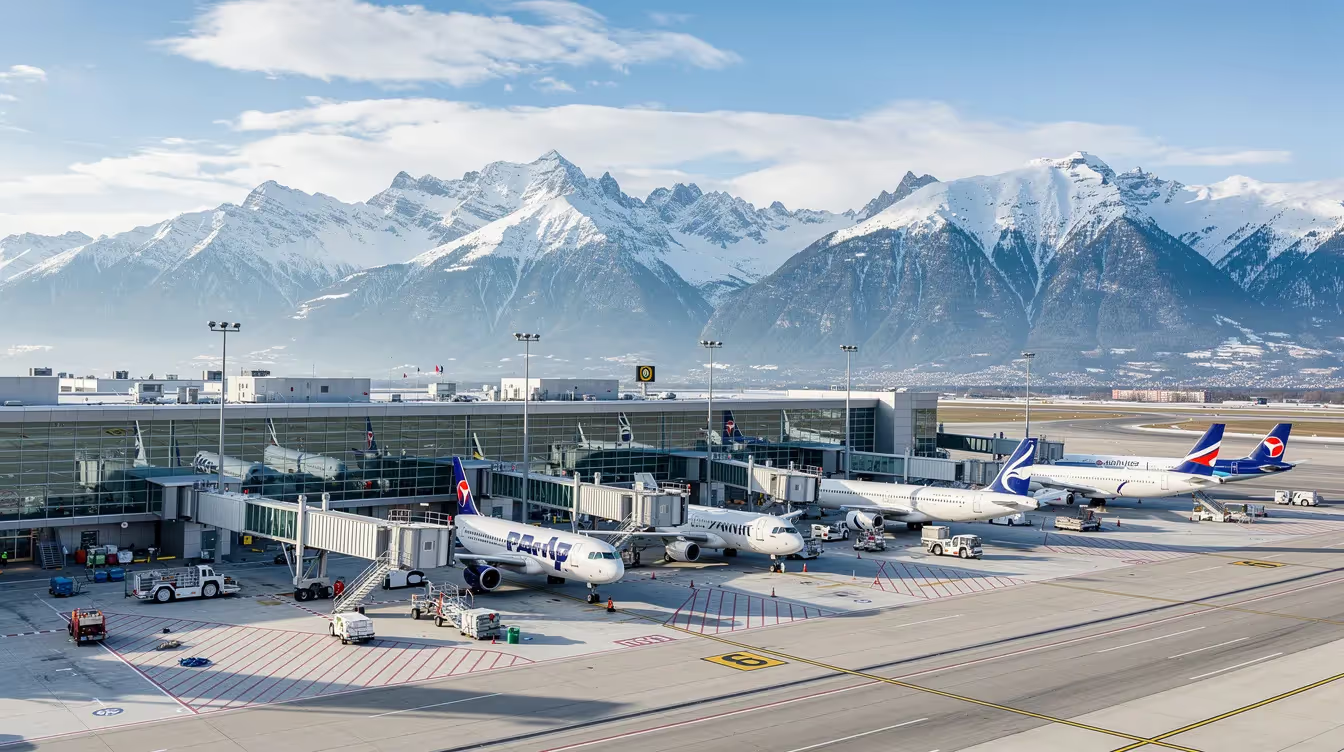
Alaska Airlines is one of North America’s most established and recognized carriers, serving as a major player in the U.S. aviation landscape. This guide is for travelers, aviation enthusiasts, and anyone considering Alaska Airlines for their next trip. It covers Alaska Airlines' history, network, services, loyalty program, and how it compares to private jet charter options. Understanding Alaska Airlines' offerings helps travelers make informed decisions in 2026's evolving air travel landscape.
Alaska Airlines has historically been one of the largest carriers on the West Coast of the United States, with strong presences in cities like Anchorage, Seattle, Portland, and San Diego. The main hubs for Alaska Airlines include Seattle, San Francisco, Portland, Los Angeles, Anchorage, San Diego, and Honolulu. This West Coast focus continues to define the airline’s network and service strengths today.
Main Hubs: Seattle, San Francisco, Portland, Los Angeles, Anchorage, San Diego, Honolulu
Alliance Membership: Member of the oneworld alliance
Destinations: Over 125 destinations across the U.S. and internationally, including the Bahamas, Belize, Canada, Costa Rica, Guatemala, and Mexico; expanding into long-haul international routes such as Tokyo, Seoul, Rome, and London
Cabin Classes: First Class, Premium Class with extra legroom, Main Cabin
Loyalty Program: Atmos Rewards—no membership fee, miles never expire, earn status points on Alaska and partner flights, redeem for award travel, elite tiers: Titanium, Platinum, Gold, Silver
Lounge Locations: Nine airport lounges, including Seattle–Tacoma, Portland, Anchorage, San Francisco, New York JFK, and Los Angeles
Wi-Fi & Entertainment: Streaming entertainment on personal devices; Starlink high-speed Wi-Fi rollout planned by 2026
Operational Reliability: Low cancellation rate (under 1%), high on-time performance, recognized as the best overall U.S. airline for 2026 for operational reliability and superior customer service, including shorter phone wait times and more helpful airport agents than larger carriers
Overview: Alaska Airlines operates as the fifth-largest airline in North America by scheduled passengers carried. It is headquartered in SeaTac, Washington, with main hubs in Seattle, San Francisco, Portland, Los Angeles, Anchorage, San Diego, and Honolulu. The airline is a member of the oneworld alliance, connecting travelers to 1,200+ destinations worldwide.
Network & Destinations:
Serves continental U.S. cities, Alaska, Hawaii, Mexico, Canada, Belize, Costa Rica, Guatemala, and the Bahamas
Expanded international reach after the 2024 Hawaiian Airlines acquisition
Expanding long-haul international routes with new flights to Tokyo, Seoul, Rome, and London
Services:
Three cabin classes: First Class, Premium Class with extra legroom, Main Cabin
Atmos Rewards loyalty program with Silver, Gold, Platinum, and Titanium tiers
Airport lounges at key hubs
Onboard Wi-Fi and streaming entertainment on personal devices, with Starlink high-speed Wi-Fi planned by 2026
Operational Reliability & Customer Service:
Low cancellation rate under 1%
Frequently ranks high for on-time departures and arrivals
Recognized for superior operational reliability and extensive customer service, including shorter phone wait times and more helpful airport agents than larger carriers
Digital Tools & Private Charter Options:
Digital tools, including the mobile app and online account, make booking, check-in, and trip management straightforward
Travelers needing direct flights to smaller airports or custom schedules can compare private charter options through platforms like Jettly
Alaska Airlines stands as a major U.S. carrier based in SeaTac, Washington, ranking fifth-largest in North America by scheduled passengers carried as of 2024. The airline maintains a strong focus on the West Coast, operating over 1,400 daily flights to more than 140 cities directly.
The primary hub sits at Seattle–Tacoma International Airport, supported by additional hubs in San Francisco, Portland, Los Angeles, Anchorage, San Diego, and Honolulu. Focus cities include San Diego and San Jose, creating a network that spans the western United States.
Through membership in the oneworld alliance, Alaska connects travelers to hundreds of destinations worldwide via regional partners and global carriers. This partnership structure means a Seattle-based traveler can earn and redeem miles on flights to London, Tokyo, or Sydney through alliance members.
Key regions served include:
Continental U.S. transcontinental routes
Alaska statewide service
Hawaii (Honolulu, Maui, Kauai, Kona)
Canada (Vancouver, Calgary, Edmonton, Toronto)
Mexico resort destinations
Central America, including Belize, Costa Rica, and Guatemala
Bahamas is part of Alaska Airlines' expanding international destinations
Alaska’s scheduled service works well for regular West Coast commutes, family Hawaii vacations, and trips between major airports. For travelers needing direct flights to smaller airports, last-minute business trips, or group charters, private jet platforms like Jettly offer an alternative worth considering, especially when paired with an airport locator tool that identifies suitable private terminals and runways.
McGee Airways launched in 1932 when founder James Martin McGee began unscheduled flights between Anchorage and Bristol Bay using small aircraft suited to Alaska’s rugged terrain. The Great Depression created financial struggles, leading to a 1934 merger with Star Air Service.
In 1938, Civil Aeronautics Board regulations granted most Alaskan routes but excluded the Seattle–Fairbanks sector. The company adopted the Alaska Airlines name in 1944.
World War II brought challenges:
Pilot shortages across the industry
Maintenance constraints on aging aircraft
Growing demand for transportation to remote regions
These wartime conditions forged operational expertise in difficult environments that continues to define Alaska’s identity today.
Under President James Wooten, the airline hired its first stewardesses in 1945 and acquired surplus DC-3 and DC-4 aircraft after the war. The main base relocated to Paine Field near Seattle, better connecting Alaska with the West Coast.
A 1949 CAB shutdown of certain charter operations for safety issues prompted investment in helicopters like the Bell 47B for North Slope oil work.
Operation Magic Carpet (1949–1950) showcased humanitarian capability, airlifting nearly 49,000 Yemenite Jews to Israel without loss of life—a remarkable logistical achievement for any airline of that era.
The late 1950s and 1960s brought pressurized Douglas DC-6 aircraft, early jets like the Convair 880 and Boeing 727, plus creative marketing to differentiate the brand in expanding markets.

The early 1970s saw Alaska fly Boeing 707 charters to Soviet Siberia after secret negotiations—an unusual route strategy for the time. Economic difficulties followed from rising fuel costs and Trans-Alaska Pipeline delays.
A fatal 1971 Boeing 727 crash near Juneau killed 111 people, triggering leadership changes. CEO Ronald Cosgrave implemented cost-cutting that returned the carrier to profitability by 1973. The 1970s rebranding introduced the now-recognizable smiling Inuk tail logo.
The 1978 Airline Deregulation Act enabled expansion into Portland, San Francisco, Southern California, and Mexico. Competition intensified with Northwest, Western, and Wien Air Alaska on routes like Anchorage–Seattle.
Key corporate developments:
1985: Formation of Alaska Air Group as parent company
1986: Acquisition of Horizon Air for regional integration
1987: Purchase of Jet America Airlines
The 1990s brought Boeing 737-400 aircraft, route trials to the Russian Far East and Toronto, and innovations including heads-up guidance systems, online ticket sales, and self-service kiosks called “Instant Travel Machines.”
Alaska took delivery of its first Boeing 737-900 in 2001 and quickly returned to Washington, D.C.’s Reagan National Airport after post-9/11 restrictions eased.
William Ayer became CEO in 2002, launching “Alaska 2010”—a project focused on costs, reliability, and customer service improvements. By 2008, the airline removed MD-80 aircraft from its fleet in favor of more efficient Boeing 737 Next Generation models.
Expansion pushed beyond the Pacific Northwest into transcontinental routes:
Seattle–New York service
California–East Coast connections
Increased West Coast–Hawaii frequencies
Regional operations strengthened through Horizon Air’s capacity purchase model and cooperation with SkyWest Airlines on feeder services to smaller markets.
In December 2023, Alaska Airlines announced it would acquire Hawaiian Airlines through the purchase of its parent company, Hawaiian Holdings, Inc., in a $1.9 billion cash transaction, including the assumption of roughly $900 million in debt. Regulators and shareholders reviewed the deal throughout 2024, with completion in September 2024.
Both brands remain visible to customers. Hawaiian joined oneworld, and a combined frequent-flyer ecosystem is planned. The deal added Hawaiian’s long-haul widebody capability (Airbus A330 aircraft) to Alaska’s fleet, enabling more Asia-Pacific and South Pacific options.
The combined network announced 19 new routes, including Seattle-Toronto, San Diego-Washington Dulles (the only nonstop on that route), and connections to Australia and New Zealand.
With this historical foundation, Alaska Airlines has developed a robust route network, which is detailed in the next section.
Alaska Airlines connects the West Coast to domestic and international markets through mainline and regional operations. Alaska's network design emphasizes frequent service between high-demand city pairs.
Flagship West Coast hubs include:
Seattle (the largest)
San Francisco
Portland
Los Angeles
Anchorage
San Diego
Honolulu
Portland’s new terminal opened in August 2024, and San Francisco’s Harvey Milk Terminal 1 features an 11,000 sq ft lounge.
Transcontinental links serve:
New York
Boston
Washington D.C.
Chicago
Leisure destinations cover:
Alaska statewide service
Hawaii: Honolulu, Maui, Kauai, Kona
México: Cabo San Lucas, Puerto Vallarta, Cancún
Central America: Belize, Costa Rica, Guatemala
Cross-border Canada routes connect to:
Vancouver
Calgary
Edmonton
Toronto
Regional affiliate Horizon Air and partner SkyWest Airlines operate Embraer 175 jets under the Alaska brand, expanding connectivity from hubs to smaller markets. These 2-2 configured aircraft offer comfortable regional jet travel without middle seats.
For destinations not covered by Alaska’s network or for direct point-to-point flying to smaller airports, private jet charter platforms like Jettly fill network gaps when scheduled service doesn’t fit the trip, and travelers can use guides on affordable private jet charter costs to understand pricing before booking.

With a clear understanding of Alaska Airlines' destinations and network, let's explore the onboard experience and cabin options available to travelers.
Alaska Airlines offers First Class, Premium Class with extra legroom, and Main Cabin seating options.
First Class: The most spacious and premium cabin, offering wider recliner seats, priority check-in and boarding, complimentary meals and beverages, and front-of-aircraft seating for quick boarding and exit.
Premium Class: Offers 35 inches of seat pitch, which is four inches more than in the Main Cabin, along with priority boarding and complimentary beverages, with USB and power outlets available at each seat.
Main Cabin: The economy class of Alaska Airlines, providing passengers with a complimentary non-alcoholic beverage and a small snack, with food and alcoholic beverages available for purchase.
First Class represents Alaska’s most spacious cabin with wider recliner seats arranged in a 2-2 configuration, providing 36–41 inches of pitch. All seats have power outlets.
Key benefits include:
Priority check-in and boarding
Two free checked bags
Complimentary meals on longer flights
Complimentary alcoholic beverages
Front-of-aircraft seating for quick boarding and exit
On some flights, First Class guests receive enhanced snacks or plated food depending on route length and time of day.
For travelers seeking more control, a Jettly charter offers fully private cabins, custom in-flight catering, and tailored departure schedules—useful when commercial First Class doesn’t meet specific requirements.
Premium Class provides an enhanced Main Cabin experience in the first few rows behind First Class, offering 35 inches of seat pitch—four inches more than Main Cabin.
Benefits include:
Priority boarding
Complimentary alcoholic or non-alcoholic beverages
Dedicated overhead bin space where available
Power and USB outlets at the seat
Seat width matches Main Cabin, but additional space makes working or relaxing easier. For a typical Seattle–Los Angeles or Portland–San Francisco flight of 2–3 hours, Premium Class improves comfort without First Class pricing.
Main Cabin serves as Alaska’s standard economy product with typical narrow-body seating in a 3-3 configuration on Boeing 737 aircraft. Legroom falls in the low-30-inch pitch range.
Core services include:
Complimentary non-alcoholic beverages and small snacks
Food and alcoholic beverages available for purchase (card or mobile pay)
Satellite Wi-Fi on most 737s
Streaming entertainment available on personal devices
Various fare types affect flexibility—basic fares restrict changes and seat selection, while fully flexible fares offer more options. For groups finding that multiple First or Premium tickets add up quickly, comparing total cost with charter options through Jettly and using a private jet charter cost estimator may reveal alternatives worth considering.
With a clear understanding of Alaska Airlines' cabin classes and onboard experience, let's move on to the benefits of the Atmos Rewards loyalty program.
Atmos Rewards functions as Alaska Airlines’ loyalty program, letting travelers earn miles and status points on Alaska and partner flights. The program rewards frequent West Coast and network travelers with escalating benefits.
Starting in late 2026, Atmos Rewards will allow members to choose how to earn points based on distance traveled, dollars spent, or segments flown.
Key features:
No membership fee
Accumulated miles do not expire, providing flexibility for travelers
Earn status points every time you fly with Alaska Airlines or any of its airline partners
Redeem points for award travel
Elite status tiers: Titanium, Platinum, Gold, Silver
Miles earned on eligible flights can be redeemed for award travel on Alaska and oneworld partners, covering transcontinental, Hawaii, and international long-haul routes. Points accumulate through flights, partner credit cards, and everyday spending.
Loyalty to one airline can complement occasional private jet use. Many travelers fly Alaska for routine trips while using Jettly charters, sometimes through structured jet card programs, for time-critical or remote-destination journeys where scheduled service falls short.
Qualification for status tiers depends on miles flown, segments completed, or spend thresholds under current program rules.
|
Tier |
Core Benefits |
|---|---|
|
Silver |
Bonus miles on paid flights, preferred seating |
|
Gold |
Complimentary upgrades when available, priority check-in |
|
Platinum |
Higher upgrade priority, baggage fee waivers |
|
Titanium |
Top upgrade priority, Oneworld Emerald recognition |
Reciprocal elite recognition with oneworld partners allows benefits like lounge access and priority services on connecting international itineraries. A Seattle-based traveler reaching Gold status after frequent trips to Los Angeles, Anchorage, and Maui can then use those benefits on partner flights to London or Tokyo.
With loyalty benefits in mind, let's look at the lounge and airport experience for Alaska Airlines travelers.
Alaska Airlines operates nine airport lounges across major locations, including:
Seattle–Tacoma International Airport
Portland International Airport
Ted Stevens Anchorage International Airport
San Francisco International Airport
New York JFK
Los Angeles International Airport
Alaska's lounges provide a quiet space for passengers to relax, recharge, or work between flights—especially useful for frequent business travelers and those with long layovers.
Typical amenities feature:
Comfortable seating
Complimentary snacks and drinks
Workspaces
Wi-Fi
In some locations, hot food and premium beverage options
Access comes through:
Paid memberships
Certain premium credit cards
Day passes
Elite status with cabin class upgrades on selected itineraries
The contrast between busy hub terminals and quiet lounges is notable. Private terminals and FBOs often used for private charters booked through platforms like Jettly offer yet another level of separation from typical airport crowds, whether on shared charter flights or full charters.
With lounge access and airport amenities covered, let's explore Alaska Airlines' digital tools for booking and managing your travel.
Alaska’s digital ecosystem includes its website, mobile app, and integration with platforms like Facebook for easier account access. These tools streamline the customer journey from booking through landing.
Travelers can:
Create or access an Alaska Airlines account using conventional email login or Facebook sign-in
View upcoming trips
Manage seats
Store traveler details (TSA PreCheck number, Atmos Rewards number, passport information)
Track miles and status progress
Alaska encourages users to provide feedback or request help to improve their digital experience, whether it’s reporting issues or sharing suggestions for the app and online tools.
While Alaska’s digital tools work for scheduled flights, Jettly’s online platform operates separately for instant pricing and booking on-demand private charters when commercial schedules don’t fit, making it one of several ways to get a seat on a private jet easily.
The combined Alaska–Hawaiian mobile app handles searching and booking flights, checking in, selecting seats, and displaying mobile boarding passes—all from one device.
Additional functions include:
Monitoring Atmos Rewards balances and recent transactions
Pre-ordering meals for various cabin classes
Updating traveler details and adding Known Traveler numbers
Payment via Apple Pay and saved cards
In-app change and cancel tools
Real-time gate and delay notifications
On privacy: The app encrypts data in transit and follows standard airline industry security practices. Some information may be shared with third parties under the privacy policy. Users can review privacy settings, limit optional data sharing, and request deletion of stored personal data through official channels if needed.
With digital tools in place, let's examine Alaska Airlines' partnerships and alliances that expand its global reach.
Alaska Airlines leverages alliances and interline agreements to offer more destinations than it could serve alone. This partnership structure extends reach without expanding the fleet to every market.
As a full oneworld member, Alaska collaborates with global carriers for connecting itineraries, mileage earning, and redemptions. A single ticket can combine Alaska domestic segments with partner international flights.
Codeshare agreements allow Alaska flight numbers to appear on partner flights and vice versa. This simplifies booking multi-segment trips and creates seamless connections for passengers.
Interline agreements let passengers and baggage transfer between Alaska and other carriers on a single itinerary—useful for complex international trips requiring ground connections at hub airports.
For specialized missions like corporate roadshows to multiple smaller cities without scheduled links, travelers may supplement alliance connectivity with bespoke charter itineraries using private jet platforms such as Jettly, including options to crowdsource and share empty seats to manage costs.
With a strong partnership network, let's review the aircraft types that make up Alaska Airlines' fleet.
Alaska Airlines’ mainline fleet consists primarily of Boeing 737 variants, supported by regional Embraer 175 aircraft operated by Horizon Air and SkyWest Airlines. All aircraft in the fleet must meet required certifications and undergo regular maintenance checks as mandated by the FAA and industry standards to ensure safety and compliance.
Boeing 737 family (including 737-800, 737-900, and 737 MAX) handles most domestic and some international routes. These narrow-body jets balance range and fuel efficiency for typical West Coast and transcontinental service.
Embraer 175 regional jets feature a 2-2 configuration without middle seats, serving thinner routes from hubs and focus cities. This creates a more comfortable regional airline experience on shorter segments.
Post-merger widebodies: Through Hawaiian’s integration, the broader group gains access to Airbus A330 aircraft, ideal for long over-water routes and extended international services to Asia-Pacific destinations.
With a modern and diverse fleet, Alaska Airlines maintains high safety and operational standards, which are discussed in the next section.
Alaska Airlines, like most legacy carriers, has experienced accidents across its long history while operating today under stringent U.S. safety regulations.
The airline has recorded 11 major accidents resulting in 226 passenger and crew fatalities and two ground fatalities over several decades. Nine incidents involved loss of life, with two aircraft write-offs occurring without fatalities.
Modern safety oversight comes from the FAA and other regulators, with strict requirements on maintenance, crew training, and operational procedures. Alaska adopted technology, including heads-up guidance systems and advanced navigation, to improve reliability in challenging weather—particularly important for Alaska and Pacific Northwest operations, where conditions vary dramatically.
The airline’s 2024 annual report noted continued investment in new aircraft, AI efficiency software, and sustainable aviation fuel. Alaska Airlines is also committed to responsible business practices, emphasizing environmental sustainability and community engagement as part of its corporate social responsibility efforts. Thanks to ongoing modernization, the current fleet represents significant advances over earlier eras.
With safety and operational standards in mind, let's compare when to choose Alaska Airlines versus private jet charter.
Scheduled commercial travel with Alaska Airlines and private jet charter via Jettly serve different needs. Understanding when each option makes sense helps travelers optimize time, comfort, and money.
Alaska Airlines works well for:
Routine West Coast business trips between major airports
Family vacations to Hawaii or Mexico resort destinations
Flights with set schedules and loyalty benefits create value
Travelers who prefer earning Atmos Rewards miles
Private charter through Jettly suits:
Last-minute departures when commercial options are booked
Access to remote or smaller airports that Alaska doesn’t serve
Multi-city same-day business meetings
Groups needing custom itineraries without connections
Practical example: A corporate team might fly Seattle–San Francisco on Alaska for regular meetings, then use a Jettly-arranged charter for a same-day multi-stop tour to smaller regional airports in the same week, perhaps evaluating it as a NetJets alternative when comparing long-term private aviation solutions.
Many travelers mix both options—using Alaska for high-frequency routes and Jettly for specialized trips, often formalizing their usage through private jet memberships. This blended approach balances cost efficiency on routine travel with flexibility when requirements change.

With these travel options in mind, let's address some of the most frequently asked questions about Alaska Airlines.
Alaska Airlines offers extensive West Coast and transcontinental coverage with fixed schedules and loyalty perks, making it efficient for predictable routes between major cities. Private charter through Jettly allows travelers to set their own departure times, fly nonstop to smaller airports, and use dedicated terminals—dramatically reducing total door-to-door time. Many companies maintain a blended approach: commercial flights for routine trips and on-demand charters for high-stakes meetings or tight itineraries. Cost considerations differ between per-seat commercial pricing and whole-aircraft charter rates, and resources that compare the best private jet charter companies can help evaluate options alongside Alaska Airlines.
Atmos Rewards miles are earned on eligible Alaska Airlines and partner flights and can be redeemed for award travel within that ecosystem. Jettly operates as a separate private jet charter platform and does not participate in Alaska’s loyalty program—flights booked through Jettly typically don’t earn Atmos miles. Focus mileage earning on commercial itineraries while using Jettly for trips where schedule flexibility, privacy, or airport access matters more than mileage accrual. Check Alaska’s official Atmos Rewards page for the latest partner earnings and redemption details.
Upgrades provide the most value on longer flights over 2–3 hours or on busy business routes where extra space, priority boarding, and included drinks or meals add tangible benefits. Premium Class offers extra legroom and perks at a moderate price increase, while First Class adds significantly more space and service. Atmos Rewards elites may receive complimentary or discounted upgrades through the app, which changes the value calculation. Compare the upgrade cost against how much you value comfort and productivity on each specific trip.
The app encrypts data in transit and follows standard airline industry security practices. Some information, such as app activity or device identifiers, may be shared with third parties under the privacy policy. Enable device security features like screen lock and biometric login, and avoid using public Wi-Fi for sensitive transactions. Users can review privacy settings within the app, limit optional data sharing, and request deletion of stored personal data through official channels if needed.
Alaska Airlines is typically more cost-effective for standard family vacations to popular destinations like Hawaii, Mexico, or major U.S. cities—especially when booking early and using saved Atmos Rewards miles. Private charter via Jettly becomes attractive for larger family groups, remote destinations, multi-stop itineraries, or trips where avoiding crowds and connecting flights is a priority, particularly when considering some of the best private planes for families. Compare the total per-person cost of commercial tickets (including baggage fees and airport time) with the all-in cost of chartering a whole aircraft. Consider your priorities—budget versus privacy, schedule control, and direct routing—before choosing.
Alaska Airlines has evolved from 1930s Alaskan bush operations into a major West Coast-based oneworld carrier with extensive reach throughout North America, Hawaii, and key leisure markets in Mexico and Central America. Core strengths include a strong West Coast presence, multiple cabin options, the Atmos Rewards program, airport lounges, and robust digital tools for booking and trip management.
Travelers can combine Alaska Airlines’ scheduled services with private jet charter via Jettly to cover both routine and highly specialized journeys efficiently. When commercial schedules, airport access, or group size don’t align with standard airline offerings, private charter fills the gap, whether that’s arranging private jet charter in Abuja for international business or selecting from a broad range of private charter aircraft.
Ready to experience private travel on your terms? Learn more about on-demand private jet options and request a quote at https://www.jettly.com.
Share this post:
Jay Franco Serevilla
Apr 18, 2026
|
5
min read
Discover tips and trends in the industry.
5
min read
Range of 737: How Far the Boeing 737 Flies, and When a Private Charter Makes More Sense
The Boeing 737 family offers a range from 1,500 to 3,850 nautical miles, making it versatile for various flight missions. While chartering a 737 can be cost-effective for large groups, private jet options through Jettly provide greater flexibility and access to more airports, often reducing total travel time. Understanding the range and capabilities of the 737 helps travelers make informed decisions about their flight options.
Read More
5
min read
How Many Planes Crashed This Year? (2026 Update)
In 2026, aviation safety continues to improve, with over 600 aviation accidents reported in the U.S. by September, primarily involving small general aviation aircraft. Fatal accidents remain rare in commercial aviation, with only a handful of incidents globally. Understanding the context of these numbers is crucial for travelers concerned about flying safety.
Read MoreStay updated with our latest insights and tips to elevate your journey with us.
MEMBERSHIPS AND ASSOCIATIONS



Disclaimer: Jettly operates as a charter broker, offering access to a global digital jet charter marketplace. Jettly is not a direct air carrier and does not own or operate aircraft. All advertised flights are conducted by third-party air carriers that are fully licensed and hold the appropriate Part 135 or Part 121 certifications issued by the Federal Aviation Administration (FAA) or equivalent regulatory authorities under U.S. or foreign law. Jettly complies fully with the U.S. Department of Transportation's Part 295 and Part 298 Charter Broker regulations. Jettly does not carry additional liability insurance. Passengers are covered by aircraft operator insurance. TICO: 50023770


