


Login
Get Instant Pricing On 23,000+ Aircraft

>
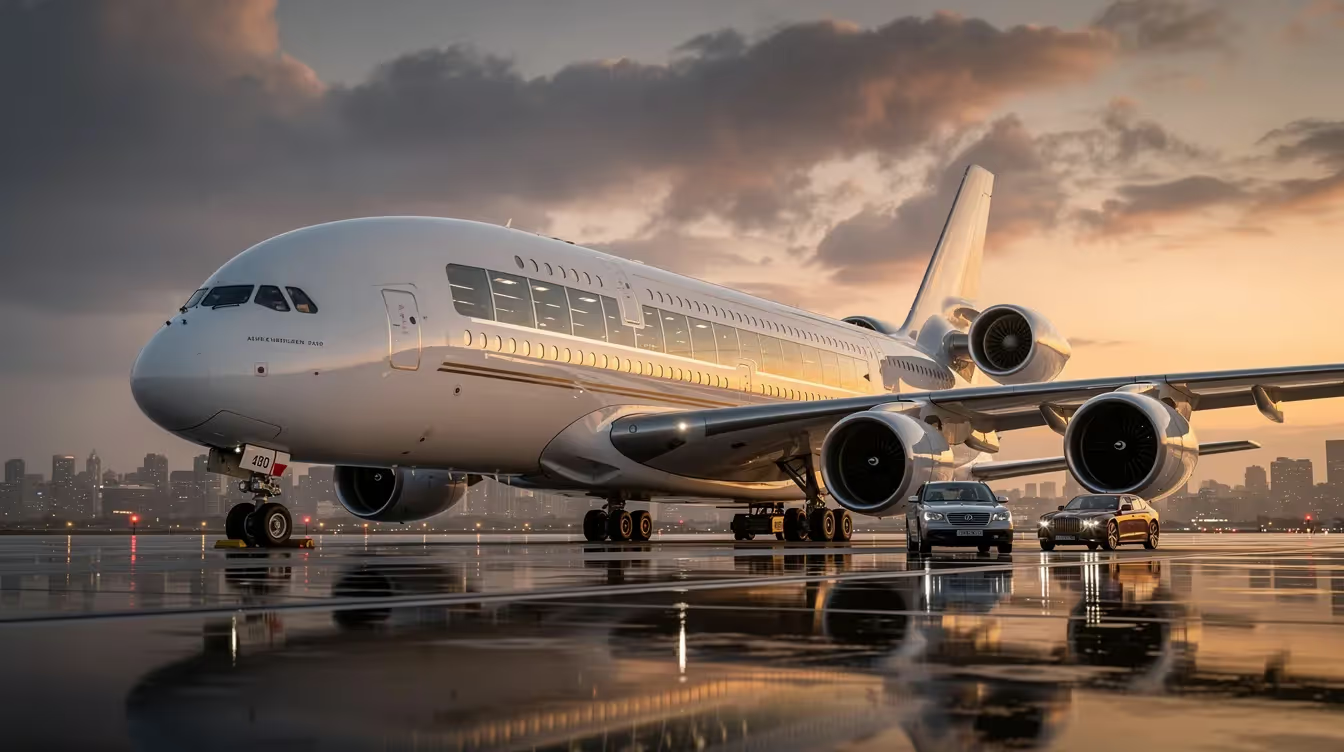
The Airbus A380 private plane stands as a remarkable example of aviation engineering and luxury, transforming the world’s largest passenger aircraft into a flying palace tailored for exclusive travel. Unlike traditional private jets, the A380 offers unparalleled space, customization, and comfort, accommodating VIP passengers with amenities that rival five-star hotels. This aircraft redefines what is possible in private air travel, combining extensive range, advanced technology, and bespoke interiors to serve the unique needs of governments, corporations, and ultra-high-net-worth individuals.
This article explores the concept of the Airbus A380 as a private plane, detailing its design, capabilities, costs, and the practical considerations involved in owning or chartering such a massive aircraft. It also highlights how Jettly’s platform facilitates access to large private jets and VIP airliners, providing travelers with flexible, transparent options for premium aviation experiences without the complexities of ownership.
Discover how the Airbus A380 private plane blends monumental scale with personalized luxury, and learn why it remains an exclusive yet influential icon in the world of private aviation.
The Airbus A380 private plane is the largest private jet concept in the world: a full double-deck aircraft often called a flying palace, with three decks in some VIP concepts and space for roughly 50–100 VIP passengers.
Only a handful of A380S have been linked to private or government VIP plans, and no fully completed private ACJ380 is widely documented in regular service. High-end airline products such as Singapore Airlines Suites remain the closest real-world A380 experience for most travelers.
Real-world figures are substantial: A380 program development cost reached about €18 billion by 2006, new aircraft list prices were around $445–455 million, used airframes can be near $50 million, and charter pricing can exceed $30,000–$35,000 per flight hour.
Most travelers will never own an Airbus A380 private plane, but platforms like Jettly can arrange access to large private jets and VIP airliners with similar privacy, more space, and flexible charter terms.
The A380’s private use concepts continue to influence modern aviation design, from spacious cabins and quiet cabin zones to secure connectivity and advanced technology in long-range business aircraft.
The Airbus A380 private plane is less a normal private jet and more a study in what happens when the largest passenger plane ever built is redesigned for maximum passenger comfort. It combines the scale of a commercial aircraft with the privacy, service, and customization expected in private aviation.
This guide explains what a private A380 can include, what it costs, why it is so rare, and how Jettly helps customers access large private jets and VIP aircraft without the burden of ownership.
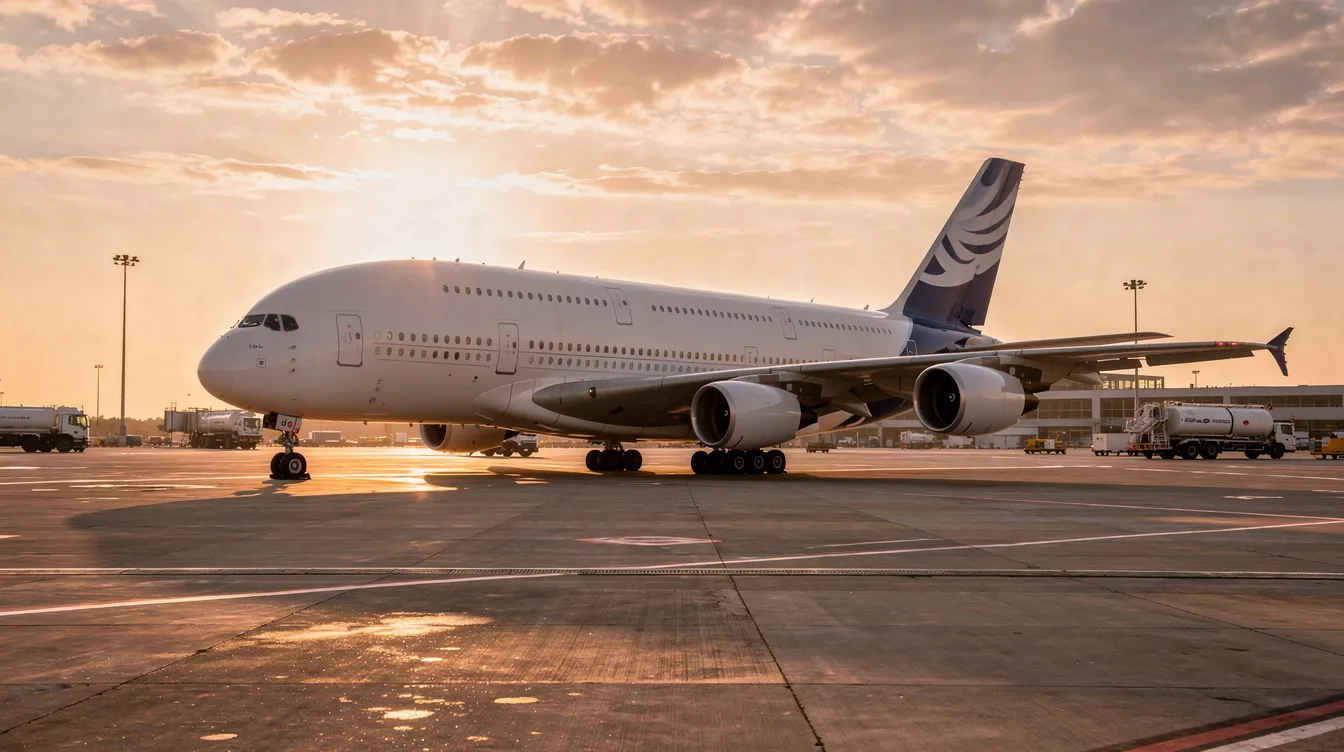
The Airbus A380 was designed as the world’s largest passenger aircraft. In commercial service, it can move more passengers than any other airliner. In a VIP layout, the same aircraft becomes an ultra-large private jet concept with living rooms, bedrooms, conference areas, staff zones, and secure communications.
The Airbus A380 private plane idea is rare because the aircraft is expensive to buy, complex to modify, and limited to key destination airports with suitable runways and ground infrastructure, which is why tools such as Jettly’s airport locator for private jet charters are useful when planning viable routes.
|
Specification |
Commercial A380 |
VIP / Private A380 concept |
|---|---|---|
|
Typical passenger capacity |
500+ passengers |
50–100 passengers |
|
Maximum passenger capacity |
Up to 853 in an all-economy configuration |
Far lower, with wider seats, suites, lounges, and staff areas |
|
Typical range |
About 8,000 nautical miles / 14,800 km |
Up to 9,400 nautical miles / 17,500 km in some ACJ concepts |
|
Flight time |
About 14.5 to 16 hours non-stop |
Similar or longer, depending on payload |
|
Decks |
Two full passenger decks |
Two full passenger decks plus possible lower-level service or third deck use |
|
Wingspan |
About 79.75 m |
Same |
|
MTOW |
575,155 kg |
Same baseline, depending on configuration |
Core facts matter here:
The Airbus A380 has a maximum takeoff weight (MTOW) of 575,155 kg. Some summaries describe this as over 1.4 million pounds, though the direct conversion is closer to 1.27 million pounds. Either way, it allows a very high payload capacity.
The A380 has a typical range of approximately 8,000 nautical miles, or 14,800 km, enabling it to fly non-stop for 14.5 to 16 hours.
The A380 can fly up to 9,400 nautical miles, or 17,500 km, without refueling in extended VIP concepts.
In an all-economy configuration, the A380 can carry up to 853 passengers, making it the largest passenger aircraft in the world.
The aircraft entered commercial service with Singapore Airlines on October 25, 2007.
The A380 features over 5,500 square feet of floor space across two full decks. Some VIP concepts cite around 5,700–5,950 square feet, or roughly 530–550 m², when both passenger decks and selected service areas are used.
That amount of cabin space is what makes the Airbus A380 private plane concept different from other aircraft. A large business jet may have one or two cabin zones. A private A380 can create entire floors for work, rest, dining, wellness, and security.
The flying palace idea became famous after a planned ACJ380 project for a Saudi prince around 2007–2010. The aircraft was expected to move far beyond an airline layout and become a mansion in the sky.
The interior space of the A380 allows for limitless customization, including features like Turkish baths and concert halls. A VIP-configured A380 can house features comparable to a luxury mega-yacht or a five-star hotel.
Commonly discussed flying palace features include:
A full owner’s deck with master bedrooms, en-suite spa bathrooms, dressing rooms, a private office, and entertainment lounges.
Guest cabins with beds, wardrobes, sound-insulated partitions, and private bathrooms.
Business areas for confidential meetings with business partners, secure calls, and video conferencing.
A full dining room, lounge with bar, private cinema, conference rooms, fitness area, and prayer room.
Wellness areas with Turkish baths, walk-in showers, spa treatments, and spa facilities.
Lower deck areas for crew rest, storage, security teams, and even space designed to carry a car or luxury vehicle on board.
Concepts with onboard concert halls for exclusive performances, holographic tables, and flexible entertainment spaces.
Common amenities in private A380 configurations include high-speed global Wi-Fi, full bars, walk-in showers, and spa facilities, creating an unparalleled in-flight experience.
Design studios have explored these ideas in detail. edese doret industrial design and Design Q have both been associated with published ACJ380-style concepts that show how three decks could be arranged for private use. These plans are useful because they show what is technically possible, even if the final aircraft project is more complicated to certify and operate.
A simple day on board could look like this: the principal sleeps in a private suite during a Middle East–US flight, staff prepare meetings on the main deck, children use an entertainment lounge, and the crew manages service from separate corridors. The goal is not just luxury. It is privacy, continuity, and time saved across long-distance travel.
Airbus Corporate Jets, often called ACJ, is the Airbus division focused on corporate, government, and head-of-state aircraft. ACJ aircraft are based on standard Airbus models, then modified with custom interiors, communications, and operational support.
The ACJ380 concept is based on the A380-800 platform. Instead of carrying 500 or more passengers, it would typically be configured for 50–100 VIP passengers with an extended range of roughly 9,400–9,500 nautical miles, depending on weight, fuel, and layout.
ACJ customers can include governments, royal families, global companies, and ultra-high-net-worth individuals. Their priorities are different from those of airline operators. They need secure communication, meeting space, sleeping areas, crew support, and cabin layouts that allow work and rest during intercontinental missions.
ACJ380 projects can involve:
Custom completion centers in Europe and other specialist aviation facilities.
Tailored maintenance programs for both aircraft systems and cabin systems.
Secure communications, encrypted data networks, and protected meeting rooms.
Additional safety, surveillance, and operational planning for government or diplomatic service.
Cabin engineering that handles heavy furniture, showers, stairs, partitions, and electrically actuated doors or dividers.
The A380 sits at the extreme end of the private jets spectrum.
|
Aircraft type |
Typical VIP passengers |
Practicality |
Best use case |
|---|---|---|---|
|
ACJ319 / ACJ320 |
15–30 |
High |
Corporate and family long-range travel |
|
ACJ330 / ACJ350 |
25–60 |
Medium to high |
Delegations, governments, large groups |
|
Global 7500 / Gulfstream G700 |
8–19 |
Very high |
Fast access to more airports |
|
ACJ380 concept |
50–100 |
Low for most users |
Head-of-state or exceptional group missions |
A standard long-range business jet is usually more fuel efficient, easier to park, and capable of using more airports. The A380 offers far more space, but that space comes with major cost and infrastructure requirements.
Singapore Airlines became the launch customer for the A380 and introduced its famous Suites Class on the Singapore–Sydney inaugural flight on 25 October 2007. For many passengers, Singapore Airlines Suites became the closest scheduled-flight example of what private A380 travel might feel like.
Suites are fully enclosed cabins with sliding doors, leather armchairs, separate lie-flat beds, wardrobes, and refined meal service. In some cases, two adjacent suites can be combined into a double-bed layout, creating a private zone that feels closer to a jet cabin than a normal first-class seat.
The airline’s A380 service has appeared on routes such as Singapore–London, Singapore–Sydney, and Singapore–Frankfurt–New York at different times. These long sectors show why the A380 works best on premium, high-demand routes where passengers value privacy, space, and service.
Key cabin details include:
Fully enclosed suites with doors.
Separate the bed and seat instead of a simple seat conversion.
Quiet cabin areas with strong sound insulation.
Restaurant-style dining and personalized service.
Spacious lavatories with vanity space.
A premium environment that helps reduce fatigue on long flights.
High-profile travelers sometimes book entire first-class cabins or charter wide-body aircraft when they need privacy, while others reduce costs by using crowdsourced private jet flights and shared empty seats. The design lessons from Singapore Airlines Suites carry into genuine private jets: private sleep zones, restaurant-style dining, spa-like bathrooms, and dedicated service flow.
The Airbus A380 private plane concept simply expands that idea across a much larger cabin.
An A380 configured as a private plane still relies on the same underlying performance as the airline version. It uses four engines, either Rolls-Royce Trent 900 or Engine Alliance GP7000 turbofans, and has long-range capability exceeding 8,000 nautical miles.
The A380’s four engines provide an elevated level of power and safety redundancy. The inboard engines and outboard engines are managed through advanced flight systems, while the cockpit uses fly-by-wire controls and glass displays.
The aircraft typically cruises around Mach 0.85, or roughly 560 mph / 900 km/h. That makes non-stop legs such as London–Singapore, New York–Hong Kong, or the Middle East–US West Coast practical in the right configuration.
The cockpit is equipped with an engine parameter display and system display architecture that helps crews monitor performance. Each pilot can call up one engine parameter display and one system display, along with navigation charts and aircraft status pages. This advanced technology supports increased reliability and workload management on long-haul flights.
Operating economics are where the Airbus A380 private plane becomes difficult, and travelers usually start by using a private jet charter cost estimator or a more specialized jet card flight cost estimator to understand how aircraft size and range affect hourly rates.
Fuel burn is often estimated at under 10–11 metric tonnes per hour.
Fuel alone can exceed $10,000 per flight hour, depending on market prices.
Operating costs for the Airbus A380 range between $25,000 and $35,000 per flight hour, which includes expenses for fuel, maintenance, and crew.
VIP operation can push all-in costs higher once staff, catering, security, handling, and cabin support are included.
The hourly rental rate for chartering an Airbus A380 is around $37,150 in some broker estimates, usually for large charter use rather than a completed private palace interior.
Compared with a Gulfstream G650, Gulfstream G700, Bombardier Global 7500, or Dassault Falcon 10X, the A380 offers more passengers, more space, and more onboard zones. But it needs longer runways, larger stands, more crew, and far higher hourly spend, which is why many buyers first study how much a private jet really costs or consult a comprehensive guide on how much to rent a private jet before committing to ownership.
The A380 can also meet noise restrictions set by major international airports, and its quietest cabin zones have often been praised in airline service. Even so, cabin noise, airport fees, and heavy ground handling remain operational considerations.
Owning an Airbus A380 private plane is a multi-hundred-million-dollar project. It is not just a purchase. It is an aviation program involving acquisition, interior design, certification, maintenance, crew hiring, hangar planning, and long-term support.
The average purchase price of a new Airbus A380 is approximately $455 million, while pre-owned models can be acquired for around $50 million. New-build A380 list prices in the late 2010s were generally around $445–455 million.
Purchasing and customizing an A380 can cost anywhere from $300 million to over $600 million. The estimated cost to convert an A380 into an ultra-luxurious private jet configuration, often referred to as the Flying Palace, ranges between $380 million and $500 million in some industry estimates. A more conservative interior completion can still exceed $150–200 million once design, certification, materials, security systems, and cabin engineering are included.
Ongoing ownership costs include:
Fuel for long-haul sectors.
Maintenance, heavy checks, engine overhauls, and component replacement.
Storage at airports or hangars capable of accepting a Code F aircraft.
Insurance for the aircraft, passengers, and operations.
Multiple flight crews, cabin crew, engineers, security, and service staff.
Navigation fees, landing fees, airport handling, and parking charges.
Periodic cabin refurbishment, software updates, and entertainment system upgrades.
The reported cost of ownership explains why full A380 charters are rare. They are usually arranged for governments, large corporations, sports teams, entertainment tours, or major event organizers, while most individuals focus on more accessible options and study affordable airplane rental costs and options instead.
By contrast, chartering a large private jet through Jettly can provide access to VIP-configured Boeing Business Jets, Airbus ACJ330 or ACJ350 aircraft, and large-cabin business jets without aircraft ownership. Travelers can also compare shared charter flights vs full charters to match privacy and budget, and with flexible private jet memberships, they pay for the flight they need, rather than committing hundreds of millions of dollars to one plane.
Learn more about Jettly’s charter options at https://www.jettly.com.
The A380’s double-deck structure gives designers unusual flexibility. Wide aisles, tall cabin zones, large staircases, and separate service routes make it possible to divide the aircraft into areas for business, family, rest, and entertainment.
The upper deck is often imagined as the primary living space, with lounges, dining areas, bedrooms, and private offices. The main deck can host conference rooms, cinema space, guest suites, or a larger dining area. The lower level can support crew rest, storage, technical systems, or wellness features.
A private A380 cabin can include:
Master bedrooms with en-suite spa bathrooms.
Private offices for calls, confidential work, and video meetings.
Entertainment lounges with high-fidelity audio and large screens.
Walk-in showers and spa spaces for long-haul comfort.
Full bars, dining rooms, and catering galleys.
Sound-insulated partitions separating family and business zones.
High-speed global Wi-Fi, VPN access, and video conferencing.
Tablet-controlled lighting, temperature, shades, and entertainment.
The A380’s cabin layout allows for bespoke environments, including wellness areas with Turkish baths, prayer rooms, and even onboard concert halls for exclusive performances. This level of customization is possible because the aircraft has so much floor area and volume.
Comfort is not only about space. Low cabin noise, advanced LED mood lighting, strong air filtration, and carefully managed cabin pressure all help create a comfortable flying experience. Designers can also focus on saving weight by using modern composites, lightweight stone veneers, and efficient cabin systems rather than heavy traditional materials.
Airbus designed the A380 as a modern commercial aircraft, and many systems were built with service reliability in mind. For private use, these systems can be adapted to our communications and cabin management technology.

The A380 entered service in 2007 and has built a strong safety record in airline operations. As of the mid-2020s, the aircraft type has recorded no hull loss accidents, which is notable for a large wide-body aircraft operating across the world.
Private and governmental A380S benefit from the same core safety architecture used by airlines:
Advanced avionics and fly-by-wire flight controls.
Multiple hydraulic and electrical systems.
Redundant flight computers and monitoring.
Rigorous certification by EASA, FAA, and national aviation authorities.
Established training pipelines for pilots, cabin crew, and maintenance teams.
Global MRO support for engines, structures, avionics, and cabin systems.
Many private operators would recruit experienced A380 airline captains and engineers because the aircraft requires specific training. A private A380 is not operated like a small jet. It requires airline-level procedures, dispatch support, maintenance planning, and safety management systems.
Regulatory oversight still applies even when the aircraft is configured as a private jet. Operator certificates, crew duty rules, maintenance tracking, emergency equipment, and cabin certification are all part of keeping passengers safe.
The scale of the aircraft does not reduce safety expectations. It increases the need for disciplined operations.
The A380’s fuel consumption per seat in commercial configuration is impressive, but its size results in significant environmental impact and higher carbon emissions per flight when used privately. A 500-passenger airline flight spreads emissions across many people. A private A380 carrying 50–100 passengers changes that calculation.
The A380 sets a bar for environmental responsibility and efficiency in the aviation industry, thanks to its innovative technologies that reduce CO2 and NOx emissions compared to other aircraft of its size. The A380 also incorporates advanced wing designs that improve aerodynamics and fuel efficiency, contributing to its status as one of the most economical large transport category aircraft with the lowest emissions per passenger among aircraft of its class.
Still, private operation is resource-intensive.
Sustainability levers include, along with smarter airport choices based on where private jets typically land and operate:
Sustainable Aviation Fuel, or SAF, where available.
Efficient routing to reduce unnecessary flight time.
Higher load factors when transporting teams or delegations.
Carbon-offsetting programs and emissions reporting.
Choosing newer twin-engine wide-bodies such as the A350 or Boeing 787 when they meet the mission.
Comparing large private jets against VIP airliners before booking.
Fuel efficiency matters, but aircraft selection matters more. A smaller aircraft that can complete the mission may deliver greater fuel efficiency, lower cost, and better airport access.
Digital charter platforms like Jettly can help customers compare aircraft options, including size, range, fuel burn, routing, and likely operating costs. Its global inventory of private charter aircraft, including local options such as private jet charter in Jaipur, Rajasthan, makes it easier to choose the right plane instead of defaulting to the biggest aircraft available.
The Airbus A380’s design phase began in 1994, and the aircraft was officially launched in December 2000 with a projected development cost of €9.5 billion. It was created to challenge the Boeing 747 and serve high-density routes between major hubs.
The first A380 was unveiled on January 18, 2005, and it made its first flight on April 27, 2005, before entering service with Singapore Airlines on October 25, 2007.
The project was technically ambitious. The A380 faced significant production delays due to complex wiring issues, which included 530 km of wiring and 98,000 wires, leading to a total development cost that eventually reached around €18 billion by 2006.
Airbus announced the end of A380 production in February 2019, after its main customer, Emirates, canceled an order for 39 aircraft, leading to a total of 251 A380S delivered by the end of the program.
That production history affects private buyers today. No new A380S are coming from the factory. Any future Airbus A380 private plane project would likely start with an existing airline aircraft, identified by serial number, maintenance history, cycles, and storage condition.
Some early aircraft, including test flight version airframes, helped prove the design. But most available aircraft were built for airlines. Converting one into a private jet means removing seats, redesigning cabin systems, adding new interiors, certifying every change, and building a maintenance plan around private use, which is why many travelers instead look at the best private plane manufacturers for different budgets and needs.
Due to its massive wingspan and weight, the A380 requires specialized heavy-duty runways and cannot land at smaller private aviation airfields. It is classified as a Code F aircraft, meaning airports need suitable runway width, taxiway separation, pavement strength, stands, gates, and ground equipment.
This is one of the biggest practical limits of the Airbus A380 private plane. A normal private jet can often land closer to the final destination. A private A380 must operate through major international airports.
That affects:
Privacy on arrival.
Ground handling time.
Airport slot availability.
Parking and overnight storage.
Customs and security planning.
Passengers transfer to helicopters, cars, or smaller jets.
For some missions, an A380 is capable of carrying more passengers and more cargo in one flight. For many private travel missions, other aircraft are more practical, such as twin‑engine wide‑bodies like the Airbus A330-300 with efficient long‑haul performance, or long-range jets chosen specifically for international private jet flights and regulations.
A family flying from Toronto to Europe, a corporate team flying from New York to Dubai, or an entertainment group moving staff and equipment may be better served by a VIP airliner, heavy jet, or chartered commercial aircraft with a tailored layout, chosen from a broad list of charter airlines and private operators, especially when they apply strategies for booking the cheapest private jet flights.
Jettly is a digital private jet charter marketplace that connects travelers with a global inventory of more than 20,000 aircraft. The platform supports access to light jets, midsize jets, super-midsize jets, heavy jets, turboprops, helicopters, and large VIP airliners across a global network of private charter aircraft, whether you’re flying to hubs like New Delhi with dedicated private jet charter services or to secondary cities worldwide.
True Airbus A380 private jet charters are extremely rare. They are usually bespoke arrangements involving governments, large organizations, or complex long-term planning. Most customers looking for an A380-style experience can get a better result with large-cabin private jets or converted airliners such as Boeing BBJ aircraft, Airbus ACJ330 aircraft, or Airbus ACJ350 aircraft, booked from key markets like Mumbai, Maharashtra via private jet charter.
Jettly can help with affordable private jet charter pricing through marketplace solutions like Zenflight, an instant-book private jet service, and:
Instant pricing for many routes and aircraft categories.
On-demand booking without traditional ownership obligations.
Transparent cost breakdowns.
Membership options for frequent flyers, including structured jet card programs with fixed hourly rates.
Access to safety-vetted operators and regulated fleets.
In-flight catering, ground transportation, and tailored schedules.
Aircraft selection based on range, cabin size, airport access, and budget.
Use cases include, often supported by premium services such as in-flight catering for private jets:
A multinational team flying from New York to Dubai in a VIP airliner with meeting space and sleep zones, arranged through brokers that connect travelers with operators like Dexter Air Taxi and other private jet carriers, or regional specialists when booking a private jet charter in Abuja, Nigeria’s Federal Capital Territory.
A family traveling from Toronto to Europe in a heavy jet with lie-flat seating and privacy, or booking regional trips such as a private jet charter in Kolkata, West Bengal, for local access, or arranging a private jet charter in Atlanta, Georgia, for U.S. domestic and transcontinental flights.
An entertainment tour using a large chartered aircraft to move staff, luggage, and equipment, supported by city-specific services such as a private jet charter in Lagos, Nigeria.
Executives meet business partners on board while avoiding multi-stop commercial schedules, often flying through hubs served by private jet charter services in Bangalore, Karnataka.
For almost all clients, chartering through a platform like Jettly is more practical than pursuing ownership of an Airbus A380 private plane. It combines flexibility with predictable costs and access to the right aircraft for each mission.

As of the mid-2020s, fewer than five A380S worldwide are known or believed to have been connected to private or governmental VIP use. Most of the global fleet has served airlines such as Emirates, Singapore Airlines, British Airways, and Qantas.
Some early flying palace plans were canceled or modified. No fully completed private ACJ380 is widely documented as operating in regular private service, which makes the Airbus A380 private plane more of an extreme concept than a common charter option, typically compared with offerings from the best private jet charter companies or local solutions such as private jet charter in Chennai, Tamil Nadu.
Technically, yes, but it is rare. A380 charters are usually arranged for governments, sports teams, major corporate events, or large groups. They often involve an airline aircraft rather than a dedicated private jet layout.
Minimum hours, repositioning costs, crew planning, airport slots, and Code F airport limits make one-off A380 charters complex. Most travelers choose VIP-configured Boeing, Airbus, or large business aircraft through platforms such as Jettly, often evaluating it as a flexible NetJets alternative.
An A380 needs airports built for Code F operations. Runways are often around 9,000–10,500 feet, or 2,700–3,200 meters, depending on conditions, payload, and route.
The airport must also have reinforced taxiways, large stands, suitable rescue and fire services, and ground equipment sized for an 80-meter wingspan. This is why the A380 cannot use smaller private aviation airfields.
In absolute space, yes. A private A380 can include multiple lounges, bedrooms, office areas, gyms, spa spaces, and staff zones that no conventional business jet can fully match.
For most groups, however, large business jets such as the Global 7500, Gulfstream G700, and Falcon 10X offer a better balance of comfort, range, airport access, and cost. They also provide quiet cabins, low cabin altitude, and lie-flat sleeping arrangements for smaller groups, similar to what leading operators like NetJets offer in their private aviation programs, or what regional providers deliver through private jet charter services in Houston, Texas.
Travelers interested in space and privacy should compare VIP airliners, ultra-long-range business jets, and more accessible options, such as buying a single seat on a private jet rather than focusing only on the A380, and may also weigh regional availability, like private jet charter in Hyderabad, Telangana. The best aircraft depends on passenger count, route, airport access, budget, and schedule.
The Airbus A380 private plane remains a symbol of what is technically possible in aviation. For practical travel, Jettly helps customers compare large private jets, VIP airliners, and long-range aircraft with transparent pricing and on-demand booking, often steering them toward the cheapest private aircraft options for each budget.
Ready to experience private travel on your terms? You can explore flexible options such as getting a seat on a private jet easily or shared flights, join Jettly’s ultra high ticket affiliate program if you want to refer new flyers, and then request a quote at https://www.jettly.com.
The Airbus A380 private plane represents the pinnacle of spaciousness, customization, and luxury in private aviation. While owning or chartering a fully customized A380 remains an ultra-exclusive and complex undertaking, the aircraft’s design and capabilities continue to inspire the private jet industry. For most travelers seeking the privacy, space, and comfort associated with the A380, large VIP-configured jets and airliners offer practical alternatives that combine flexibility with premium service.
Platforms like Jettly provide seamless access to a global inventory of private jets, including large-cabin aircraft and VIP airliners, without the burdens of ownership. Through instant pricing, transparent booking, and tailored membership options, Jettly empowers travelers to choose the right aircraft for their mission—whether it’s a family vacation, corporate delegation, or special event—at competitive costs and with unparalleled convenience.
Explore Jettly’s private jet charter options at https://jettly.com/ and discover how to experience private air travel on your terms, with access to a wide range of aircraft that accommodate diverse needs and preferences.
Ready to elevate your travel experience? Visit Jettly today and request a quote for your next private flight.
Share this post:
Jay Franco Serevilla
May 20, 2026
|
5
min read
Discover tips and trends in the industry.
5
min read
Priceline Plane Ticket: How It Works, What It Costs, and When Private Charter Makes More Sense
Priceline plane tickets offer affordable commercial flight options through an online travel agency, making them popular among budget-conscious travelers. However, they come with trade-offs such as rigid change policies and nonrefundable fares. For those prioritizing time and flexibility, private jet charters via Jettly present a compelling alternative, providing tailored travel experiences.
Read More
5
min read
Cheap Time to Fly to Europe: How to Find Cheap Flights, Routes, and Travel Windows
Finding the cheapest time to fly to Europe involves understanding seasonal patterns and booking strategies. January through early March offers the best deals, with midweek flights being more affordable. Utilizing flexible dates and comparing commercial flights with private jet options can significantly reduce travel costs.
Read MoreStay updated with our latest insights and tips to elevate your journey with us.
MEMBERSHIPS AND ASSOCIATIONS



Disclaimer: Jettly operates as a charter broker, offering access to a global digital jet charter marketplace. Jettly is not a direct air carrier and does not own or operate aircraft. All advertised flights are conducted by third-party air carriers that are fully licensed and hold the appropriate Part 135 or Part 121 certifications issued by the Federal Aviation Administration (FAA) or equivalent regulatory authorities under U.S. or foreign law. Jettly complies fully with the U.S. Department of Transportation's Part 295 and Part 298 Charter Broker regulations. Jettly does not carry additional liability insurance. Passengers are covered by aircraft operator insurance. TICO: 50023770


