


Login
Get Instant Pricing On 23,000+ Aircraft

>
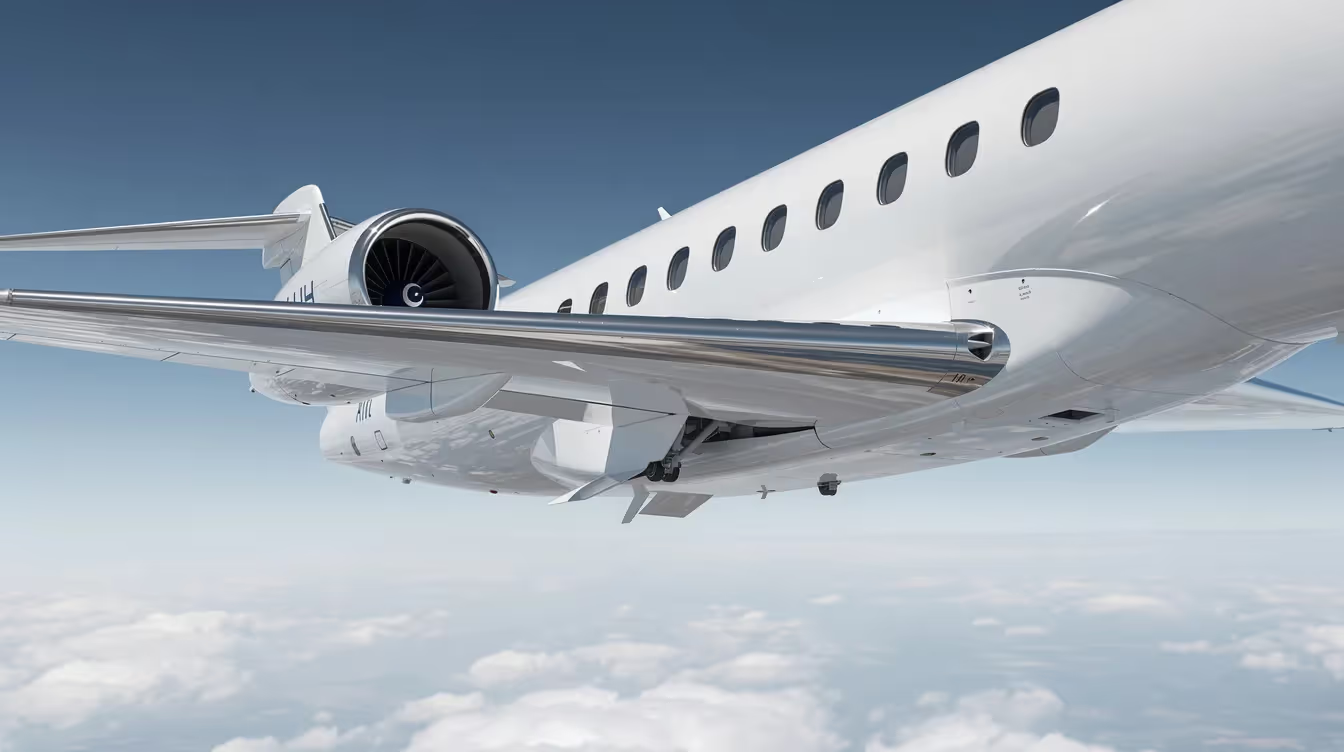
The aeroplane jet engine transformed aviation from the late 1940s onward, enabling aircraft to fly faster, higher, and farther than ever before. Where piston engines once limited commercial airliners to cruise speeds around 400 mph, the introduction of jet propulsion pushed that figure past 600 mph almost overnight. This article is designed for private and commercial aviation travelers, as well as aviation enthusiasts, who want to understand how jet engines impact their flight experience, safety, and travel options. Understanding aeroplane jet engines matters because engine type affects range, speed, noise, cost, and airport accessibility—key factors when booking flights or choosing an aircraft.
This comprehensive guide covers the main types of jet engines, how they work, their impact on both private and commercial aviation, and what travelers should know when booking flights. Modern aircraft primarily use four types of jet engines optimized for specific speeds and altitudes.
For travelers booking private charters through platforms like Jettly, tools such as a private jet charter cost estimator make it easier to see how range, speed, noise levels, and operating costs all depend on what powers the aircraft.
A jet engine generates thrust by compressing atmospheric air, mixing it with jet fuel in a combustion chamber, and accelerating hot exhaust gases through a propelling nozzle at very high velocity.
Modern aircraft primarily use four types of jet engines optimized for specific speeds and altitudes.
The basic types of jet engines include turbojet, turbofan, turboprop, and turboshaft, each designed for specific applications in aviation.
Turbofan engines power most commercial airliners and long-range business jets, while turboprop engines and light jets are common choices for private aviation and charter platforms such as Jettly.
Improvements in thrust-to-weight ratio and fuel efficiency have expanded route options, reduced operating costs, and increased aircraft choices for private travelers.
Jettly’s digital marketplace allows travelers to select aircraft with different engine types matched to their specific range, speed, and budget requirements.

The simplest way to understand how a jet engine works is the “suck–squeeze–bang–blow” sequence. The engine draws in atmospheric air, compresses it, adds fuel, and ignites it, then expels the hot gases at high speed to produce thrust that propels the airplane forward.
Intake and fan: Cold air enters through the front of the engine. In turbofan engines, a large fan accelerates incoming air and splits it between the core and the bypass duct.
Compression: Compressor stages (low-pressure and high-pressure) squeeze the air to 40–60 times atmospheric pressure. Modern engines like the LEAP-1A achieve overall pressure ratios exceeding 50:1.
Combustion: Compressed air enters the combustion chamber, where fuel injectors atomize jet fuel and continuous combustion occurs at temperatures of 1,400–1,700°C. This is where the “bang” happens.
Turbine extraction: The high-temperature gases spin turbine blades at speeds up to 15,000–20,000 rpm. The turbine extracts energy to drive the compressor and fan.
Exhaust through the nozzle: Hot gases leaving the turbine accelerate through the exhaust nozzle at 400–600 m/s, creating forward thrust.
The physics follows Newton’s third law of motion: for every action, there is an equal and opposite reaction. Jet engines generate thrust by emitting a jet of fluid rearwards at high speed, which propels the airplane forward. The engine's thrust is produced by the high-pressure, high-temperature gases exiting the engine through a nozzle, accelerating the gas stream to a very high velocity. The net thrust generated can be calculated based on the mass flow rate of the exhaust and the difference in velocity between the exhaust and the incoming air, and is crucial for efficient flight and overall aeronautical performance.
Modern jet engines use Full Authority Digital Engine Control (FADEC) systems that integrate 50+ sensors to monitor exhaust gas temperature, rotor speed, vibration, and fuel flow. These systems keep operations within safe limits automatically—providing reassurance for safety-conscious charter customers.
With a clear understanding of how jet engines work, let's examine the core components that make up these powerful machines.
Most aircraft jet engines share the same core architecture, known as the gas generator. Whether producing 3,000 lbf or 130,000 lbf of thrust, the fundamental components remain consistent.
In a turbofan engine, the fan is the large rotating assembly at the front. Modern fans span 1–3 meters in diameter and contain 18–22 composite blades. The fan creates a pressure rise of 1.5–4:1 and, in high-bypass designs, moves the majority of intake air around the core engine rather than through it. This bypass air provides up to 90% of the total thrust in high-bypass turbofans.
Behind the fan, the compressor consists of 10–18 axial stages with titanium blades. Variable stator vanes prevent stall during varying power conditions. The compressor raises high-pressure air to ratios of 30–60:1 in modern designs. Geared turbofan engines like the Pratt & Whitney PW1000G use a reduction gearbox to optimize fan and compressor speeds independently.
The combustion chamber is where fuel mixes with compressed air, and continuous burning occurs at near-constant pressure. Modern combustors use 20–30 fuel nozzles to atomize jet fuel at 100–200 bar. Since combustion temperatures exceed what materials can withstand, 40–60% of the airflow serves as cooling air to protect the liner and downstream components through film and effusion cooling techniques.
The turbine extracts energy from hot gases to drive the compressor and fan. High-pressure turbines operate at gas temperatures up to 1,000°C while spinning at 15,000 rpm. To survive these conditions, turbine blades use single-crystal nickel superalloys (such as CMSX-4) with thermal barrier coatings and internal convection cooling channels that consume about 20% of the airflow.
The exhaust nozzle converts remaining pressure energy into high-velocity jet flow. Subsonic aircraft use convergent nozzles, while supersonic aircraft and jet fighters employ convergent-divergent designs. Airliners and business jets often include thrust reversers—cascade or clamshell mechanisms that redirect exhaust forward during landing to provide 40–60% reverse thrust.
With an understanding of the main components, let's explore the history and evolution of jet engines in aviation.
Jet propulsion moved from theory to flight across two turbulent decades, setting the foundation for modern commercial aviation and private jet travel.
The first patent for a jet engine was filed in the early 1900s by Maxime Guillaume, proposing an axial-flow turbojet engine for use in airplanes. These early designs were airbreathing jet engines, which operate by compressing ambient air to generate thrust—unlike rocket engines, which carry both fuel and oxidizer. However, materials and manufacturing technology weren’t ready for practical implementation.
Sir Frank Whittle designed and patented the first turbojet engine in 1930 in the United Kingdom. His Whittle engine first flew successfully in May 1941 aboard the Gloster E.28/39. Meanwhile, German engineer Hans von Ohain independently developed a working turbojet, and the first airplane to successfully use a gas turbine engine was the German Heinkel He 178, which made its flight in August 1939—marking the dawn of practical jet propulsion.
By the 1940s, several countries had successfully developed turbojet engines. World War II accelerated development dramatically. In the United States, General Electric built the I-16 and I-40 engines, while the UK produced thousands of Gloster Meteors for combat.
The jet age of commercial aviation began with the de Havilland Comet in 1952, the first commercial jetliner. Despite early setbacks from metal fatigue issues, the Comet pioneered pressurized jet travel. The Boeing 707 entered service in 1958 and proved the commercial viability of jet travel, completing over 25,000 flights by the early 1960s.
Business aviation followed quickly. The Learjet 23 arrived in 1963 with GE CJ610 turbojet engines, cruising at 500 knots. The Cessna Citation 500 in 1972 brought turbofan efficiency to smaller aircraft. These early business jets evolved into the modern fleet now accessible through digital charter platforms like Jettly and the broader charter airlines and private aviation ecosystem.

As jet engine technology advanced, different types of engines were developed to suit a variety of aircraft and mission profiles. Next, let's look at the main types of jet engines used in aviation today.
Modern aircraft primarily use four types of jet engines optimized for specific speeds and altitudes. The basic types of jet engines include turbojet, turbofan, turboprop, and turboshaft, each designed for specific applications in aviation. Propulsion efficiency is a key factor in choosing between these engine types, as features like bypass ratios and blade design impact their performance at different flight speeds. Turboshaft engines are primarily used to power the helicopter rotor, converting mechanical energy into lift and rotational motion for helicopter propulsion systems.
A turbojet engine is a type of jet engine that compresses all intake air, mixes it with fuel, and burns it to produce thrust, making it suitable for high-speed aircraft. All the air flows through the core engine and exits at a jet velocity of 600–1,000 m/s. The turbojet engine excels at supersonic flight and supersonic speeds, but turbojets and ramjets suffer from lower fuel efficiency at lower speeds. As a result, turbojets are largely restricted to high-speed military applications and certain jet fighter designs.
A turbofan engine is a type of jet engine that features a large front fan bypassing a significant portion of the intake air around the engine core, providing greater thrust and improved fuel efficiency at subsonic speeds. This bypass ratio—the ratio of air flowing around the core versus through it—drives efficiency. In turbofans, the bypass ratio drives efficiency; the higher the ratio, the quieter and more fuel-efficient the engine. Turbofan engines are ideal for high-altitude airliners and operate best at speeds around 310–620 mph. High-bypass turbofans with ratios of 8:1 to 12:1 power 99% of commercial airliners and most long-range business jets. Low-bypass designs serve military aircraft requiring sustained high speed.
A turboprop engine is a type of jet engine that powers a propeller through a turbine connected to a shaft, using the turbine’s exhaust to drive the propeller. This design, which includes a reduction gearbox (10–15:1 ratio) connecting the power turbine to the propeller, makes turboprop engines particularly efficient for lower-speed flights. The propulsion efficiency of turboprop engines is highest at lower flight speeds, achieving 80–90% propulsive efficiency below 450 knots, and they excel at accessing short runways. However, turboprop engines lose efficiency quickly above 500 mph due to propeller tips reaching supersonic speeds, creating massive drag. Aircraft like the ATR 72 with PW127 engines (5,000 shp) demonstrate this balance of efficiency and capability.
A turboshaft engine is a type of gas-turbine engine designed to deliver power to a shaft rather than a propeller. Turboshaft engines are primarily used to power the helicopter rotor, which acts as the main lifting device by converting mechanical energy from the engine into lift and rotational motion. The free turbine design allows independent speed control between the gas generator and output shaft. VIP helicopters used in charter services, such as the Sikorsky S-76 and Bell 429, rely on modern turboshaft engines like the PT6T producing 1,800 shp.
Ramjet engines rely on high forward speed to compress air and are used primarily in missiles and experimental high-speed aircraft. Unlike turbojet and turbofan engines, ramjets have no moving parts and cannot operate from a standing start—they require an initial velocity to begin functioning. Ramjets are a type of jet engine that relies on high forward speed to compress incoming air, making them suitable for supersonic flight applications.
On Jettly’s charter platform, travelers encounter:
Light jets: Turbofan engines (Williams FJ44, 3,000–4,000 lbf), 1,200–2,000 nm range
Midsize jets: Turbofan engines (Honeywell HTF7000), 2,000–3,000 nm range
Heavy jets: Large turbofans (Rolls-Royce BR725, 16,900 lbf), 7,000+ nm range
Turboprops: PT6A-powered aircraft like the King Air for regional missions
Helicopters: Turboshaft-powered VIP transport
With a clear understanding of the different jet engine types, let's examine how thrust and performance characteristics affect both private and commercial aviation.
Thrust is the forward force produced by a jet engine’s thrust output. The engine's thrust is essential for overcoming aerodynamic drag and enabling flight, as it propels the aircraft forward. During takeoff and climb, the engine’s thrust must exceed the aircraft's weight by a significant margin.
Thrust-to-weight ratio measures engine power relative to its mass. A turbofan producing 10,000 lbf while weighing 2,500 lb has a thrust-to-weight ratio of 4:1. Higher ratios enable shorter takeoff distances, steeper climb rates, and better high-altitude performance.
|
Aircraft Type |
Thrust per Engine |
Example |
|---|---|---|
|
Light business jet |
2,500–5,000 lbf |
Citation CJ4 (FJ44-4A: 3,621 lbf) |
|
Midsize business jet |
6,000–10,000 lbf |
Citation Latitude (PW306D: 5,900 lbf) |
|
Large-cabin business jet |
15,000–18,000 lbf |
Gulfstream G650 (BR725: 16,900 lbf) |
|
Narrow-body airliner |
20,000–35,000 lbf |
Boeing 737 (CFM56-7B: 27,000 lbf) |
For private charter missions, these numbers translate to real-world benefits. A New York–Miami flight (roughly 1,000 nm) needs a midsize jet with adequate thrust for efficient cruise. A transcontinental Toronto–Vancouver route requires greater range and sustained thrust at altitude.
Commercial airliners optimize for different priorities—seat-mile efficiency across 150–450 passengers—while private jets balance forward speed, range, runway performance, and cabin comfort for smaller passenger counts.
Understanding thrust and performance helps travelers choose the right aircraft for their mission. Next, let's compare how jet engines are used in commercial versus private aviation.
Large commercial airliners like the Airbus A320neo use high-bypass turbofan engines (LEAP-1A with 11:1 bypass ratio) optimized for maximum seat-mile efficiency on high-traffic routes. These engines prioritize good fuel efficiency over flexibility.
Private jet aircraft take a different approach. Engines powering business jets balance several factors:
Flight speed: Mach 0.80–0.90 cruise for long-range jets
Range capability: 2,000–7,700 nm, depending on category
Runway performance: STOL capability for smaller airports
Cabin comfort: Lower vibration and noise transmission
Concrete examples:
A Cessna Citation CJ4 Gen2 uses twin Williams FJ44-4A turbofans (3,621 lbf each) for short-to-medium business trips up to 2,165 nm.
A Gulfstream G650 carries Rolls-Royce BR725 engines (16,900 lbf each) for intercontinental missions exceeding 7,000 nm.
A Pilatus PC-24 light jet with Williams FJ33 engines accesses runways as short as 2,930 feet.
Engine characteristics directly affect airport access. Many turboprops and light jets operate from secondary airports closer to city centers—Teterboro instead of JFK, for instance—saving ground time, especially when paired with an airport locator tool for private jets.
Through Jettly’s platform, travelers select aircraft whose engine type matches their speed, range, runway length, and budget requirements. Learn more about available options at https://www.jettly.com.

With the differences between commercial and private aviation in mind, let's examine how jet engine efficiency, fuel burn, and environmental considerations affect both operators and travelers.
The efficiency of a jet engine is primarily controlled by the operating conditions inside the engine, specifically the pressure produced by the compressor and the temperature of the combustion gases at the turbine blades.
Specific fuel consumption (SFC) is a standard measure used to assess engine efficiency, indicating how much fuel is needed to produce one unit of thrust. Lower SFC means better fuel efficiency.
|
Engine Type |
Typical SFC (lb/lbf-hr) |
|---|---|
|
Turbojet |
0.8–1.2 |
|
Low-bypass turbofan |
0.5–0.8 |
|
High-bypass turbofan |
0.25–0.35 |
|
Turboprop (shp basis) |
0.45–0.55 lb/shp-hr |
The overall efficiency of a jet engine at flight speed depends on how well the intake compresses the air before it is handed over to the engine compressors, with the intake compression ratio significantly affecting performance. Propulsion efficiency, which measures how effectively an engine converts fuel into useful thrust, varies between engine types—turboprops generally offer higher propulsion efficiency at lower speeds, while high-bypass turbofans excel at higher speeds due to their optimized bypass ratios and fan blade design. This makes propulsion efficiency a key factor in selecting the right engine for specific aircraft and mission profiles.
Technological progress since the 1990s has been substantial. Higher compressor pressure ratios (from 20:1 to 50:1), improved turbine cooling, and higher bypass ratios have cut fuel burn dramatically. Newer high-bypass turbofan engines are designed to be more fuel-efficient and produce less pollution compared to older turbojet and turbofan engines, with significant reductions in emissions and noise levels. The LEAP engine family offers 15% better SFC than the CFM56 it replaces.
Environmental impact remains a concern. Jet engines are a significant source of air pollution, emitting carbon dioxide, carbon monoxide, hydrocarbons, and nitrogen oxides, which contribute to the greenhouse effect and atmospheric ozone depletion.
Noise pollution from jet engines is also a major concern, with takeoff noise levels reaching around 110 decibels, which can significantly impact communities near airports.
Modern engines address these issues through acoustic liners, optimized fan nozzle design, and lower jet velocity from high-bypass configurations. Efficient fleet selection and optimized routing through platforms like Jettly help reduce overall fuel consumption, and travelers can further manage their budget by understanding affordable private jet charter pricing factors. Some operators offer carbon-offset programs to support sustainability initiatives.
With these efficiency and environmental considerations in mind, let's see how engine technology directly impacts the charter experience for Jettly customers.
Engine technology directly affects flight time, operating cost, noise levels, and airport access for charter travelers.
Engine types matched to charter use cases:
Turboprops (PT6A engines): Short regional hops under 500 nm, access to short runways, fuel-efficient for low-altitude routes. Ideal for Los Angeles–Las Vegas (1 hour, ~$4,000).
Light jets (Williams FJ44, Pratt & Whitney PW535E): Fast trips of 2–3 hours, 1,500–2,000 nm range. Perfect for New York–Miami (2.5 hours, ~$8,000).
Midsize jets (Honeywell HTF7000): Transcontinental capability, 3,000+ nm range. Suited for Toronto–Vancouver (4.5 hours, ~$15,000) and popular among travelers comparing NetJets alternatives for flexible private flying.
Heavy jets (Rolls-Royce Pearl, BR725): Intercontinental missions, 6,000–7,700 nm range. London–Ibiza nonstop in 2.5 hours, or long-haul itineraries to major hubs such as private jet charter services in Kolkata.
Jettly’s digital platform provides transparent pricing that reflects the underlying aircraft and engine type, allowing customers to evaluate the trade-offs between speed, capacity, and cost, and many frequent flyers benefit from private jet membership programs that streamline access to suitable aircraft.
Explore aircraft profiles with engine specifications, compare jet card programs for frequent private flyers, and request instant quotes at https://www.jettly.com.
This FAQ addresses common questions travelers may have about such engines that aren’t fully covered in the main sections.
Most private jets use certified turbine engines designed and tested to the same regulatory standards (FAR Part 33, EASA CS-E) as those on airline aircraft. Charter flights arranged through platforms like Jettly—including private jet charter options serving New Delhi—must be operated by licensed carriers following strict maintenance schedules and engine inspections as required by aviation authorities. Engine reliability in modern turbine-powered aircraft is extremely high, with in-flight shutdown rates below 0.006 per 1,000 flight hours.
Jet engines undergo regular checks based on flight hours and cycles, with intervals set by the manufacturer and approved by regulators. Most modern engines use “on-condition” maintenance, meaning they’re inspected and repaired based on monitored trends rather than fixed schedules. Hot-section inspections typically occur every 1,800–3,600 hours, with major overhauls at 10,000–20,000 hours. For chartered aircraft, these requirements are mandatory—choosing regulated operators through Jettly ensures compliance.
Jet engine noise mainly comes from high-speed exhaust mixing with surrounding air and from blade tips on large rotating fans reaching 400–500 m/s. Modern high-bypass turbofans and advanced turboprops are significantly quieter than early turbojets. Lower exhaust velocities, acoustic liners, and optimized fan design cut noise by 10–15 EPNdB. The same principle applies across reaction engines: reducing jet velocity while maintaining thrust decreases noise. Quieter engines help operators access noise-sensitive airports, benefiting charter travelers.
Turbojets and most turbofans are optimized for higher cruise speeds (Mach 0.78–0.90), while turboprops cruise at subsonic speeds of 280–350 knots. For short-to-medium charter routes, overall door-to-door time differences can be modest when turboprops use smaller airports closer to destinations. Jettly customers can trade speed against cost by selecting aircraft with different jet engine type options suited to their schedule and budget, or even use crowdsourced and shared-seat private flights to reduce individual trip expenses.
Multi-engine aircraft are certified to continue flight safely on one engine. Certification rules require that a jet plane maintain climb capability even with an engine inoperative—for example, Boeing 737s can climb at 1,000 fpm on a single engine. Pilots train extensively for engine-out scenarios, including securing the affected engine and diverting to a suitable airport. Such failures are rare events.
Understanding the aeroplane jet engine is key for travelers seeking the best private or commercial flight experience. Engine type influences speed, range, fuel efficiency, noise levels, and airport accessibility. Whether choosing a turbofan-powered long-range jet or a turboprop for regional hops, matching the engine to your travel needs optimizes comfort, cost, and convenience.
Jettly’s digital private jet charter platform offers access to a wide range of aircraft powered by different jet engine types, providing transparent pricing and instant booking. This empowers travelers to select the ideal aircraft for their mission, balancing speed, range, and budget with ease.
Ready to enjoy private travel tailored to your needs? Browse available flights or get a personalized quote at https://www.jettly.com.
Share this post:
Jay Franco Serevilla
May 13, 2026
|
5
min read
Discover tips and trends in the industry.
5
min read
White Cloud Aviation & Private Charter Around Lake Havasu
White Cloud Aviation in Lake Havasu City offers specialized flight training and private jet charter services, making it an ideal destination for pilots and leisure travelers. With year-round flying conditions and a focus on cloud aviation skills, students can enhance their training while enjoying seamless travel through platforms like Jettly.
Read More
5
min read
BAJ Jets: How Digital Platforms Like Jettly Are Changing Private Jet Travel
BAJ jets, or Book-A-Jet platforms, are revolutionizing private aviation by providing digital access to over 20,000 aircraft worldwide. Platforms like Jettly offer live pricing, transparent quotes, and flexible booking options, making private jet travel more accessible than ever. This article explores how these platforms work, their pricing models, and the overall booking experience.
Read MoreStay updated with our latest insights and tips to elevate your journey with us.
MEMBERSHIPS AND ASSOCIATIONS



Disclaimer: Jettly operates as a charter broker, offering access to a global digital jet charter marketplace. Jettly is not a direct air carrier and does not own or operate aircraft. All advertised flights are conducted by third-party air carriers that are fully licensed and hold the appropriate Part 135 or Part 121 certifications issued by the Federal Aviation Administration (FAA) or equivalent regulatory authorities under U.S. or foreign law. Jettly complies fully with the U.S. Department of Transportation's Part 295 and Part 298 Charter Broker regulations. Jettly does not carry additional liability insurance. Passengers are covered by aircraft operator insurance. TICO: 50023770


